
Anime Smash or Pass Quiz
How the Scales are Structured
Who Usually Takes This Test?
See How You Compare
Below is a preview of how scores are typically distributed across each scale.
Example Questions From the Test
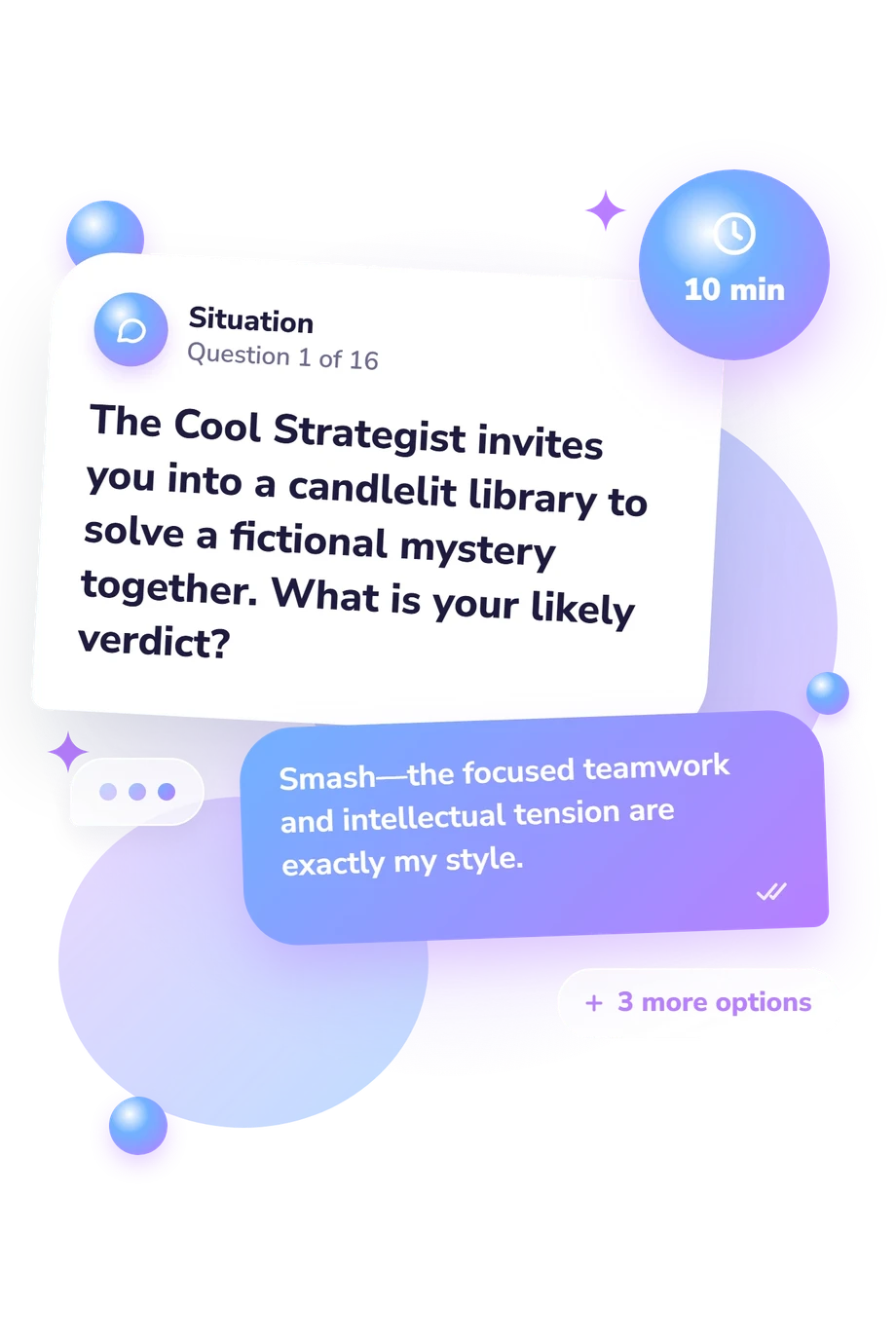
- Smash—the focused teamwork and intellectual tension are exactly my style.
- Maybe; I would enjoy it more once the conversation became personal.
- Pass; I would prefer a lively outing with less analysis.
- The setting is appealing, though the mystery itself is not the main draw.
- That steady kindness is extremely attractive to me.
- I like it, especially if they also let others support them.
- It is sweet, but dramatic charisma catches my attention more.
- Caretaking does not add much to romantic appeal for me.
- A calm café visit would suit me better than their energetic ideas.
- A training session followed by a huge ramen dinner sounds ideal.
- I would pass because even a playful challenge feels too intense.
- I could enjoy an adventurous date if there were time to unwind afterward.
Anime Smash or Pass Quiz - Description and methodology of the test
Designed for anime fans who want to understand their fictional preferences, the anime smash or pass quiz turns imagined dates, missions, and character moments into a focused profile of attraction. As a smash or pass anime characters quiz, it shows whether chemistry grows from intensity, intelligence, humor, or dependable care, helping readers reflect on patterns without reducing their taste to one favorite character.
What This Assessment Explores
Anime fans can use this anime attraction quiz to explore fictional chemistry across four styles. Scenarios test confidence, strategy, humor, care, and compatibility; results show what appeals most.
The dimensions are:
- Bold Powerhouse (0-12) measures attraction to confident, intense adult characters facing challenges head-on; Quiet Preference (0-4), Situational Spark (5-8), or Powerhouse Affinity (9-12) shows strength.
- Cool Strategist (0-12) measures attraction to composed, observant adult characters whose intelligence and restraint create intrigue; Open-Book Preference (0-4), Selective Intrigue (5-8), or Strategist Affinity (9-12) indicates level.
- Playful Charmer (0-12) measures attraction to witty, expressive adult characters using humor, teasing, and spontaneity; Steady Preference (0-4), Playful in Moderation (5-8), or Charmer Affinity (9-12) indicates level.
- Warm Protector (0-12) measures attraction to caring, dependable adult characters offering reassurance and steady support; Independent Preference (0-4), Comfort with Balance (5-8), or Protector Affinity (9-12) indicates level.
Methodology and Scientific Basis
Each item presents an anime scenario with four response choices. Options range from strong attraction and qualified interest to preferring another quality or rejecting the featured dynamic. This structure captures conditional preferences, such as liking humor when paired with sincerity or protection when independence remains intact.
Results report the displayed scale ranges, while the highest score identifies the strongest affinity; scores within one point of it create a blended result.
Arda (2006), Rain and Mar (2021), and Sprecher and Regan (2002) offer related research on parasocial interaction, fictional-character engagement and attachment, and preferred partner qualities. This questionnaire is conceptually consistent with those works, not a direct adaptation or reproduction of their measures.
Because it is an online self-report profile, results can shift with current mood, anime familiarity, and the gap between imagined chemistry and real-life preference. The questionnaire functions as an anime character preference quiz with a structured profile for reflection.
- Arda, S. (2006). Predictors of parasocial interaction with the favorite and the least desirable characters portrayed in TV serials (Master's thesis, Middle East Technical University).
- Rain, M., & Mar, R. A. (2021). Adult attachment and engagement with fictional characters. Journal of Social and Personal Relationships, 38(9), 2792-2813. 10.1177/02654075211018513
- Sprecher, S., & Regan, P. C. (2002). Liking some things (in some people) more than others: Partner preferences in romantic relationships and friendships. Journal of Social and Personal Relationships, 19(4), 463-481. 10.1177/0265407502019004048
Updated: