
Amino Acid 3-Letter Abbreviations Quiz
How the Scales are Structured
Who Usually Takes This Test?
See How You Compare
Below is a preview of how scores are typically distributed across each scale.
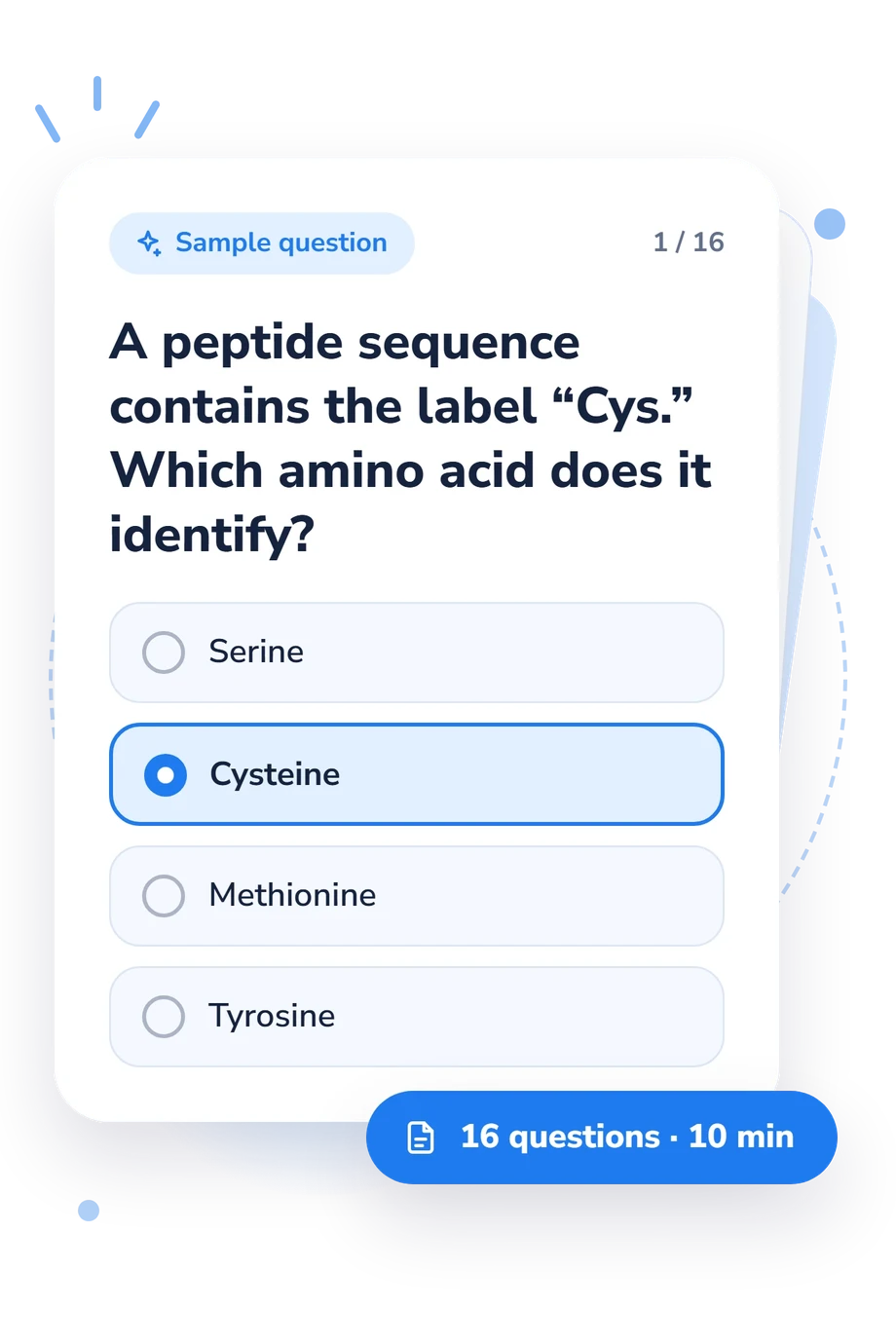
Example Questions From the Test
- Serine
- Cysteine
- Methionine
- Tyrosine
- Ile
- Lys
- Val
- Leu
- Pro
- Phe
- Tyr
- Trp
Amino Acid 3-Letter Abbreviations Quiz - Description and methodology of the test
Students, researchers, and anyone reviewing protein notation can use this assessment to check accurate identification of familiar amino-acid labels in sequence notation. The amino acid 3 letter abbreviations quiz connects each residue name with its standard three-letter symbol and shows how reliably the respondent recognizes those symbols. For focused study, this amino acid 3 letter code quiz identifies areas needing reinforcement.
What This Assessment Measures
Taken together, the items measure practical recognition of standard symbols for common amino acids; this amino acid 3 letter quiz tests accurate name-symbol matching. It suits learners who read, memorize, or enter peptide and protein sequence notation, rather than assessing broader biochemistry.
Items use both directions: identifying a residue from its abbreviation and choosing the abbreviation for a named residue. Their contexts include peptide sequences and record checking. The tested dimensions are:
- Name-symbol recall shows how reliably you connect each abbreviation with its amino-acid name.
- Confusable pairs show whether labels such as Asn/Asp and Gln/Glu stay distinct.
- Sequence and annotation recognition shows how accurately you read or enter a residue token.
Amino Acid 3-Letter Abbreviations Knowledge ranges from 0-16: Foundational Review (0-6), Developing Fluency (7-12), and Strong Command (13-16). The scale reflects abbreviation knowledge, not broader biochemistry or laboratory competence.
Methodology and Scientific Basis
Each item presents a short prompt with four answer choices. The respondent selects the amino-acid name or three-letter symbol that completes the relation, whether the cue is a standalone label, a peptide token, or an annotation correction. This is structured knowledge testing rather than open-ended recall. The questionnaire does not specify item weights or a conversion formula, so the displayed result should be read through its bands rather than reverse-engineering points from the range.
The questionnaire uses standard three-letter amino-acid nomenclature; in this amino acid three letter code quiz, each item tests matching a residue name with its established symbol. Moore's 1987 work discusses mnemonic links that can support recall, and Saffran's 1998 work places abbreviation learning in biochemical nomenclature. The questionnaire is conceptually consistent with these sources, not an adaptation of any one of them.
An amino acid three letter quiz can support targeted review of easily confused labels. Yet performance depends on attention, memory, and honest selection; no norm group, reliability estimate, or clinical interpretation is stated, so the result describes abbreviation performance at completion rather than laboratory competence or complete biochemical mastery.
- Dixon H.B., Cornish-Bowden A., Liebecq C., Loening K.L., Moss G.P., Reedijk J., Velick S.F., Vliegenthart J.F.G. Nomenclature and symbolism for amino acids and peptides: Recommendations 1983. Biochemical Journal. 1984;219(2):345-373. 10.1042/bj2190345
- Moore D.S. Biochemically informative acronyms for the twenty common amino acids. Biochemical Education. 1987;15:74-76. 10.1016/0307-4412(87)90090-2
- Saffran M. Amino acid names and parlor games: From trivial names to a one-letter code, amino acid names have strained students’ memories. Is a more rational nomenclature possible? Biochemical Education. 1998;26(2):116-118. 10.1016/S0307-4412(97)00167-2
Updated: