
Am I Indian Quiz
How the Scales are Structured
Who Usually Takes This Test?
See How You Compare
Below is a preview of how scores are typically distributed across each scale.
Example Questions From the Test
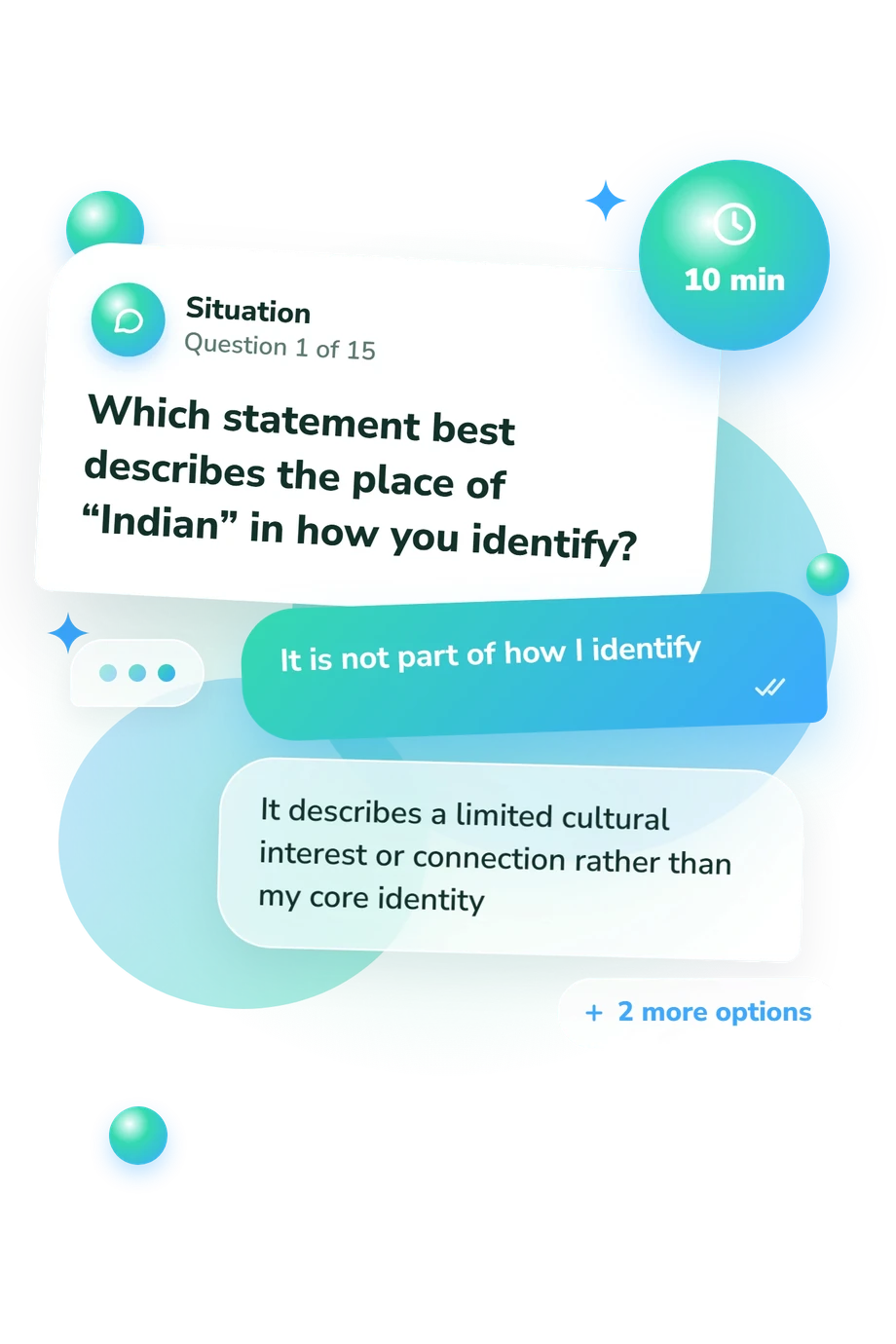
- It is not part of how I identify
- It describes a limited cultural interest or connection rather than my core identity
- It is an important part of my identity alongside other backgrounds or communities
- It is one of the central ways I understand and describe myself
- It usually does not enter my answer
- I might mention it after describing another background or influence
- I usually include it, while adding context about region, family, nationality, or upbringing
- I lead with it because it feels essential to an accurate answer
- They are usually among the main perspectives shaping my decision
- They may cross my mind but rarely affect the decision
- They are generally not relevant to how I decide
- They matter alongside my personal goals and other influences
Am I Indian Quiz - Description and methodology of the test
For people reflecting on Indian heritage, diaspora ties, or a mixed background, the Am I Indian Quiz offers a way to examine how culture and belonging appear in daily life. The assessment functions as an are you indian quiz by separating social connection, cultural participation, and personal identity rather than forcing one label. The result gives readers a profile of patterns rather than a ruling on ancestry or authenticity.
What This Assessment Explores
Items ask about identity, community involvement, food, media, celebrations, language, and belonging. They focus on experiences rather than ancestry, nationality, citizenship, or authenticity. Rather than reducing the result to one label, this how indian are you quiz separates three dimensions, so community ties can coexist with selective cultural participation or a less central identity.
The three dimensions are:
- Community Connection (0-15) reflects current ties with Indian or diaspora relatives, friends, groups, languages, and spaces; Independent connection (0-5), Situational connection (6-10), and Embedded connection (11-15) describe increasing involvement.
- Cultural Engagement (0-15) reflects current participation in traditions, food, media, arts, and celebrations; Occasional engagement (0-5), Selective engagement (6-10), and Frequent engagement (11-15) describe increasing regularity.
- Identity and Belonging (0-15) reflects how central an Indian connection feels in self-understanding; Peripheral connection (0-5), Contextual connection (6-10), and Central connection (11-15) describe increasing prominence.
Methodology and Evidence Base
Each item describes a social or cultural situation and offers four response options, usually ranging from limited involvement or personal relevance to more regular, influential, or central connection. Responses feed three scores from 0 to 15. Because the reader-facing method presents bands rather than a documented point value for every answer, interpretation should follow the displayed ranges instead of an assumed scoring formula.
Bharmal et al. (2014) is the closest conceptual anchor: its work supports using patterns of cultural and social participation when considering acculturation-related experience among Asian Indian respondents. The questionnaire also sits alongside Phinney’s (1992) multidimensional treatment of ethnic identity and Phinney and Ong’s (2007) account of meaning, exploration, commitment, and belonging. An Indian identity quiz can be conceptually consistent with these sources without being their scale or a direct adaptation.
The questionnaire presents descriptive bands rather than standardized norms. Results describe present self-report patterns, not proof of ancestry, nationality, citizenship, or authenticity, and responses may shift with location, relationships, life stage, language access, memory, and self-understanding. It is a self-reflection method, not a diagnostic instrument.
- Bharmal, N., Hays, R. D., & McCarthy, W. J. (2014). Validity of temporal measures as proxies for measuring acculturation in Asian Indian survey respondents. Journal of Immigrant and Minority Health, 16(5), 889-897. 10.1007/s10903-013-9837-1
- Phinney, J. S. (1992). The Multigroup Ethnic Identity Measure: A new scale for use with adolescents and young adults from diverse groups. Journal of Adolescent Research, 7(2), 156-176. 10.1177/074355489272003
- Phinney, J. S., & Ong, A. D. (2007). Conceptualization and measurement of ethnic identity: Current status and future directions. Journal of Counseling Psychology, 54(3), 271-281. 10.1037/0022-0167.54.3.271
Updated: