
Am I Cis Quiz
How the Scales are Structured
Who Usually Takes This Test?
See How You Compare
Below is a preview of how scores are typically distributed across each scale.
Example Questions From the Test
- Interesting briefly, but not like a more accurate way to be seen
- Unexpectedly affirming or more accurate
- Mostly uncomfortable because it would not match who I am
- Appealing in some ways and uncertain in others
- I would wish they had not made that assumption
- I would feel mostly comfortable with how they saw me
- I would feel clearly recognized as myself
- My comfort would depend strongly on the setting or wording
- Usually natural and accurate for me
- Mostly acceptable, though not fully descriptive
- Frequently uncomfortable or mismatched
- Comfortable only in certain settings or with certain terms
Am I Cis Quiz - Description and methodology of the test
People wondering how their assigned gender fits their sense of self can use reflection to organize impressions that may be difficult to name. The Am I Cis Quiz focuses on personal comfort, recognition, and curiosity rather than stereotypes. As a gender identity reflection, it helps reveal patterns without forcing a label. It helps a reader consider whether the assigned gender feels personally accurate without requiring immediate certainty.
What This Assessment Explores
Questions cover comfort with assigned-gender language, social recognition, presentation, names, pronouns, future self-images, and other gender possibilities. They distinguish personal resonance from simple interest or experimentation.
The result presents three dimensions:
- Assigned-Gender Alignment (0-15) reflects comfort and authenticity of the gender assigned at birth: Limited alignment (0-5), Mixed alignment (6-10), or Strong alignment (11-15).
- Beyond-Assignment Resonance (0-15) reflects personal meaning in other or broader genders: Little resonance (0-5), Situational resonance (6-10), or Strong resonance (11-15).
- Exploration Drive (0-15) reflects the wish to examine gender now: Little current need (0-5), Open curiosity (6-10), or Active exploration (11-15).
Together, these dimensions describe current patterns in a person's gender exploration while leaving room for uncertainty and change.
Methodology and Evidence Base
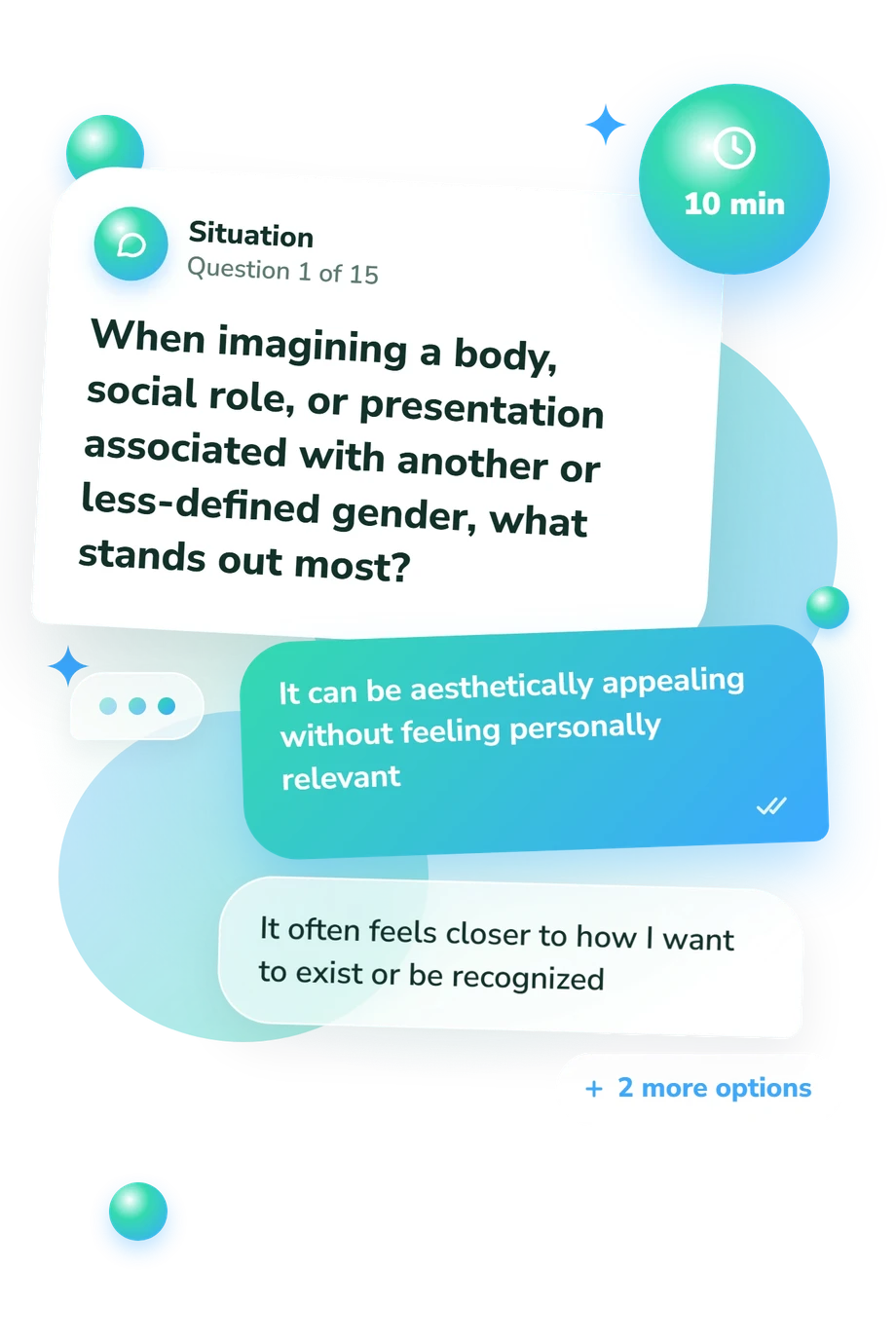
As a self-report questionnaire, each item presents a scenario or reflection prompt with four response options, each describing a different reaction or level of personal connection. This format allows mixed and context-dependent experiences rather than a simple yes-or-no result.
The questionnaire examines assigned-gender comfort, resonance beyond that assignment, and present exploration rather than producing a cis/not-cis verdict. Each score is reported with a named band, and results are reported for the three displayed dimensions. The bands organize reflection, not identity.
Its multidimensional approach is conceptually consistent with Gender Self-Report (Strang et al., 2023), but this online questionnaire is not presented as an adaptation or validation of that instrument. Related comparison points are the GIDYQ-AA (Deogracias et al., 2007), the Transgender Congruence Scale (Kozee et al., 2012), and work on changing gender and identity questions by Diamond and Butterworth (2008). The questionnaire is an online gender self-reflection tool, with displayed bands that describe patterns rather than establish standardized diagnostic cutoffs.
Because responses depend on self-awareness, honest reporting, and current context, the profile may change as feelings or circumstances change. Pause if reflection becomes distressing.
- Strang, John F., Gregory L. Wallace, Jacob J. Michaelson, et al. (2023). The Gender Self-Report: A multidimensional gender characterization tool for gender-diverse and cisgender youth and adults. American Psychologist, 78(7), 886-900. 10.1037/amp0001117
- Deogracias, Joseph J., Laurel L. Johnson, Heino F. L. Meyer-Bahlburg, Suzanne J. Kessler, Justine M. Schober, and Kenneth J. Zucker. (2007). The Gender Identity/Gender Dysphoria Questionnaire for Adolescents and Adults. The Journal of Sex Research, 44(4), 370-379. 10.1080/00224490701586730
- Kozee, Holly B., Tracy L. Tylka, and L. Andrew Bauerband. (2012). Measuring Transgender Individuals’ Comfort With Gender Identity and Appearance: Development and Validation of the Transgender Congruence Scale. Psychology of Women Quarterly, 36(2), 179-196. 10.1177/0361684312442161
- Diamond, Lisa M., and Molly Butterworth. (2008). Questioning Gender and Sexual Identity: Dynamic Links Over Time. Sex Roles, 59(5-6), 365-376. 10.1007/s11199-008-9425-3
Updated: