
Air Pollution Quiz
How the Scales are Structured
Who Usually Takes This Test?
See How You Compare
Below is a preview of how scores are typically distributed across each scale.
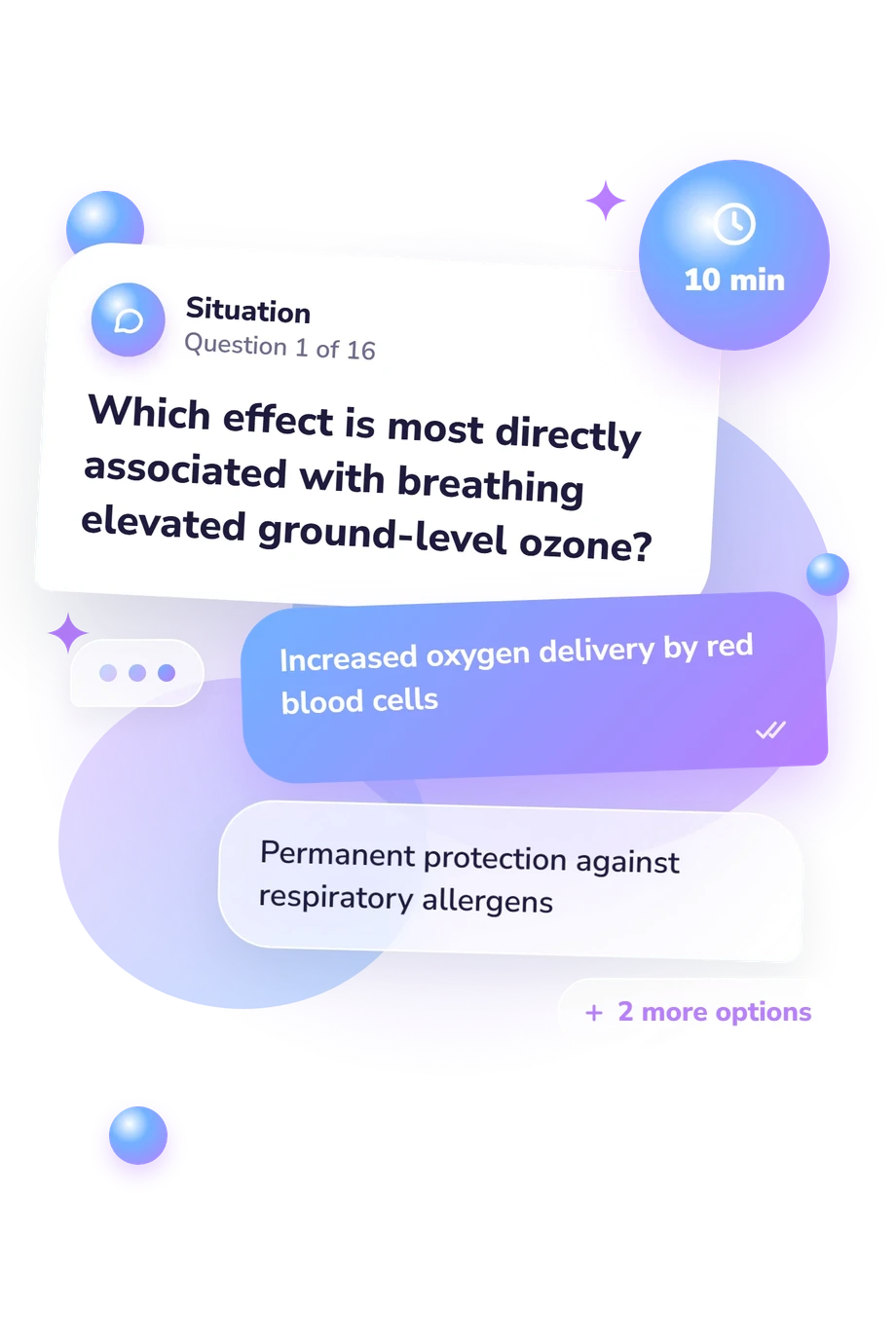
Example Questions From the Test
- Increased oxygen delivery by red blood cells
- Permanent protection against respiratory allergens
- Airway irritation and reduced lung function during exposure
- Improved filtration of particles by the lungs
- Lead dust
- Carbon monoxide
- Ground-level ozone
- Radon
- All volatile organic compounds
- Carbon monoxide gas
- Fine airborne particles
- Excess carbon dioxide from occupants
Air Pollution Quiz - Description and methodology of the test
People who want a clearer grasp of everyday air-quality information can use this assessment to connect scientific terms with practical situations. The air pollution quiz is intended for general readers, students, and anyone who wants to check whether they can recognize common pollutants, explain basic atmospheric processes, and choose sensible exposure-reduction actions. An air pollution knowledge test produces a profile showing recognized concepts and topics needing review.
What This Assessment Explores
These items test whether readers can distinguish pollutants and connect them with sources, formation, movement, and effects. They cover ozone, particulate matter, nitrogen dioxide, carbon monoxide, sulfur dioxide, volatile organic compounds, inversions, wildfire smoke, acid rain, PM2.5, the AQI, and exposure-reduction choices. Together, they measure pollutant distinctions, atmospheric processes, sources, movement, and exposure-reduction choices.
As readers work through air-pollution quiz questions, they encounter factual or scenario-based prompts with four answer choices. A reader may identify a pollutant, explain a process, or select an action that follows public guidance.
The result is reported as Air Pollution Knowledge (0-16) across three bands:
- Foundation (0-6) shows an emerging grasp; sources, formation, or exposure guidance merit review.
- Developing (7-12) indicates familiar concepts alongside gaps in real-world applications or pollutant comparisons.
- Strong (13-16) signals broad command of major pollutants and practical air-quality ideas.
Methodology and Scientific Basis
A four-option multiple-choice format combines factual checks with applied scenarios. Each item asks the reader to choose among four responses, and the questionnaire displays a resulting educational category. The score is educational and does not assess personal exposure or health.
The published AQIQ instrument provides the closest conceptual reference for assessing air-quality understanding. This questionnaire is conceptually consistent with that source instrument, not a direct adaptation or standardized administration of it. Del Ponte and colleagues also examined knowledge and related responses during and after U.S. wildfires in a separate 2022 study, while the EPA’s AQI guide supports the focus on communicating pollution levels and health-concern categories.
The displayed bands are educational categories rather than normative or clinical cutoffs, so the result identifies topics for review rather than a population-based standing. As readers work through air-pollution quiz questions and answers, they practise distinguishing pollutants and applying air-quality guidance. Results can vary with prior instruction, terminology familiarity, attention, and current context, so local alerts remain the source for current conditions.
- Del Ponte, Alessandro, Lina Ang, Lianjun Li, Noah Lim, Wilson Wai San Tam, and Wei Jie Seow. "Development and validation of a new scale to assess air quality knowledge (AQIQ)." Environmental Pollution, vol. 299, 2022, article 118750. 10.1016/j.envpol.2021.118750
- Del Ponte, Alessandro, Lina Ang, Lianjun Li, Noah Lim, Wilson Wai San Tam, and Wei Jie Seow. "Change of air quality knowledge, perceptions, attitudes, and practices during and post-wildfires in the United States." Science of the Total Environment, vol. 836, 2022, article 155432. 10.1016/j.scitotenv.2022.155432
- U.S. Environmental Protection Agency. "Air Quality Index (AQI): A Guide to Air Quality and Your Health." EPA-456/F-09-002. Office of Air Quality Planning and Standards, 2009.
Updated: