
Affect vs Effect Quiz
How the Scales are Structured
Who Usually Takes This Test?
See How You Compare
Below is a preview of how scores are typically distributed across each scale.
Example Questions From the Test
- affect
- effect
- effecting
- affects
- effect
- affect
- effects
- effected
- affects
- affect's
- effects
- effect's
Affect vs Effect Quiz - Description and methodology of the test
People who write, edit, study, or teach English can use this assessment to resolve uncertainty about two easily confused words. For learners and editors, the affect vs effect quiz tests whether the distinction holds when meaning, grammar, and sentence structure change. An affect and effect quiz is especially useful for targeted practice because the result points to the kinds of usage decisions that need review.
What This Assessment Measures
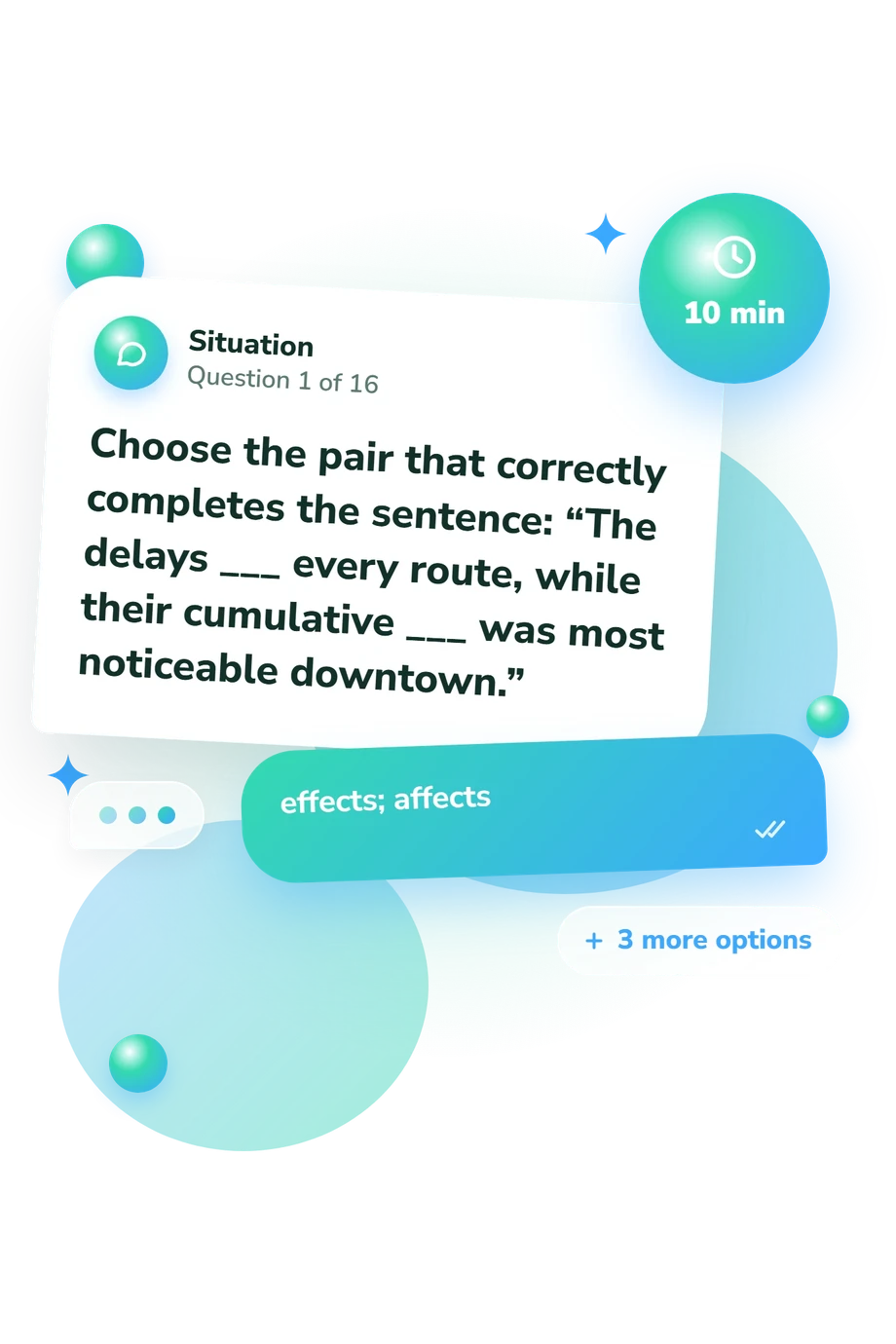
This questionnaire examines how affect and effect function in context rather than in isolation. Its items test the usual verb meaning influence, the usual noun meaning result, less common formal uses, inflected forms, and fixed expressions. The situations are practical: choosing a word in a sentence, correcting an error, or recognizing a grammatical role. An affect effect quiz can therefore show whether uncertainty concerns meaning, word class, or a particular construction.
The result is reported on Affect vs Effect Knowledge (0-16), with the following bands:
- Foundations to Review (0-6) indicates that core meanings and sentence patterns need focused review.
- Developing Command (7-12) shows that many common distinctions are understood, while structure, expressions, or exceptions may still cause hesitation.
- Strong Command (13-16) reflects accurate handling of standard uses and greater control of less common meanings.
Methodology and Evidence Base
Each item presents a sentence, phrase, or editing decision with four answer choices. The respondent selects the form that fits the intended meaning and grammar; prompts cover common contrasts, inflections, formal meanings, and expressions such as take effect. The score is the number of correct responses on the displayed scale.
Its main reference point is the Affect/effect usage distinction (Garner, 2016), which separates ordinary verb and noun roles while allowing for less common uses. The grammatical account is consistent with Huddleston and Pullum (2002), and editorial guidance with Christiansen and colleagues (2020). The questionnaire is conceptually consistent with these works, not an adaptation of any one published instrument.
An affect or effect quiz of this kind is best read as a focused usage profile. No population norms or external standardization are attached to the displayed score, so the bands describe this question set rather than general English proficiency. Attention, prior instruction, and familiarity with examples can influence answers, making the result most useful for targeted practice.
- Garner, Bryan A. Garner's Modern English Usage. 4th ed. Oxford University Press, 2016.
- Huddleston, Rodney, and Geoffrey K. Pullum. The Cambridge Grammar of the English Language. Cambridge University Press, 2002. 10.1017/9781316423530
- Christiansen, Stacy L., Cheryl Iverson, Annette Flanagin, et al., editors. AMA Manual of Style: A Guide for Authors and Editors. 11th ed. Oxford University Press, 2020. 10.1093/jama/9780190246556.001.0001
Updated: