
Why Does My Girlfriend Hate Me Quiz
How the Scales are Structured
Who Usually Takes This Test?
See How You Compare
Below is a preview of how scores are typically distributed across each scale.
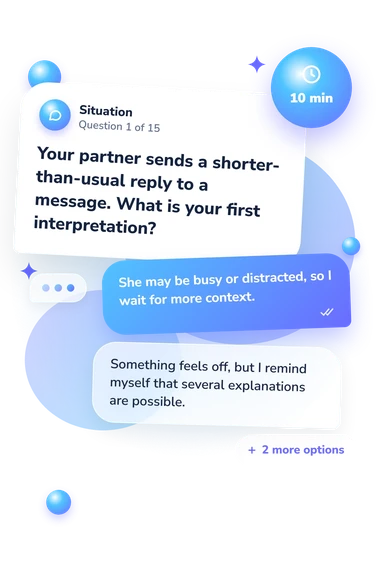
Example Questions From the Test
- She may be busy or distracted, so I wait for more context.
- Something feels off, but I remind myself that several explanations are possible.
- I assume she is annoyed with me and start reviewing what I might have done.
- I take it as confirmation that she cannot stand hearing from me.
- She notices and checks in, while respecting it if I need space.
- She offers support once I clearly explain what I need.
- She seems unsure how to respond and often changes the subject or retreats.
- She regularly treats my distress as an annoyance or refuses any engagement with it.
- I become convinced the silence is meant to punish or reject me.
- I worry that I caused it, though I also consider that her day may be the reason.
- I ask how she is doing without assuming the silence is about me.
- I initially feel uneasy, then look for a suitable moment to check in.
Why Does My Girlfriend Hate Me Quiz - Description and methodology of the test
For someone concerned about a change in a relationship, the Why Does My Girlfriend Hate Me Quiz offers a structured prompt for deciding what to discuss and what to observe next. Someone wondering whether a girlfriend hates them can use the does my gf hate me quiz to organize a calm conversation, clarify unmet needs, and separate immediate feelings from patterns that deserve closer reflection.
What This Assessment Explores
This questionnaire examines disagreement, repair, warmth, responsiveness, and ambiguous moments across everyday relationship situations. The result dimensions describe:
- Conflict and Respect Strain (0-15) reflects friction and repair. Manageable friction (0-5) leaves respect visible; Recurring strain (6-10) marks unresolved tension; Strong strain (11-15) shows repeated damage to respect or resolution.
- Emotional Distance (0-15) reflects warmth, responsiveness, and shared connection. Connection available (0-5) indicates accessible closeness; Uneven connection (6-10) signals inconsistency; Pronounced distance (11-15) indicates repeated disengagement.
- Rejection-Focused Interpretation (0-15) reflects how ambiguity is read. Evidence-led reading (0-5) separates facts from assumptions; Mixed certainty (6-10) leaves room for worry; Rejection-focused reading (11-15) makes hostility feel more certain.
Together, they separate observable relationship conflict patterns from assumptions about hidden intentions and indicate where clarification or a needs-based conversation may help.
Methodology and Evidence Base
Each item presents a situation with four response options. Across questions, they contrast contextual, supportive, compromise-oriented, and repair-focused responses with interpretations involving withdrawal, contempt, rejection, or poor responsiveness; their order varies and does not indicate severity or scoring direction. The format captures observed behavior and assigned meaning.
Scoring reports three totals with displayed bands. Since the questionnaire does not state each answer’s point contribution, the ranges do not reveal a complete formula. The displayed bands are reflective summaries, not clinical findings or population-norm interpretations; they summarize interactions and uncertain moments rather than establish a partner’s feelings.
The questionnaire's themes are conceptually consistent with the Romantic Partner Conflict Scale (Zacchilli et al., 2009), Crasta et al. (2021) on perceived partner responsiveness and insensitivity, and rejection-sensitivity research by Downey and Feldman (1996). It remains a separate questionnaire rather than an adaptation; the connection is conceptual, not an empirical comparison.
Current stress, self-awareness, and uncertainty can shape self-report when relationship concerns are hard to sort out; interpret results alongside context. Fear, threats, coercion, or physical harm should take priority and call for safety-focused support.
- Zacchilli, T. L., Hendrick, C., & Hendrick, S. S. (2009). The romantic partner conflict scale: A new scale to measure relationship conflict. Journal of Social and Personal Relationships, 26(8), 1073-1096. 10.1177/0265407509347936
- Crasta, D., Rogge, R. D., Maniaci, M. R., & Reis, H. T. (2021). Toward an optimized measure of perceived partner responsiveness: Development and validation of the perceived responsiveness and insensitivity scale. Psychological Assessment, 33(4), 338-355. 10.1037/pas0000986
- Downey, G., & Feldman, S. I. (1996). Implications of rejection sensitivity for intimate relationships. Journal of Personality and Social Psychology, 70(6), 1327-1343. 10.1037/0022-3514.70.6.1327