
Who's That Pokemon Quiz
How the Scales are Structured
Who Usually Takes This Test?
See How You Compare
Below is a preview of how scores are typically distributed across each scale.
Example Questions From the Test
- Practice consistently and trust small gains to accumulate.
- Alternate intense practice with long breaks to keep it exciting.
- Set short milestones so I can see regular signs of progress.
- Explore several methods until one holds my attention.
- A lively event that replaces tiredness with fresh excitement.
- A playful outing where the schedule can change as I go.
- A familiar, comfortable place with a few meaningful activities.
- A peaceful green space where I can slow down and feel grounded.
- Stay close to the person I know and warm up gradually.
- Find a calm corner and enjoy a few focused conversations.
- Follow my friend into conversations and respond enthusiastically.
- Introduce myself to a small group once I spot a shared interest.
Who's That Pokemon Quiz - Description and methodology of the test
Fans who want more than trivia can use this Pokémon personality quiz to reflect on how they handle challenge, change, connection, and support. The Who's That Pokemon Quiz turns those tendencies into a playful character-affinity profile. It suits people seeking a descriptive result through familiar choices, rather than a fixed label or a test of Pokémon lore.
What This Assessment Explores
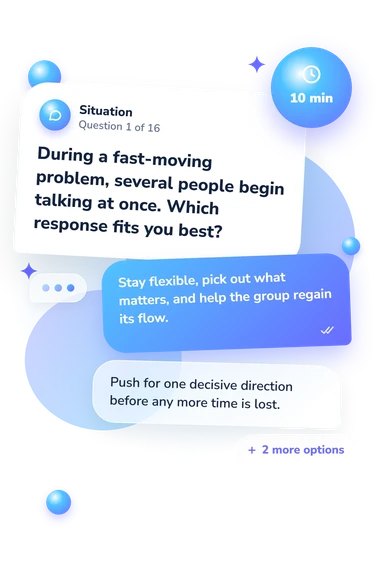
The questionnaire uses everyday scenarios involving group problems, gradual learning, support, changing plans, competition, and setbacks. Four response choices represent patterns of care, drive, loyalty, and adaptability. As a character affinity quiz, it compares choices across situations instead of relying on one favorite character.
The four dimensions are presented as separate character styles:
- Bulbasaur (0-12) reflects patience, grounded care, and steady growth: Faster Path (0-4), Growing Connection (5-8), Strong Bulbasaur Affinity (9-12).
- Charmander (0-12) reflects ambition, visible passion, and resilience: Cooler Flame (0-4), Steady Ember (5-8), Strong Charmander Affinity (9-12).
- Pikachu (0-12) reflects energetic connection, expressive loyalty, and readiness to act: Different Current (0-4), Familiar Spark (5-8), Strong Pikachu Affinity (9-12).
- Squirtle (0-12) reflects playful confidence, social adaptability, and composure when plans shift: Different Rhythm (0-4), Making Waves (5-8), Strong Squirtle Affinity (9-12).
Methodology and Evidence Base
Each item presents a familiar situation with four contrasting responses, asking you to choose the option closest to your usual instinct. The prompts cover social entry, support, enthusiasm, planning, persistence, and changing circumstances. The format works as a Pokémon self-reflection test and presents the completed response pattern through four character styles.
The questionnaire presents four affinity scores, each grouped into three named bands. These bands are descriptive categories within the quiz rather than population comparisons. They indicate how strongly each style aligns with the response pattern, not a permanent personality type.
Conceptually, the design is consistent with work by Park and Henley on personality and fantasy game-character preferences, Hoffner and Buchanan on perceived similarity and wishful identification with media characters, and Cohen on audience-character identification. This questionnaire is not presented as an adaptation or standardized version of those works. Because self-report can shift with mood, context, and candor, the result is best read as a reflective snapshot.
- Park, Anna E., and Tracy B. Henley. "Personality and Fantasy Game Character Preferences." Imagination, Cognition and Personality, 27(1), 37-46, 2007. 10.2190/IC.27.1.d
- Hoffner, Cynthia, and Martha Buchanan. "Young Adults' Wishful Identification With Television Characters: The Role of Perceived Similarity and Character Attributes." Media Psychology, 7(4), 325-351, 2005. 10.1207/S1532785XMEP0704_2
- Cohen, Jonathan. "Defining Identification: A Theoretical Look at the Identification of Audiences With Media Characters." Mass Communication and Society, 4(3), 245-264, 2001. 10.1207/S15327825MCS0403_01