
Who Is the Love of My Life Quiz
How the Scales are Structured
Who Usually Takes This Test?
See How You Compare
Below is a preview of how scores are typically distributed across each scale.
Example Questions From the Test
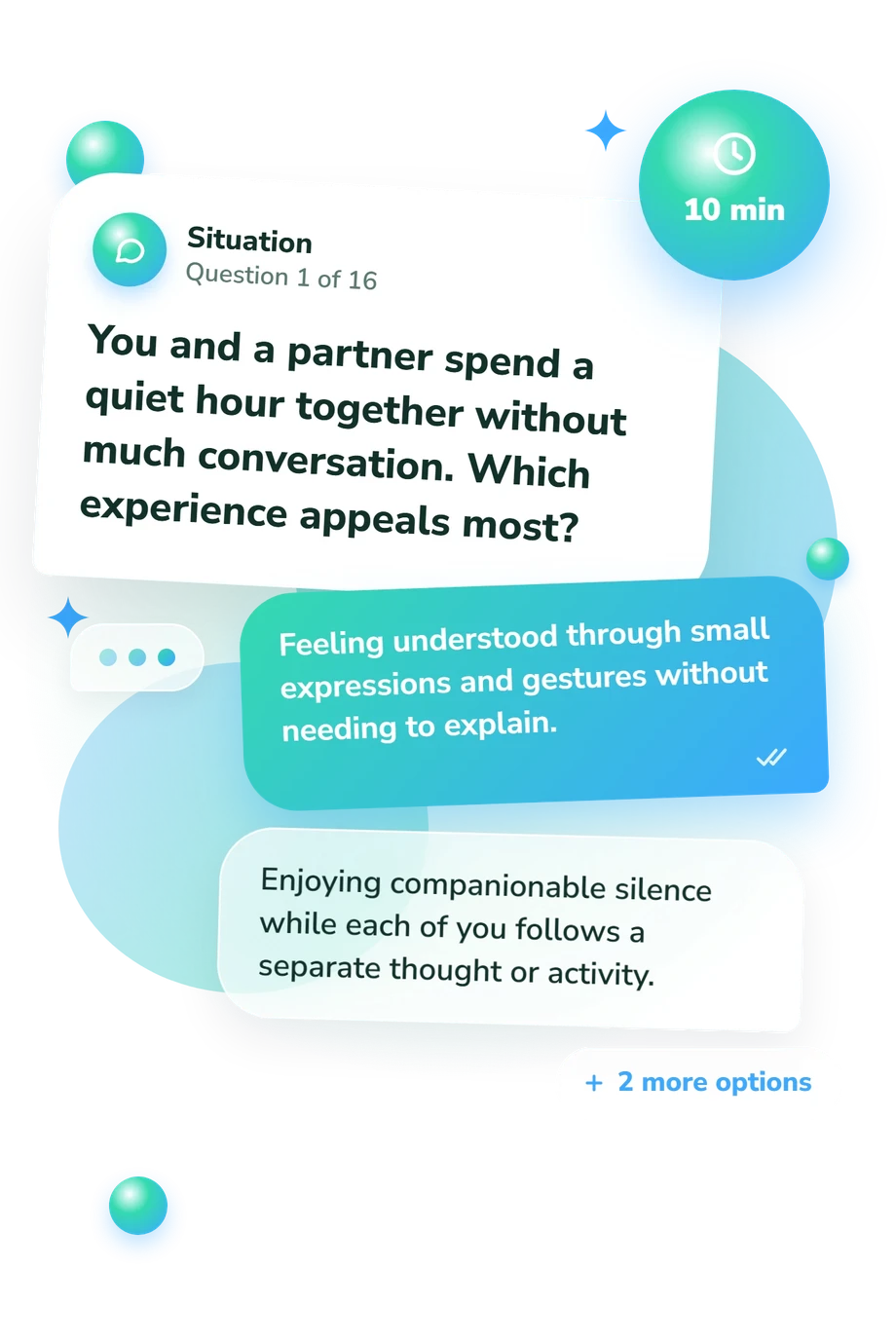
- Feeling understood through small expressions and gestures without needing to explain.
- Enjoying companionable silence while each of you follows a separate thought or activity.
- Checking in periodically so the quiet still feels connected.
- Turning the time into an active shared experience instead.
- Urging me to take the leap because they see potential I am underestimating.
- Exploring what I could gain and what fears may be holding me back.
- Helping me find a small way to test the opportunity before committing.
- Reminding me that choosing stability can be a valid decision too.
- Going immediately and letting the night unfold without a plan.
- Rearranging a few things so you can accept the invitation.
- Saving the idea for a date when you can both plan around it.
- Keeping the familiar evening you had already anticipated.
Who Is the Love of My Life Quiz - Description and methodology of the test
People considering what kind of partner feels right can use the Who Is the Love of My Life Quiz to examine romantic priorities. The result profiles four partner qualities: growth through reflection, courage, and learning; deep recognition and shared meaning; romantic intensity; and dependable teamwork. For anyone taking the who will be the love of my life quiz, this profile cannot identify a person, but it can clarify partnership expectations.
What This Assessment Explores
Questions about intimacy, conflict, change, support, attraction, and responsibility reveal partner qualities that make love meaningful. This romantic preference test shows what draws you to a significant partner.
The profiles are:
- The Growth Catalyst (0-12) reflects attraction to a partner encouraging reflection, courage, learning, and purposeful change; Low pull 0-4, Meaningful pull 5-8, Defining draw 9-12.
- The Kindred Companion (0-12) reflects attraction to emotional recognition, intellectual resonance, shared meaning, and being deeply known; Background note 0-4, Meaningful pull 5-8, Defining draw 9-12.
- The Passionate Spark (0-12) reflects attraction to chemistry, expressive romance, spontaneity, and emotional intensity; Low emphasis 0-4, Moderate pull 5-8, Defining draw 9-12.
- The Steady Teammate (0-12) reflects attraction to reliability, shared responsibility, and a life built through consistent partnership; Background Note 0-4, Meaningful Pull 5-8, Defining Draw 9-12.
The highest shows strongest affinity; scores within one point indicate a blend.
Methodology and Scientific Basis
Each item presents a relationship situation with four response options. You choose the reaction or partner behavior that feels most compelling, so the format captures relative preference rather than agreement with statements. Themes cover intimacy, conflict, change, support, attraction, routine, and repair.
Scores combine responses into four profile totals. The highest indicates strongest affinity, while totals within one point indicate a blend. Comparing totals shows whether one profile stands out or several qualities carry similar weight.
Viewed as a love profile test, the questionnaire is conceptually consistent with Fletcher et al. (1999) on intimate-partner ideals and Aron and Westbay (1996) on love prototypes. It connects with self-expansion theory from Aron and Aron (1986) and passionate-love research by Hatfield and Sprecher (1986). It is not presented as any of those instruments.
Read the result as a structured snapshot of stated preferences. Mood, relationship history, current circumstances, honesty, and self-awareness can influence choices, so the profile may change as your perspective changes. It can highlight priorities and tensions for reflection about the qualities you want in lasting love.
- Fletcher, Garth J. O., Jeffry A. Simpson, Geoff Thomas, and Louise Giles. (1999). Ideals in intimate relationships. Journal of Personality and Social Psychology, 76(1), 72-89. 10.1037/0022-3514.76.1.72
- Aron, Arthur, and Lori Westbay. (1996). Dimensions of the prototype of love. Journal of Personality and Social Psychology, 70(3), 535-551. 10.1037/0022-3514.70.3.535
- Aron, Arthur, and Elaine N. Aron. (1986). Love as the expansion of self: Understanding attraction and satisfaction. New York: Hemisphere Publishing.
- Hatfield, Elaine, and Susan Sprecher. (1986). Measuring passionate love in intimate relationships. Journal of Adolescence, 9(4), 383-410. 10.1016/S0140-1971(86)80043-4
Updated: