
What YouTuber Girlfriend Quiz
How the Scales are Structured
Who Usually Takes This Test?
See How You Compare
Below is a preview of how scores are typically distributed across each scale.
Example Questions From the Test
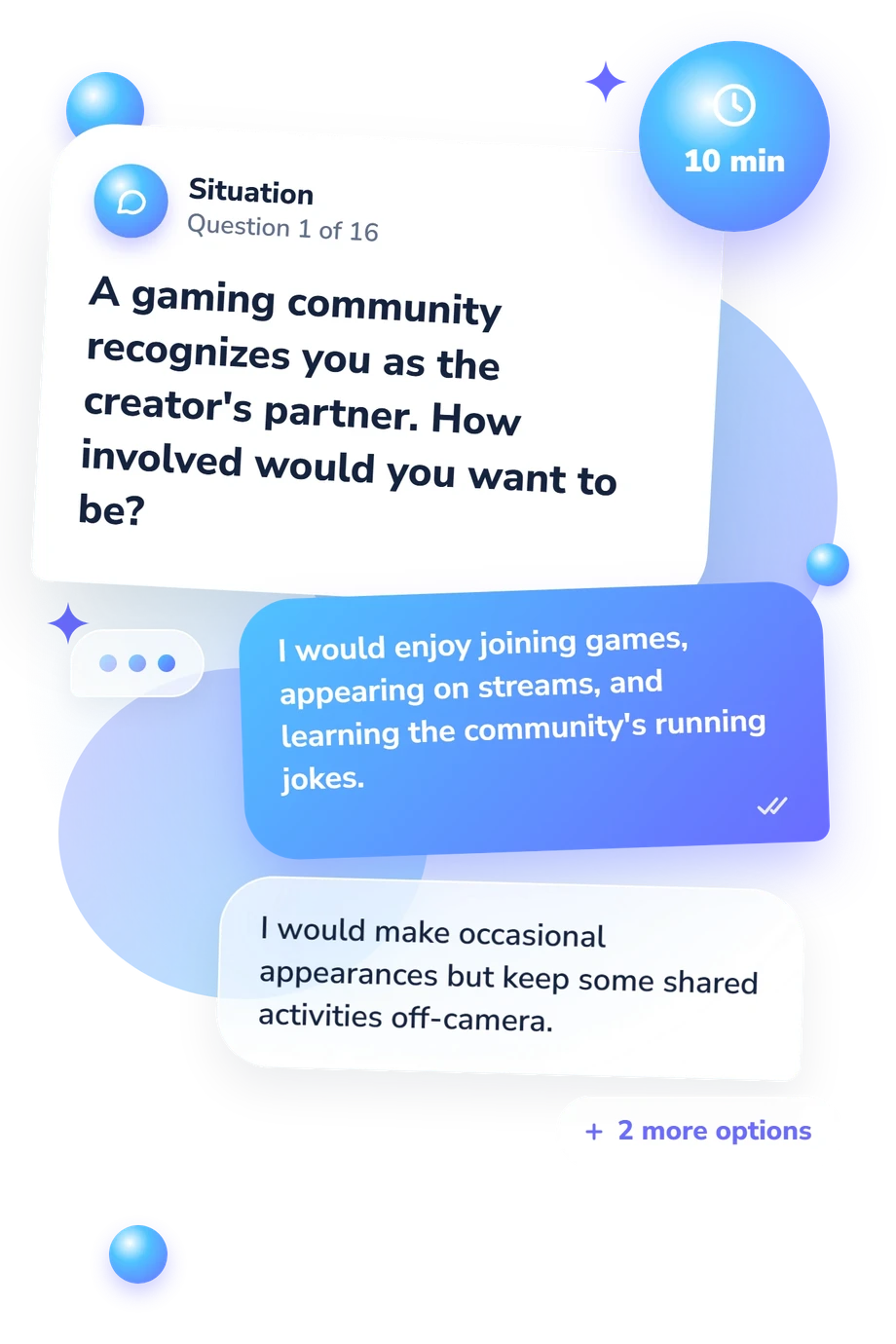
- I would enjoy joining games, appearing on streams, and learning the community's running jokes.
- I would make occasional appearances but keep some shared activities off-camera.
- I would support her work privately and attend only a few community events.
- I would prefer not to become part of the gaming community myself.
- Pack quickly and help turn the day into a visual story.
- Go along and appear in a few planned parts of the video.
- Enjoy the trip but mostly stay behind the camera.
- Choose a relaxed local plan that does not become content.
- Offer to hold the camera or help organize the scene.
- Watch and enjoy it without taking a production role.
- Accept a small role once I understand the premise.
- Jump in, build on the premise, and help keep the scene moving.
What YouTuber Girlfriend Quiz - Description and methodology of the test
People deciding how comfortable they would feel with public participation, shared routines, audience contact, and off-camera boundaries can use the What YouTuber Girlfriend Quiz to explore those preferences. Readers curious about who their YouTube girlfriend might be can use this questionnaire to compare imagined relationship arrangements. The result gives language to the conditions that feel most natural to them.
What This Assessment Explores
Questions cover gaming communities, livestreams, travel, research, comedy, routines, and couple challenges. They show whether visibility, collaboration, discussion, or privacy fits your preferences, giving the profile a YouTuber girlfriend compatibility focus rather than an identity focus.
The four result dimensions are:
- The Comedy & Entertainment Creator (0-12) measures playful-content affinity: Quieter Chemistry (0-4) prefers calm; Occasional Co-Star (5-8) selects humor; Comedy Duo Energy (9-12) embraces banter.
- The Gaming & Streaming Creator (0-12) measures digital-life comfort: Different Rhythm (0-4) favors offline interests; Playful Potential (5-8) balances both; Player Two Energy (9-12) shares gaming.
- The Learning & Commentary Creator (0-12) measures discussion interest: Experience First (0-4) favors action; Curious Companion (5-8) mixes modes; Thought-Partner Match (9-12) values analysis.
- The Lifestyle & Travel Vlogger (0-12) measures filmed-experience affinity: Home Base Preferred (0-4) values privacy; Selective Adventurer (5-8) chooses outings; Vlog-Life Match (9-12) enjoys exploration.
Methodology and Scientific Basis
Each item presents four alternative situations or preferences involving humor, gaming, filming, discussion, travel, and privacy. These are parallel choices, not points along one participation continuum: an option may favour joining a stream, analysing an idea, planning a trip, or keeping ordinary life off camera. Responses produce a separate profile score for each creator style rather than one overall winner.
Conceptually, the custom categories overlap with Ferchaud et al. (2018) on parasocial attributes and YouTube content trends, Rihl and Wegener (2019) on parasocial feedback, Lange (2007) on public and private participation, and Leite et al. (2024) on creator self-disclosure. None of these studies supplies or validates this questionnaire’s four scales or scoring, and the online version is not an adaptation of them.
Framed as a quiz about who's your YouTube girlfriend, the questionnaire offers a playful fit profile, not a named relationship. No standardized scoring procedure or population norms are specified for this version, so its displayed bands are descriptive profile categories rather than validated population cutoffs. Self-report, current mood, media habits, and the imagined situation can influence the result.
- Ferchaud, Arienne, Jenna Grzeslo, Stephanie Orme, and Jared LaGroue. (2018). "Parasocial attributes and YouTube personalities: Exploring content trends across the most subscribed YouTube channels." Computers in Human Behavior, 80, 88-96. 10.1016/j.chb.2017.10.041
- Rihl, Alexander, and Claudia Wegener. (2019). "YouTube celebrities and parasocial interaction: Using feedback channels in mediatized relationships." Convergence, 25(3), 554-566. 10.1177/1354856517736976
- Lange, Patricia G. (2007). "Publicly Private and Privately Public: Social Networking on YouTube." Journal of Computer-Mediated Communication, 13(1), 361-380. 10.1111/j.1083-6101.2007.00400.x
- Leite, Fernanda Polli, Nicolas Pontes, and Felix Septianto. (2024). "To share or not to share: When is influencer self-disclosure perceived as appropriate?" Journal of Consumer Behaviour, 23(5), 2585-2598. 10.1002/cb.2361
Updated: