
What Rock Am I Quiz
How the Scales are Structured
Who Usually Takes This Test?
See How You Compare
Below is a preview of how scores are typically distributed across each scale.
Example Questions From the Test
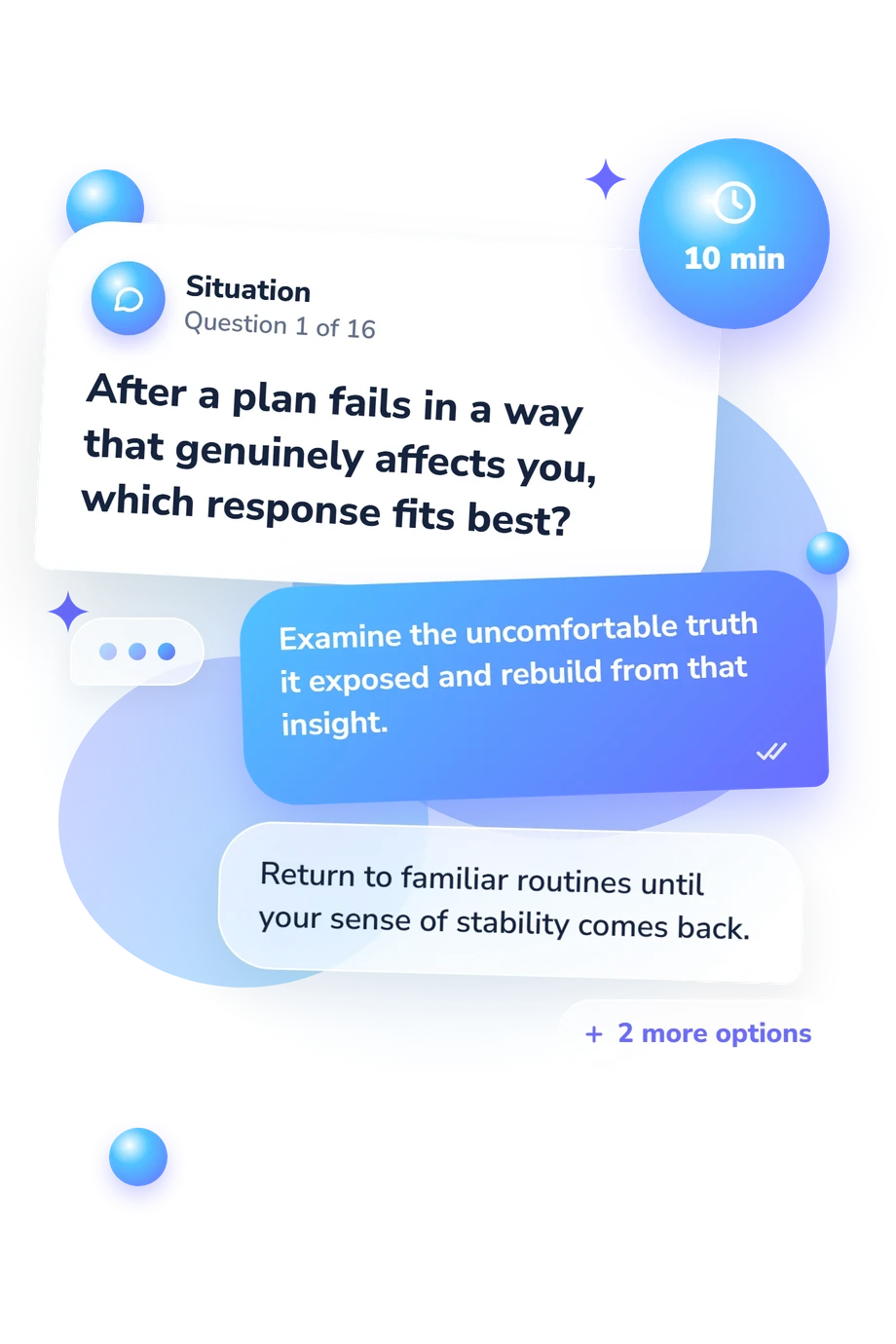
- Examine the uncomfortable truth it exposed and rebuild from that insight.
- Return to familiar routines until your sense of stability comes back.
- Change environments and let new experiences reshape your direction.
- Turn the experience into a carefully framed lesson or creative piece.
- A story about devotion, duty, and remaining dependable over many years.
- A story of hidden motives, confrontation, and profound inner change.
- A beautifully composed story about taste, identity, and social expression.
- A journey shaped by changing places, friendships, and accumulated experience.
- With durable furniture and an arrangement that works reliably every day.
- With a dramatic object that represents a private theme or turning point.
- With colors, proportions, and textures that create visual harmony.
- With flexible areas that can change as people and activities come and go.
What Rock Am I Quiz - Description and methodology of the test
People curious about how they respond when plans change or relationships become complicated may approach the What Rock Am I Quiz as a structured pause for self-observation. This symbolic rock quiz can help you examine familiar habits and consider whether your usual approach still serves you, without assigning a fixed identity.
What This Assessment Explores
Beyond rigid types, the what rock are you quiz explores patterns in setbacks, relationships, learning, teamwork, and home life. Scores within one point blend.
The four symbolic affinity scales are:
- Granite - The Steady Foundation (0-12) reflects reliability, endurance, and grounded follow-through. Light Granite affinity: 0-4; Mixed Granite affinity: 5-8; Strong Granite affinity: 9-12.
- Marble - The Expressive Refiner (0-12) reflects craft, composure, beauty, and memorable self-expression. Light Marble affinity: 0-4; Mixed Marble affinity: 5-8; Strong Marble affinity: 9-12.
- Obsidian - The Insightful Transformer (0-12) reflects candor, psychological depth, and decisive transformation. Light Obsidian affinity: 0-4; Mixed Obsidian affinity: 5-8; Strong Obsidian affinity: 9-12.
- Sandstone - The Adaptive Connector (0-12) reflects connection, flexibility, accumulated experience, and organic growth. Light affinity: 0-4; Mixed affinity: 5-8; Strong affinity: 9-12.
Methodology and Evidence Base
Each item offers four alternatives, and you choose the response that best matches your usual tendency in that situation. This forced-choice format compares competing preferences instead of asking you to rate every trait independently.
The result displays four symbolic affinity scores. The highest score is the strongest affinity, while scores within one point form a blended result; each displayed band indicates the strength of that affinity.
As a rock type quiz, this format conceptually aligns with a 2012 study by Nedelcea and colleagues on metaphorical items for personality constructs and 2014 work by Fetterman and Robinson on metaphors as expressions of perceived characteristics. It is not a direct adaptation of either source. The forced-choice approach also connects with a 2006 study by Heggestad and colleagues, while a 2021 paper by Arthur and colleagues discusses careless responding as a measurement risk.
This online questionnaire is a self-report snapshot: current context, self-awareness, social desirability, and inattentive answers can affect the profile, so consider whether the situations match your present circumstances and response style when interpreting it alongside your broader experience.
- Nedelcea, Catalin, Iulia D. Ciorbea, and Andrei Gabriel Ion. (2012). Using metaphorical items for describing personality constructs. Procedia - Social and Behavioral Sciences, 33, 178-182. 10.1016/j.sbspro.2012.01.107
- Fetterman, Adam K., and Michael D. Robinson. (2014). What Can Metaphors Tell Us about Personality? In-Mind, 20.
- Heggestad, Eric D., Morgan Morrison, Charlie L. Reeve, and Rodney A. McCloy. (2006). Forced-choice assessments of personality for selection: Evaluating issues of normative assessment and faking resistance. Journal of Applied Psychology, 91(1), 9-24. 10.1037/0021-9010.91.1.9
- Arthur, Winfred, Ellen Hagen, and Felix George. (2021). The Lazy or Dishonest Respondent: Detection and Prevention. Annual Review of Organizational Psychology and Organizational Behavior, 8, 105-137. 10.1146/annurev-orgpsych-012420-055324
Updated: