
What Kind of Woman Will I Marry Quiz
How the Scales are Structured
Who Usually Takes This Test?
See How You Compare
Below is a preview of how scores are typically distributed across each scale.
Example Questions From the Test
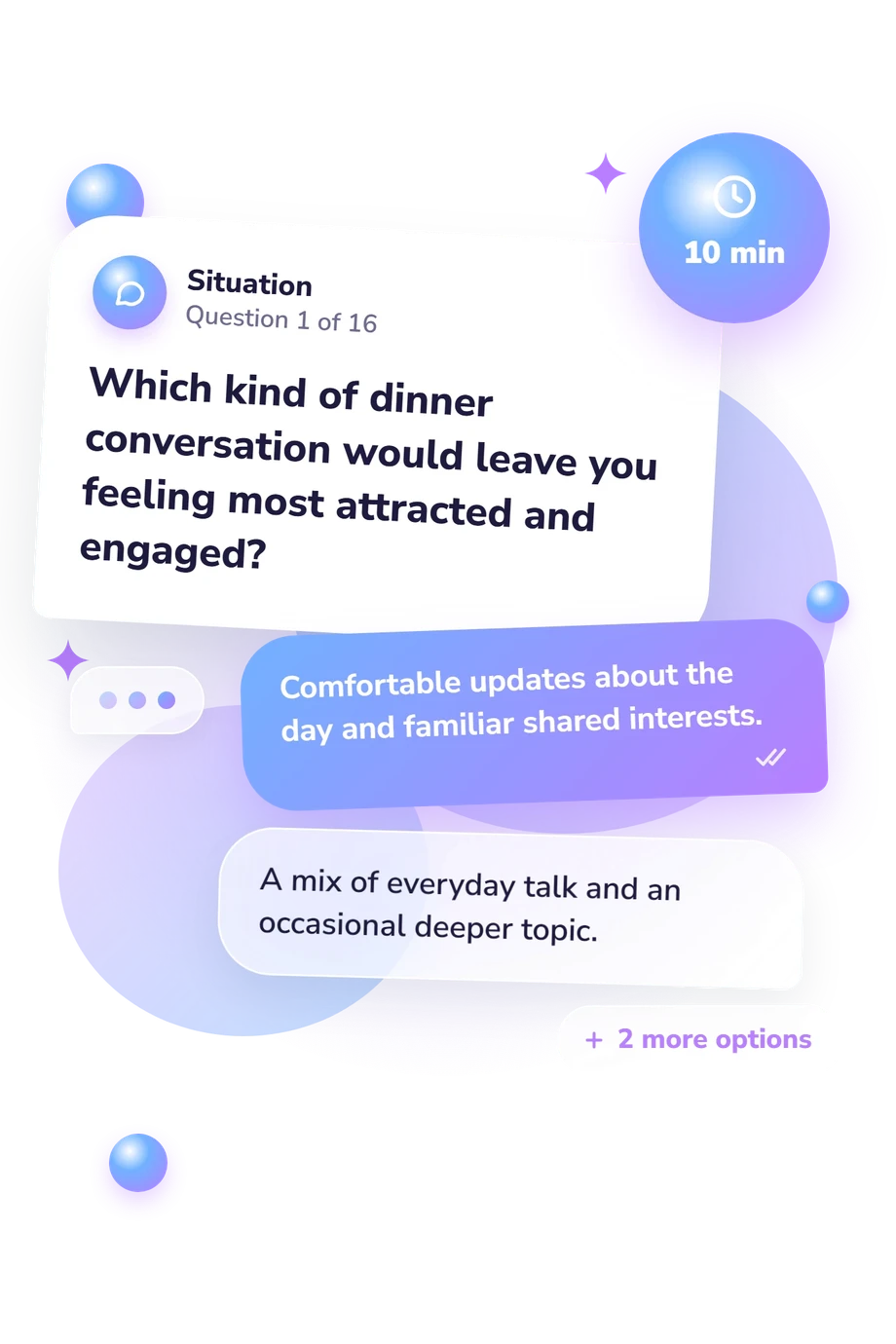
- Comfortable updates about the day and familiar shared interests.
- A mix of everyday talk and an occasional deeper topic.
- A thoughtful exchange that helps us see a topic differently.
- An energetic discussion full of questions, ideas, and unexpected connections.
- Keep plans flexible and let each person manage most obligations independently.
- Discuss only the deadlines or chores that could affect both of us.
- Divide the main responsibilities and check in when something changes.
- Create a shared plan, divide responsibilities clearly, and follow through consistently.
- Keep our normal routine and enjoy a familiar place.
- Choose a favorite activity but add one small change.
- Try a place or activity neither of us has experienced before.
- Make a short list of options and pick one based on our mood.
What Kind of Woman Will I Marry Quiz - Description and methodology of the test
People considering their relationship priorities may use the What Kind of Woman Will I Marry Quiz to reflect on the kind of partnership they value. Its result can guide reflection on relationship compatibility, especially where connection, cooperation, independence, or shared growth matter. The assessment supports thoughtful self-reflection about priorities and compatibility.
What This Assessment Explores
Scenarios cover conversation, teamwork, support, autonomy, novelty, affection, and repair. They describe preferences, not a prediction.
These result dimensions are:
- Curious Visionary (0-12) measures attraction to curiosity, creativity, and growth: Supporting Preference (0-4), Meaningful Pull (5-8), and Strong Affinity (9-12).
- Grounded Teammate (0-12) measures attraction to reliability, cooperation, and shared structure: Supporting Preference (0-4), Meaningful Pull (5-8), and Strong Affinity (9-12).
- Independent Explorer (0-12) measures attraction to autonomy, spontaneity, and new experiences: Supporting Preference (0-4), Meaningful Pull (5-8), and Strong Affinity (9-12).
- Warm-Hearted Connector (0-12) measures attraction to affection, openness, and close connection: Supporting Preference (0-4), Meaningful Pull (5-8), and Strong Affinity (9-12).
Your highest score identifies your strongest affinity and the ideal partner qualities it represents. An outcome within one point of that score contributes to a blended result.
Methodology and Scientific Basis
Across the scenarios, four response choices address conversation, planning, emotional support, autonomy, novelty, affection, and repair. Selecting the option that feels most compatible creates a profile rather than a pass/fail score. Themes remain separate rather than becoming one overall trait.
Scoring is descriptive: the highest total is the strongest affinity, and any outcome within one point of it contributes to a blended result. Displayed ranges organize interpretation but do not specify how many points each answer adds or establish clinical cutoffs.
Research by Fletcher and colleagues on intimate-relationship ideals is the closest conceptual anchor because it treats partner ideals as multidimensional. Campbell's work adds ideal standards, self-views, and flexibility, while Eastwick's research cautions against assuming that stated preferences predict relationship outcomes. This questionnaire is conceptually consistent with those studies, not an adaptation of them.
The displayed bands are descriptive result labels; no standardization or population norms are stated for this online assessment. Self-report can shift with mood, hopes, self-awareness, and response style. The result offers a snapshot of relationship preferences and compatibility priorities.
- Fletcher, Garth J. O., Simpson, Jeffry A., Thomas, Geoff, & Giles, Louise. (1999). Ideals in intimate relationships. Journal of Personality and Social Psychology, 76(1), 72-89. 10.1037/0022-3514.76.1.72
- Campbell, Lorne, Simpson, Jeffry A., Kashy, Deborah A., & Fletcher, Garth J. O. (2001). Ideal standards, the self, and flexibility of ideals in close relationships. Personality and Social Psychology Bulletin, 27(4), 447-462. 10.1177/0146167201274006
- Eastwick, Paul W., Luchies, Laura B., Finkel, Eli J., & Hunt, Lucy L. (2014). The predictive validity of ideal partner preferences: A review and meta-analysis. Psychological Bulletin, 140(3), 623-665. 10.1037/a0032432
Updated: