
Total Drama Character Quiz
How the Scales are Structured
Who Usually Takes This Test?
See How You Compare
Below is a preview of how scores are typically distributed across each scale.
Example Questions From the Test
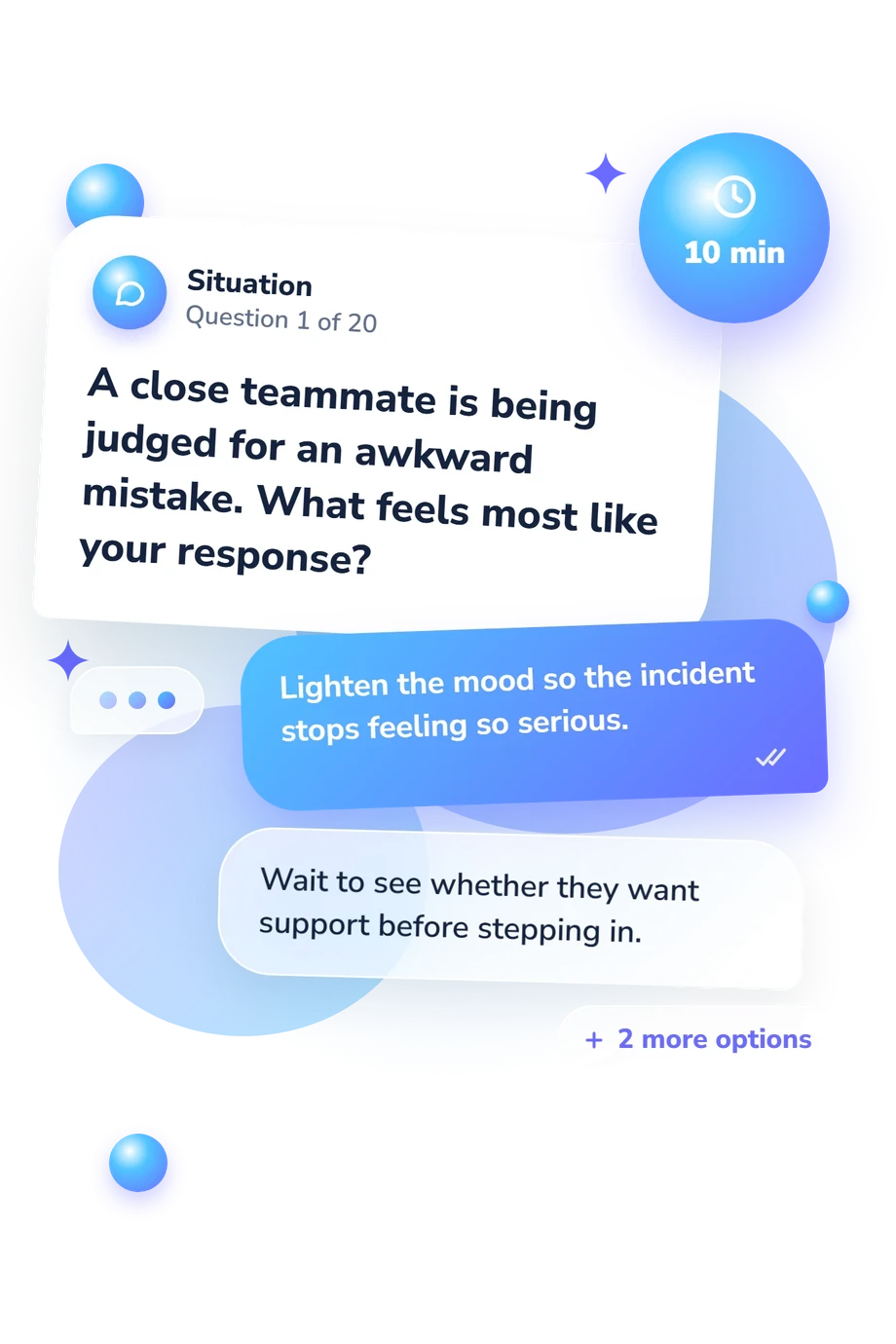
- Lighten the mood so the incident stops feeling so serious.
- Wait to see whether they want support before stepping in.
- Stay beside them and make it clear that one mistake does not change my loyalty.
- Focus on helping the whole team move past the setback.
- I analyze why it happened and try not to repeat it.
- I feel awkward but recover once attention moves elsewhere.
- I laugh along and turn it into a story people can enjoy.
- I make a quick joke, then help everyone refocus.
- Start a lively group activity so nobody gets bored.
- Find one or two people and settle into a low-key conversation.
- Use the strange mood as inspiration for a sketch or story.
- Take some quiet time first, then rejoin people when I feel ready.
Total Drama Character Quiz - Description and methodology of the test
Fans who want a character-based way to examine their habits can use this playful profile to consider alliances, pressure, recognition, rules, and group energy. Readers can use the Which Total Drama Character Are You Quiz to compare patterns rather than accept a single label. Close scores can suggest a blended style. With the Total Drama Quiz What Character Are You, those choices become an accessible reflection on how you act around competition and other people.
What This Assessment Explores
Five scales cover support, alliances, rules, leadership, and setbacks. Scores indicate whether choices resemble organized, rebellious, introspective, strategic, or enthusiastic styles.
- Courtney (0-12) reflects organized leadership: Flexible operator (0-4), Structured ambition (5-8), Strong Courtney affinity (9-12).
- Duncan (0-12) reflects rebellious, street-smart daring: By-the-book tendency (0-4), Independent edge (5-8), Strong Duncan affinity (9-12).
- Gwen (0-12) reflects introspective independence and loyalty: Different wavelength (0-4), Shared undertones (5-8), Strong Gwen affinity (9-12).
- Heather (0-12) reflects strategic ambition and image-awareness: Cooperative approach (0-4), Strategic streak (5-8), Strong Heather affinity (9-12).
- Owen (0-12) reflects enthusiasm, sociability, and resilience: Calmer frequency (0-4), Shared energy (5-8), Strong Owen affinity (9-12).
Together, the scores create a Total Drama character match, showing the closest fictional style and any blend.
Methodology and Scientific Basis
Each item presents a social or competition situation with four response options. Selecting the most representative choice links judgments about support, confrontation, organization, improvisation, leadership, or celebration to character affinities. Responses are tallied comparatively across five character scores; the strongest pattern leads the result, while scores within one point form a blend. Methodologically, this Total Drama character profile is a four-option self-report comparison of responses across character scores rather than a performance measure.
Its conceptual fit is closest to the Character Recognizability Scale (CRS), which examines recognition of personality patterns in media characters. This questionnaire is conceptually consistent with that work, not an adaptation of it. The comparison offers background for interpreting character-related responses, but it does not establish this questionnaire's scoring or construct.
The bands are descriptive levels within this online questionnaire, rather than standardized population norms or clinical cutoffs. Scores may shift with mood, current group experiences, self-presentation, and which response feels most relatable, so the profile works best as a comparative snapshot for reflection.
- Żerebecki, Bartosz G., Suzanna J. Opree, Joep Hofhuis, and Susanne Janssen. "Beyond Perceived Similarity: Development and Validation of the Character Recognizability Scale (CRS)." Mass Communication and Society, 27(5), 1220-1251 (2024). 10.1080/15205436.2024.2366224
- Żerebecki, Bartosz G., Esther van der Vliet, and Julia Kneer. "I Want to Be You(r Friend): An Investigation of the Effects of Gendered Personality Traits on Engagement with Different Modern Family Characters." Journalism and Media, 3(2), 362-381 (2022). 10.3390/journalmedia3020026
- Cohen, Jonathan. "Defining identification: A theoretical look at the identification of audiences with media characters." Mass Communication and Society, 4(3), 245-264 (2001). 10.1207/S15327825MCS0403_01
Updated: