
The One Direction Quiz
How the Scales are Structured
Who Usually Takes This Test?
See How You Compare
Below is a preview of how scores are typically distributed across each scale.
Example Questions From the Test
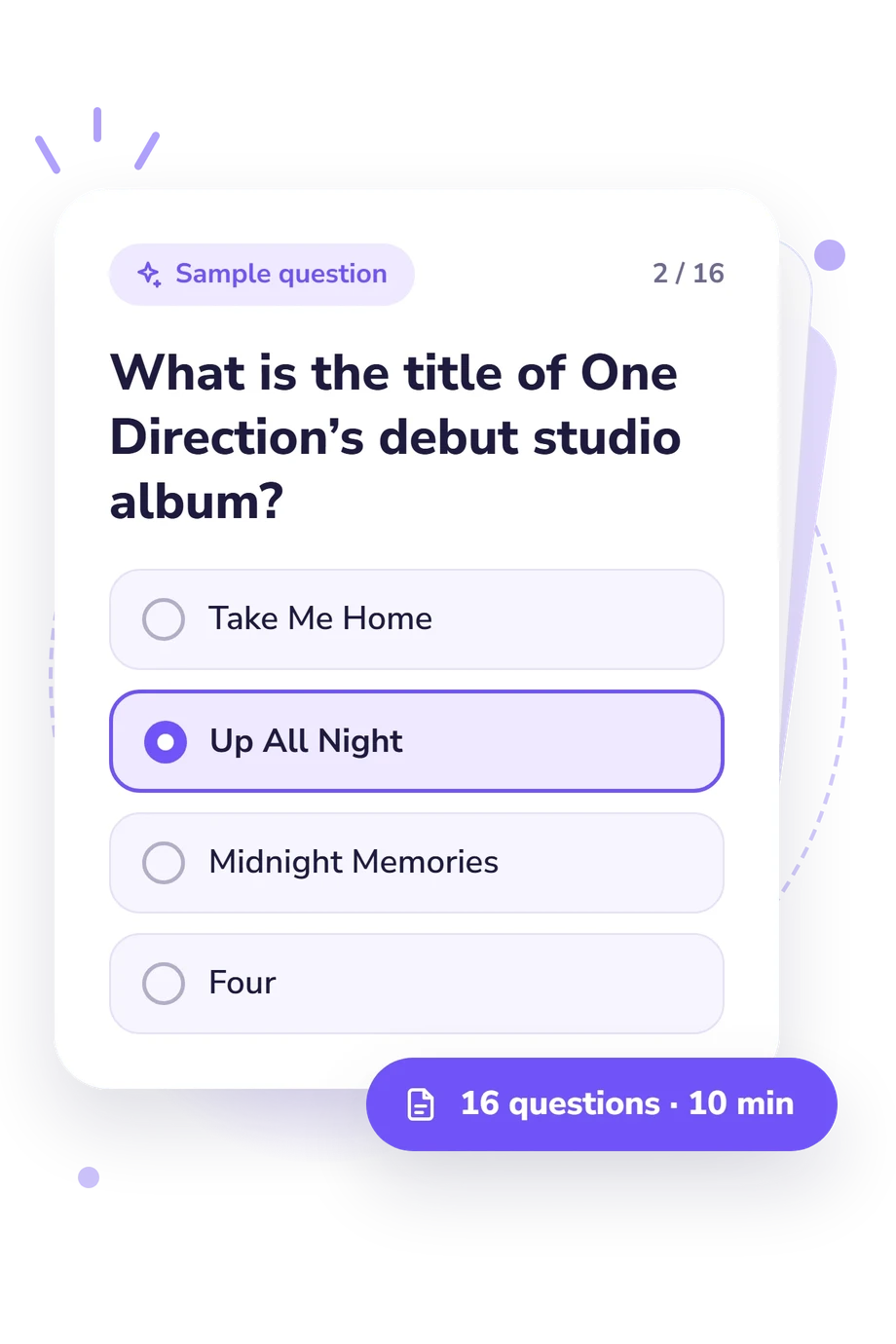
- Take Me Home
- Up All Night
- Midnight Memories
- Four
- Live While We’re Young
- Best Song Ever
- What Makes You Beautiful
- One Thing
- A fan of One Direction
- A contestant who auditioned alongside the group
- A member of One Direction’s touring band
- A collector of the band’s official awards
The One Direction Quiz - Description and methodology of the test
Fans who want a focused way to check their knowledge of the band can use the One Direction Quiz to decide what they genuinely remember. It suits casual listeners, longtime Directioners, and anyone whose recall extends beyond familiar singles. Taking a 1D knowledge quiz offers a compact self-check, helping reveal which parts of the group’s story feel secure and which deserve another listen.
What This Assessment Explores
Factual familiarity is the focus, rather than preference or emotional attachment. Items cover members, the original lineup, X Factor history, album chronology, songs, the 2013 concert film, and the 2015 departure and hiatus. They ask respondents to connect names, releases, milestones, and dates across the band’s career.
Casual listeners can find topics to refresh, while dedicated Directioners can check knowledge beyond familiar singles. The 2015 departure, later releases, and hiatus sit within this One Direction history quiz as parts of a much wider career timeline. One Direction Knowledge (0-16) is divided into these bands:
- Casual Listener (0-6) shows recognition of some history, with gaps in members, releases, or milestones.
- Developing Directioner (7-12) shows solid knowledge and links many songs, albums, and career events.
- One Direction Expert (13-16) reflects detailed knowledge of the lineup, discography, timeline, film, and fandom.
Methodology and Evidence
Each item presents four answer options and asks for one factual selection rather than a rating of attitude or intensity. The result is reported through three descriptive bands; the displayed range alone does not establish how individual answers are weighted. The format therefore reflects recall of this content, not intelligence, musical taste, or the strength of fan identity.
Brooks and Hodgin (2012) offer the closest comparison for this fact-based, fan-oriented subject. The official autobiography and music archive provide reference points for names, chronology, releases, and songs. The questionnaire is conceptually consistent with those sources, but is not presented as their reproduction or a validated adaptation. Korobkova and Black (2014) provide contextual background that distinguishes fan identity and community participation from the factual recall assessed here. That distinction helps interpret this One Direction trivia quiz without treating the source as validation of its questionnaire or score.
Results can shift with attention, memory, and recent exposure. Someone may know the songs well yet miss dates or lineup details, while recent review may improve recall temporarily. Since recognition among supplied choices shapes performance, the score is best read as focused self-reflection on factual familiarity rather than a full profile of fandom.
- Brooks, Riley, and Molly Hodgin. One Direction: Quiz Book. New York: Scholastic Inc., 2012. ISBN 978-0-545-50545-1.
- One Direction. One Direction: Who We Are: Our Official Autobiography. London: HarperCollins, 2014. ISBN 978-0-00-757731-6.
- One Direction. "Music." The Official Website. Accessed September 24, 2026.
- Korobkova, Ksenia A., and Rebecca W. Black. "Contrasting Visions: Identity, Literacy, and Boundary Work in a Fan Community." E-Learning and Digital Media, vol. 11, no. 6, 2014, pp. 619-632. DOI 10.2304/elea.2014.11.6.619.
Updated: