
Spongebob Character Quiz
How the Scales are Structured
Who Usually Takes This Test?
See How You Compare
Below is a preview of how scores are typically distributed across each scale.
Example Questions From the Test
- Strongly disagree
- Disagree
- Not sure
- Agree
- Strongly disagree
- Disagree
- Not sure
- Agree
- Strongly disagree
- Disagree
- Not sure
- Agree
Spongebob Character Quiz - Description and methodology of the test
People who enjoy personality-based character matching can use the Spongebob Character Quiz to explore which fictional pattern resembles their everyday way of handling goals, uncertainty, and mood. As a quiz asking which SpongeBob character you are, it offers a playful route into self-reflection without reducing a person to one label. It can help readers notice recurring preferences in pressure, planning, social energy, and recovery after setbacks.
What This Assessment Explores
These questions focus on three tendencies: reactions to busy or uncertain situations, motivation to set and pursue goals, and the emotional tone you bring to daily interactions. The result is a descriptive profile, so the closest match reflects answer patterns rather than a complete identity.
The result report uses these dimensions:
- Chaos Tolerance (0-30) measures comfort with unpredictability, messiness, and hectic situations; its bands are Structure-Seeking (0-10), Balanced (11-20), and Chaos-Thriving (21-30).
- Drive & Ambition (0-30) measures motivation to achieve, compete, and move plans forward; its bands are Laid-back (0-10), Steady Striver (11-20), and High Hustle (21-30).
- Optimism & Cheer (0-30) measures how upbeat, hopeful, and enthusiastic you tend to be; its bands are Reserved (0-10), Balanced (11-20), and Sunny (21-30).
As a SpongeBob personality quiz, it compares styles in context without making the result permanent.
Methodology and Scientific Basis
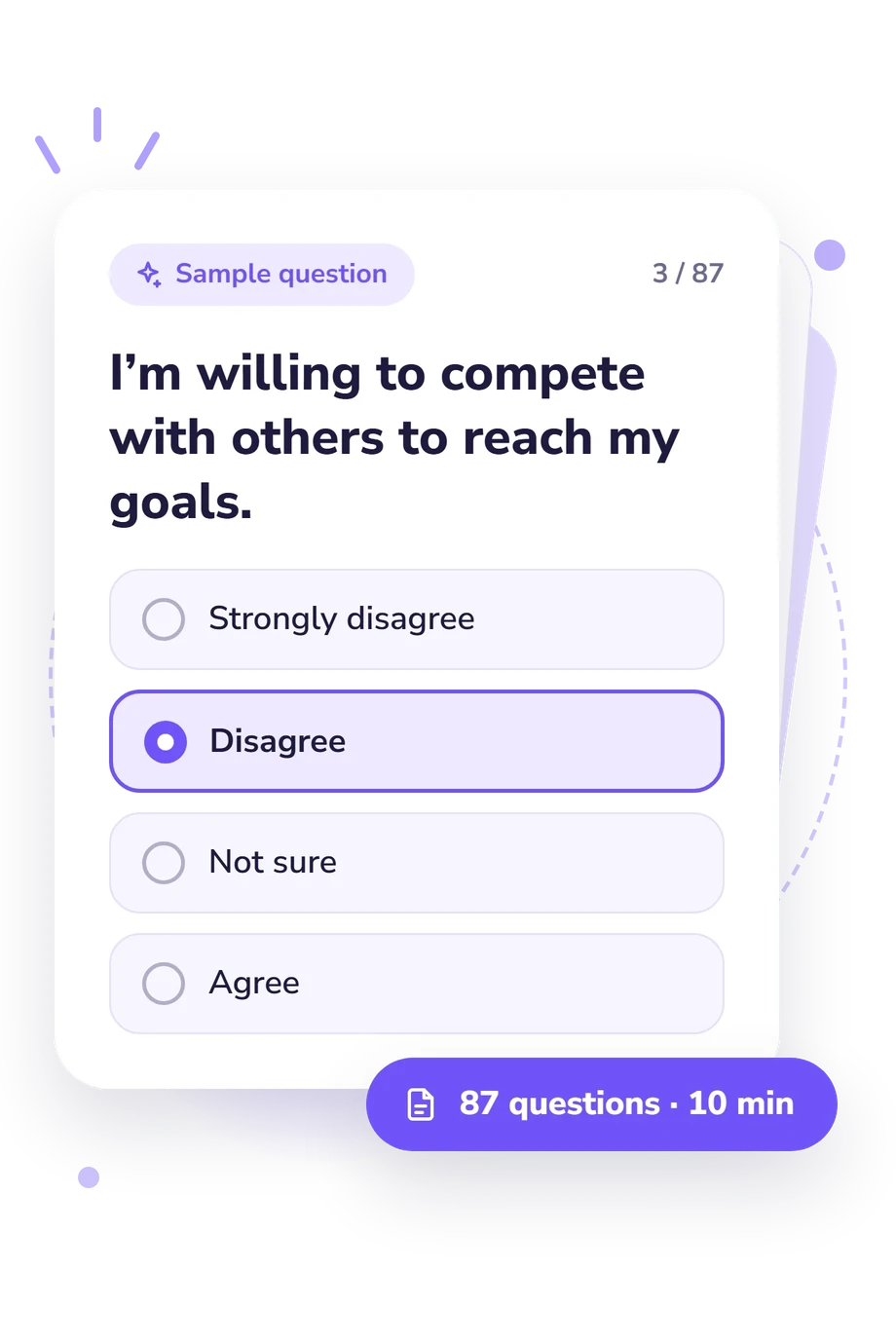
Each statement asks you to rate agreement with a description of behavior or outlook. The sample uses four agreement choices. Some items include Not sure and end with Agree; others omit Not sure and end with Strongly agree. Items address planning, persistence, leadership, disorder, enthusiasm, and expectations.
The report gives each displayed scale a named band. No clinical cutoff or diagnostic rule is established; read the result as a snapshot of tendencies expressed while answering.
Conceptually, chaos items are consistent with the Tolerance for Ambiguity Scale (Herman et al., 2010), which treats comfort with unclear or changing situations as a measurable disposition. Ambition items align with Hirschi and Spurk (2021), who describe ambition as a personal disposition; optimism items relate to dispositional optimism examined by Scheier, Carver, and Bridges (1994). These sources support the constructs, but this questionnaire is not an adaptation of them.
As a SpongeBob character test, this version is an online self-report questionnaire without published norms. Mood, recent experiences, self-awareness, and self-presentation can influence answers, so results are most useful for reflecting on current tendencies.
- Herman, Jeffrey L., Michael J. Stevens, Allan Bird, Mark E. Mendenhall, and Gary Oddou. (2010). The Tolerance for Ambiguity Scale: Towards a more refined measure for international management research. International Journal of Intercultural Relations, 34(1), 58-65. 10.1016/j.ijintrel.2009.09.004
- Hirschi, Andreas, and Daniel Spurk. (2021). Striving for success: Towards a refined understanding and measurement of ambition. Journal of Vocational Behavior, 127, 103577. 10.1016/j.jvb.2021.103577
- Scheier, Michael F., Charles S. Carver, and Michael W. Bridges. (1994). Distinguishing optimism from neuroticism (and trait anxiety, self-mastery, and self-esteem): A reevaluation of the Life Orientation Test. Journal of Personality and Social Psychology, 67(6), 1063-1078. 10.1037/0022-3514.67.6.1063
Updated: