
Southeast Asia Capitals Quiz
How the Scales are Structured
Who Usually Takes This Test?
See How You Compare
Below is a preview of how scores are typically distributed across each scale.
Example Questions From the Test
- Ho Chi Minh City
- Da Nang
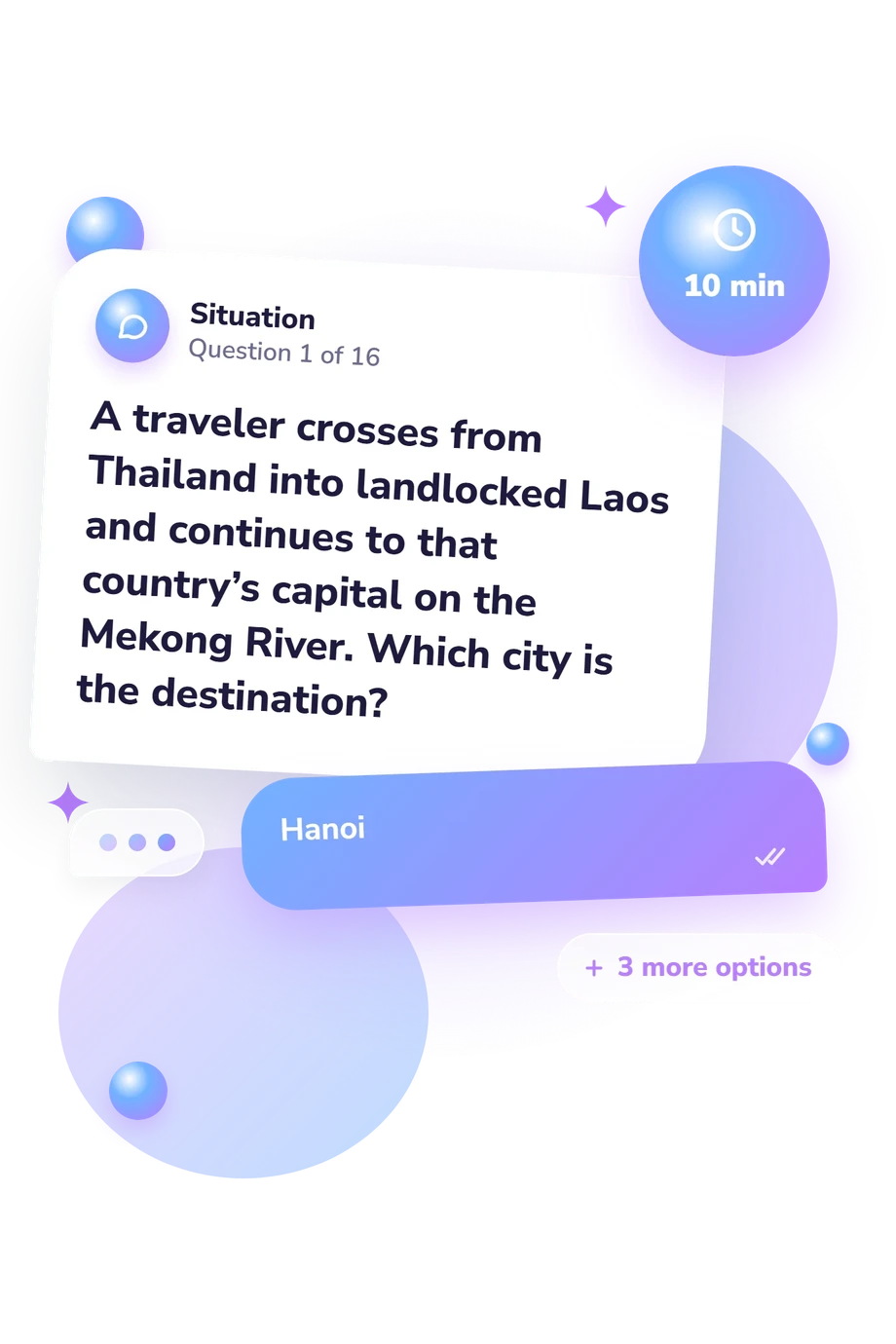
- Hanoi
- Hue
- Cambodia
- Thailand
- Laos
- Vietnam
- Johor Bahru
- Kuala Lumpur
- George Town
- Malacca City
Southeast Asia Capitals Quiz - Description and methodology of the test
Designed for learners, travelers, and anyone refreshing regional geography, this assessment checks whether familiar city names are correctly linked to their countries and positions. The Southeast Asia Capitals Quiz gives readers a focused way to test regional recall. Its capital geography quiz format avoids a broad world-geography sweep, while the result highlights the strength of recall and the geographic distinctions that deserve another look.
What This Assessment Explores
Questions move beyond simple recall. They ask respondents to identify capitals, match cities with countries, distinguish a national capital from a former or administrative center, and follow travel or geographic clues. Together, these tasks test factual retrieval and the ability to keep nearby places and similar city names separate.
As a Southeast Asia capitals geography quiz, it suits learners, travelers, and anyone revising regional knowledge. The result describes performance on the capital-country knowledge sampled here, not a personality profile.
The catalogue reports one scale, Southeast Asia Capitals Knowledge (0-16), with these result bands:
- Foundation to build (0-6) indicates that some capitals are recognized, while neighboring countries or prominent non-capital cities may still cause confusion.
- Developing knowledge (7-12) shows that many key matches are secure, while less familiar capitals need reinforcement.
- Strong command (13-16) reflects accurate identification across routes, geographic clues, and institutional distinctions.
Methodology and Evidence Base
Each item uses four fixed-choice alternatives, with one point for every correct answer. As a Southeast Asia capital quiz, it combines direct recall with comparison, sequencing, route, and institutional-distinction clues, so performance depends on more than recognizing a famous city.
Capital Cities Around the World (Cybriwsky, 2013) supplies reference context for capital status and geographic distinctions. The questionnaire is conceptually consistent with this work, not an adaptation of it.
Crutch and Warrington’s 2003 and 2010 studies provide conceptual context: country and city knowledge can be shaped by geographic proximity and the semantic representation of geographical terms. The neighboring-capital and route items are conceptually consistent with that research, but those studies neither created nor validated this questionnaire.
The resulting bands describe performance on the tested capital items rather than general ability. Education, travel experience, language familiarity, and attention may affect responses; use the outcome to target geography review.
- Cybriwsky, Roman Adrian. Capital Cities around the World: An Encyclopedia of Geography, History, and Culture. Santa Barbara, CA: ABC-CLIO, 2013. ISBN 978-1-61069-247-2.
- Association of Southeast Asian Nations. ASEAN Member States. Jakarta: ASEAN Secretariat, accessed September 24, 2026.
- Crutch, Sebastian J., and Elizabeth K. Warrington. Spatial coding of semantic information: knowledge of country and city names depends on their geographical proximity. Brain 126, no. 8 (2003): 1821-1829. DOI 10.1093/brain/awg187
- Crutch, Sebastian J., and Elizabeth K. Warrington. Spatially coded semantic information about geographical terms. Neuropsychologia 48, no. 7 (2010): 2120-2129. DOI 10.1016/j.neuropsychologia.2010.04.003
Updated: