
Sleep Apnea Quiz
How the Scales are Structured
Who Usually Takes This Test?
See How You Compare
Below is a preview of how scores are typically distributed across each scale.
Example Questions From the Test
- A sudden need for less sleep than usual without fatigue
- Improved concentration after an unusually fragmented night
- A predictable fever that disappears by lunchtime
- Excessive sleepiness or difficulty concentrating
- Long fingers and flexible wrists
- Enlarged tonsils or a recessed lower jaw
- A broad forehead or attached earlobes
- Flat feet or a curved spine
- Bone density, body temperature, and digestive enzyme levels
- Airflow, blood oxygen, heart activity, and breathing effort
- Visual acuity, hearing thresholds, and hand strength
- Blood type, skin sensitivity, and joint flexibility
Sleep Apnea Quiz - Description and methodology of the test
People who want a clear starting point for understanding possible sleep-related breathing problems can use this sleep apnea quiz to check essential knowledge before discussing concerns with a clinician. An online quiz about sleep apnea can be useful when snoring, witnessed pauses, or daytime sleepiness prompt questions. The result identifies topics to review rather than estimating whether a person has the disorder.
What This Assessment Explores
Questions cover recognition, mechanisms, risk factors, evaluation, treatment, and safety. They distinguish obstructive from central sleep apnea and connect snoring, pauses, gasping, daytime sleepiness, anatomy, substances, body size, position, and childhood symptoms with possible breathing disruption. A free quiz about sleep apnea can therefore serve as a structured knowledge check, not a symptom calculator.
The result groups the educational content into these practical areas:
- Breathing patterns and signs explain what nighttime observations and daytime experiences may suggest.
- Risk factors show how anatomy, substances, body size, and sleep position can affect likelihood.
- Evaluation clarifies what home testing and overnight studies measure, including airflow, oxygen, heart activity, and breathing effort.
- Treatment and safety describe CPAP, oral appliances, positional therapy, and steps to take when drowsiness makes driving unsafe.
For readers reviewing a possible concern, the result shows which concepts need review before speaking with a clinician.
Methodology and Evidence Base
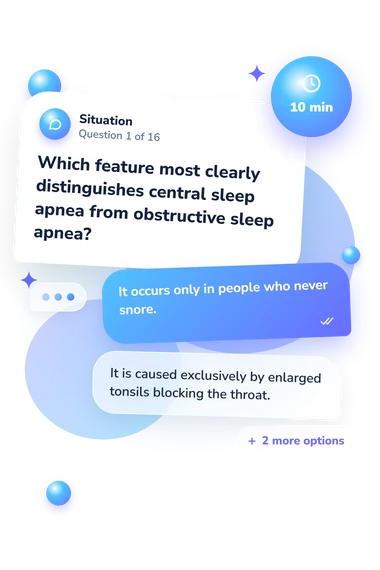
Each item uses a single-best-answer format with four alternatives. Scenarios ask the respondent to distinguish mechanisms, interpret signs, identify appropriate evaluation, or choose safer management. The displayed result is one Sleep Apnea Knowledge scale scored 0-16, with Foundations to build (0-6), Developing understanding (7-12), and Strong understanding (13-16). These bands summarize knowledge only; they are not validated screening, severity, or diagnostic cutoffs.
Conceptually, the questionnaire aligns with the Apnea Knowledge Test (Smith et al., 2004), which assessed knowledge about obstructive sleep apnea and CPAP, but this online version is not a direct adaptation or standardized administration of that instrument. Kapur et al. (2017) supports the distinctions around diagnostic testing, while Patil et al. (2019) supports the CPAP and positive-airway-pressure content.
As a sleep apnea knowledge test, it has no published norms, diagnostic accuracy, or severity categories. Answers can reflect prior exposure, interpretation, guessing, and current concerns. Persistent symptoms, witnessed pauses, gasping, or dangerous daytime sleepiness warrant medical discussion; anyone dangerously drowsy should stop driving as soon as safe.
- Smith S, Lang C, Sullivan K, Warren J. Two new tools for assessing patients' knowledge and beliefs about obstructive sleep apnea and continuous positive airway pressure therapy. Sleep Medicine. 2004;5(4):359-367. 10.1016/j.sleep.2003.12.007
- Kapur VK, Auckley DH, Chowdhuri S, Kuhlmann DC, Mehra R, Ramar K, Harrod CG. Clinical Practice Guideline for Diagnostic Testing for Adult Obstructive Sleep Apnea: An American Academy of Sleep Medicine Clinical Practice Guideline. Journal of Clinical Sleep Medicine. 2017;13(3):479-504. 10.5664/jcsm.6506
- Patil SP, Ayappa IA, Caples SM, Kimoff RJ, Patel SR, Harrod CG. Treatment of Adult Obstructive Sleep Apnea with Positive Airway Pressure: An American Academy of Sleep Medicine Clinical Practice Guideline. Journal of Clinical Sleep Medicine. 2019;15(2):335-343. 10.5664/jcsm.7640