
Should I Get a Male or Female Cat Quiz
How the Scales are Structured
Who Usually Takes This Test?
See How You Compare
Below is a preview of how scores are typically distributed across each scale.
Example Questions From the Test
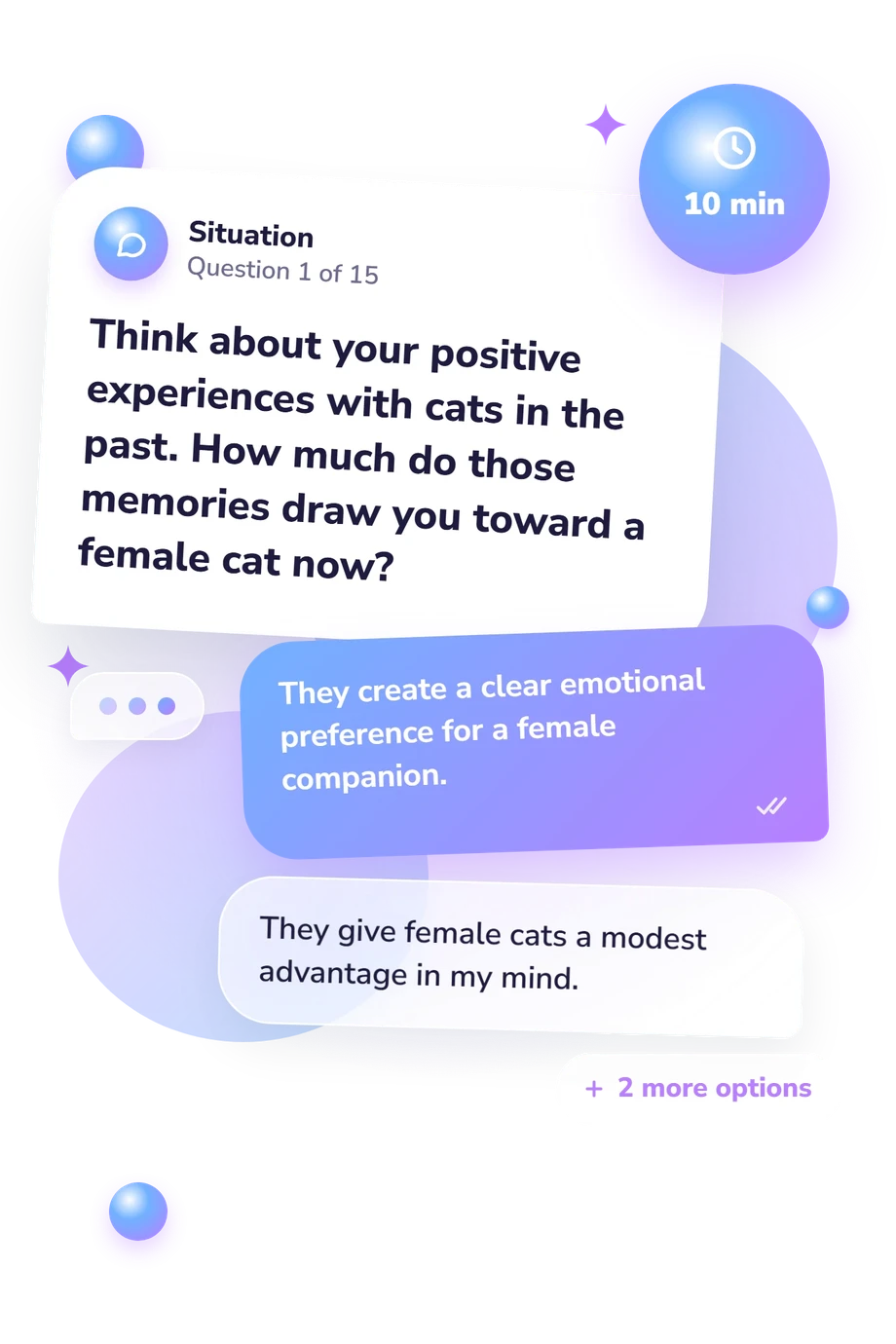
- They create a clear emotional preference for a female companion.
- They give female cats a modest advantage in my mind.
- They influence me a little, but I would not rely heavily on them.
- My memories either favor males or do not draw me toward females.
- I would feel noticeably more drawn to the male cat.
- I would lean slightly toward the male cat, then compare their individual behavior.
- Their sex would barely influence me.
- I would naturally lean toward the female cat.
- A more compact build strongly appeals to me.
- I mildly prefer a smaller cat, so it gives females a slight edge.
- Size matters little enough that this would not create much preference.
- I tend to prefer a larger-built cat, so it points me toward males.
Should I Get a Male or Female Cat Quiz - Description and methodology of the test
Choosing between otherwise suitable cats can be difficult when sex-based expectations compete with observed compatibility. The Should I Get a Male or Female Cat Quiz is intended for prospective adopters who want to clarify that preference before meeting or comparing candidates. It can also help with a male or female cat adoption decision by showing whether sex or individual fit usually carries more weight.
What the Test Measures
The assessment examines how sex preference and individual compatibility shape an adoption choice. Scenarios address memories, size, health, reproductive status, observed behavior, and willingness to revise an initial plan. As a cat adoption quiz, it suits people comparing candidates, not predicting personality from sex.
Its three result dimensions are:
- Female Cat Affinity (0-15) shows how strongly suitable female candidates appeal to you: Open but Unfocused 0-5; Meaningful Lean 6-10; Strong Female Affinity 11-15.
- Male Cat Affinity (0-15) shows how strongly suitable male candidates appeal to you: Open but Unfocused 0-5; Meaningful Lean 6-10; Strong Male Affinity 11-15.
- Temperament-First Affinity (0-15) shows how much individual fit can outweigh sex: Sex-Led Search 0-5; Flexible Comparison 6-10; Individual-Fit Priority 11-15.
Together, the profiles indicate whether sex or compatibility currently carries more weight. They describe preference, not a guarantee about an individual cat.
Methodology and Evidence Base
This male or female cat test presents each adoption situation with four scenario-specific response choices that contrast sex preference, flexibility, practical considerations, and observed compatibility. Scenarios cover equal candidates, size, health or procedure information, observed behavior, and resistance to stereotypes.
Selections produce three displayed profiles. The questionnaire displays each profile on a 0-15 scale; the highest score is the strongest affinity, while scores within one point form a blended result.
Sinn (2016) examines factors influencing cat selection by adopters, making it relevant context for the adoption priorities explored here. Weiss et al. (2012) and Zito et al. (2015) examine adopter priorities and cat-selection factors. Barry and Crowell-Davis (1999) provide context for sex-related behavior patterns in neutered indoor cats, while reminding readers that group tendencies do not describe every individual.
Together, these studies offer conceptual context for the topics, but they do not validate or establish the scoring of this questionnaire. Self-report may reflect current expectations or limited self-knowledge, so compare the result with observation, health history, and practical care requirements.
- Sinn, Leslie. Factors affecting the selection of cats by adopters. Journal of Veterinary Behavior. 2016;14:5-9. 10.1016/j.jveb.2016.06.001
- Weiss, Emily; Miller, Katherine; Mohan-Gibbons, Heather; Vela, Carla. Why Did You Choose This Pet?: Adopters and Pet Selection Preferences in Five Animal Shelters in the United States. Animals. 2012;2(2):144-159. 10.3390/ani2020144
- Zito, Sarah; Paterson, Mandy; Vankan, Dianne; Morton, John; Bennett, Pauleen; Phillips, Clive. Determinants of Cat Choice and Outcomes for Adult Cats and Kittens Adopted from an Australian Animal Shelter. Animals. 2015;5(2):276-314. 10.3390/ani5020276
- Barry, Kimberly J.; Crowell-Davis, Sharon L. Gender differences in the social behavior of the neutered indoor-only domestic cat. Applied Animal Behaviour Science. 1999;64(3):193-211. 10.1016/S0168-1591(99)00030-1
Updated: