
Should I Confess to My Crush Quiz
How the Scales are Structured
Who Usually Takes This Test?
See How You Compare
Below is a preview of how scores are typically distributed across each scale.
Example Questions From the Test
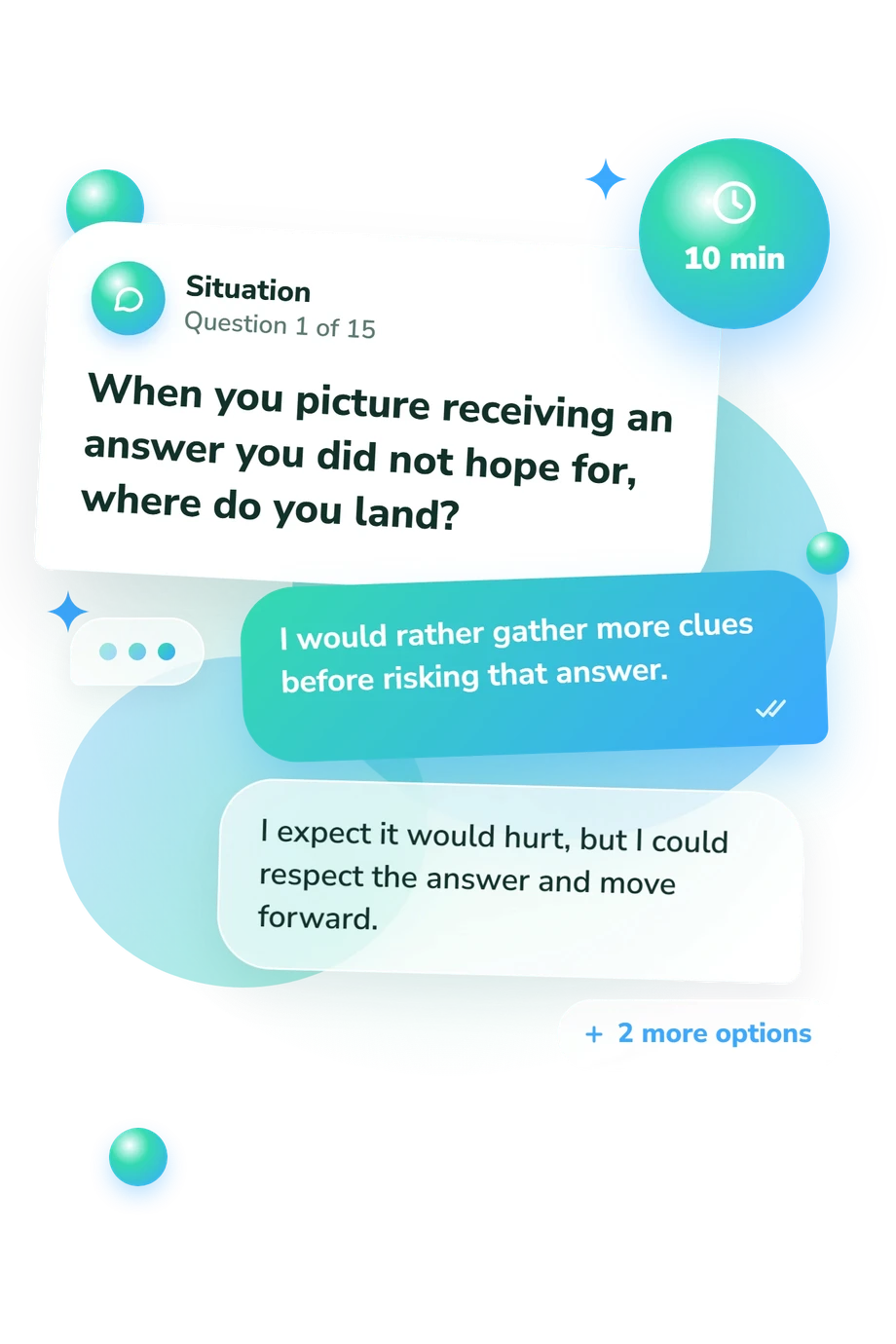
- I would rather gather more clues before risking that answer.
- I expect it would hurt, but I could respect the answer and move forward.
- The possibility feels too disruptive for me to raise it right now.
- I could probably handle it, though I would want time and support afterward.
- Suggest a simple one-on-one activity and notice whether interest feels mutual.
- Continue casual conversations and let familiarity develop gradually.
- Tell them exactly how I feel so the ambiguity ends.
- Step back from interpreting their behavior and invest attention elsewhere.
- Attend and make room for a natural one-on-one conversation.
- Use the gathering as the moment to make a full confession.
- Go, stay friendly, and notice whether they choose to seek me out.
- Decline this time so I can reset my expectations.
Should I Confess to My Crush Quiz - Description and methodology of the test
People deciding whether to reveal romantic feelings can use this assessment to slow an emotionally charged choice and consider what fits their situation. The Should I Confess to My Crush Quiz compares three possible directions: creating more connection, pausing, or sharing openly. A should i tell my crush i like him quiz can help organize reflection when uncertainty, mixed signals, or fear of rejection make the next step unclear.
What This Assessment Explores
When the decision is which action fits your emotional state and the available evidence, a should i tell him i like him quiz can structure reflection. The questions examine tolerance for an unwanted answer, gradual contact, disclosure readiness, and respect for another person's limits. The result shows which direction fits your answers, not the crush's feelings or the outcome.
The displayed scales cover these possible directions:
- Build More Connection First (0-15) indicates whether gradual contact and reciprocity fit; bands: Not the leading fit (0-5), A possible fit (6-10), Strong fit (11-15).
- Pause and Respect the Timing (0-15) indicates whether waiting and boundaries fit; bands: Not a leading fit (0-5), A possible fit (6-10), Strong fit (11-15).
- Share Your Feelings Now (0-15) indicates whether respectful disclosure fits; bands: Not the leading fit (0-5), A possible fit (6-10), Strong fit (11-15).
Methodology and Evidence Base
Each item presents a situation involving mixed signals, disclosure, timing, reciprocity, or emotional strain. Four response options describe different actions, so the respondent selects the response closest to how they would probably handle the situation rather than rating a statement from low to high.
The questionnaire maps selected options onto three displayed scores and their result bands. That scoring organizes a response pattern; it does not provide norms or predict another person's feelings. If the person has declined or set a boundary, that boundary takes priority over any total.
Conceptually, the themes are consistent with the Interpersonal Competence Questionnaire (Buhrmester et al., 1988), particularly handling interpersonal situations and initiating contact. They also connect with the Emotional Self-Disclosure Scale, rejection-sensitivity research by Downey and Feldman (1996), and Altman and Taylor's social penetration theory. This questionnaire is not a standardized adaptation of those instruments.
For someone weighing disclosure, a should i tell him that i like him quiz can organize self-observation. Honest answers and current context matter, and anxiety, new information, or changing boundaries can shift the result.
- Duane Buhrmester, Wyndol Furman, Mitchell T. Wittenberg, and Harry T. Reis. (1988). Five domains of interpersonal competence in peer relationships. Journal of Personality and Social Psychology, 55(6), 991-1008. 10.1037/0022-3514.55.6.991
- William E. Snell, Jr., Rowland S. Miller, and Sharyn S. Belk. (1988). Development of the emotional self-disclosure scale. Sex Roles, 18(1-2), 59-73. 10.1007/BF00288017
- Geraldine Downey and Scott I. Feldman. (1996). Implications of rejection sensitivity for intimate relationships. Journal of Personality and Social Psychology, 70(6), 1327-1343. 10.1037/0022-3514.70.6.1327
- Irwin Altman and Dalmas A. Taylor. (1973). Social penetration: The development of interpersonal relationships. New York: Holt, Rinehart and Winston.
Updated: