
Psychic Test
How the Scales are Structured
Who Usually Takes This Test?
See How You Compare
Below is a preview of how scores are typically distributed across each scale.
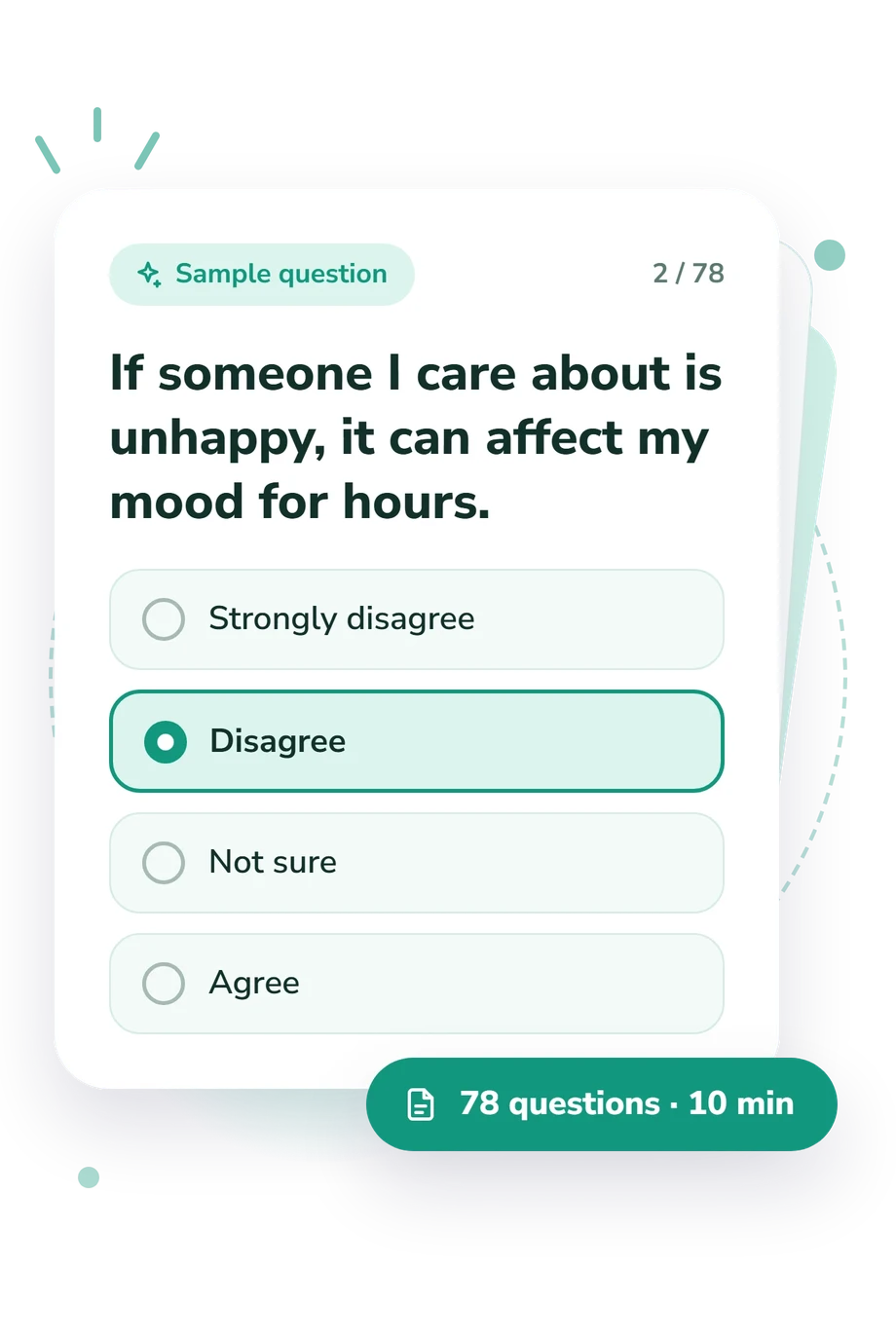
Example Questions From the Test
- Strongly disagree
- Disagree
- Not sure
- Agree
- Strongly disagree
- Disagree
- Not sure
- Agree
- Strongly disagree
- Disagree
- Not sure
- Agree
Psychic Test - Description and methodology of the test
People who are curious about inner signals can use this psychic test to examine how they interpret subtle impressions, dreams, coincidences, and emotional information. It suits readers who want to name and organize their responses to ambiguous social and personal cues. The resulting profile organizes intuition patterns into dimensions that can make those experiences easier to compare and describe.
What This Assessment Explores
The questions treat psychic experiences as patterns of attention and interpretation, not proof of supernatural ability. They ask about dream interpretation, coincidences, emotional and atmospheric cues. The intuition-related items examine how respondents notice gut feelings and subtle signals, while the wider questionnaire organizes these experiences into three dimensions:
- Dream & Synchronicity Awareness (0-30) measures attention to dreams, symbolism, and meaningful coincidences. Low awareness (0-10), Moderate awareness (11-20), and High awareness (21-30) show increasing recall and meaning-making.
- Empathic Attunement (0-30) measures sensitivity to people's emotions and needs. Boundaried (0-10), Balanced attunement (11-20), and Highly attuned (21-30) range from clearer emotional boundaries to stronger emotional absorption.
- Intuitive Sensitivity (0-40) measures reliance on gut feelings and subtle cues, including tone, posture, and atmosphere. Evidence-First (0-13), Balanced Intuitive (14-27), and Highly Sensitive (28-40) describe deliberate versus impression-led interpretation.
Methodology and Scientific Basis
The questionnaire is self-report. The questions represented here use four response options: Strongly disagree, Disagree, Not sure, and Agree. Items cover dream recall, meaningful patterns, emotional cues, and bodily or atmospheric impressions. Responses are grouped by theme into displayed score ranges, but the response-to-score rule is not specified. The bands are descriptive catalogue categories rather than established clinical benchmarks.
For noticing coincidences and assigning meaning, the synchronicity items are conceptually consistent with Russo-Netzer and Icekson's 2023 Synchronicity Awareness and Meaning-Detecting Scale. Interpersonal content offers a relevant conceptual comparison with Davis's multidimensional empathy approach (1983), while the contrast between gut impressions and deliberate evidence can be compared with Pacini and Epstein's rational-experiential processing model (1999). They provide conceptual comparisons, not evidence that this questionnaire is an adaptation or validated version of those instruments.
The result is a profile of subjective sensitivity and meaning-making. Higher results indicate more frequent endorsement of the experiences represented by a dimension; lower results indicate less endorsement or a more evidence-first or boundaried style. Mood, memory, expectations, and self-awareness can influence answers, so the profile is a reflective snapshot.
- Pninit Russo-Netzer and Tamar Icekson. An underexplored pathway to life satisfaction: The development and validation of the synchronicity awareness and meaning-detecting scale. Frontiers in Psychology, 13, 1053296 (2023). 10.3389/fpsyg.2022.1053296
- Mark H. Davis. Measuring individual differences in empathy: Evidence for a multidimensional approach. Journal of Personality and Social Psychology, 44(1), 113-126 (1983). 10.1037/0022-3514.44.1.113
- R. Pacini and S. Epstein. The relation of rational and experiential information processing styles to personality, basic beliefs, and the ratio-bias phenomenon. Journal of Personality and Social Psychology, 76(6), 972-987 (1999). 10.1037/0022-3514.76.6.972
Updated: