
Property and Casualty Quiz
How the Scales are Structured
Who Usually Takes This Test?
See How You Compare
Below is a preview of how scores are typically distributed across each scale.
Example Questions From the Test
- An employee’s allegation of wrongful termination
- A customer’s bodily injury caused by a business
- Fire damage to an insured commercial building
- A driver’s legal responsibility for another person’s injuries
- Duty, breach, causation, and damages
- Ownership, possession, insurance, and damages
- Offer, acceptance, consideration, and capacity
- Intent, concealment, reliance, and rescission
- $100,000 for property damage and $300,000 for bodily injury
- $100,000 deductible and $300,000 policy limit
- $100,000 per injured person and $300,000 total per accident
- $100,000 per accident and $300,000 per policy year
Property and Casualty Quiz - Description and methodology of the test
People who want to check their grasp of everyday insurance concepts can use the property and casualty quiz as a focused learning review. It is intended for students, new professionals, and curious policyholders who want to see which foundations feel secure and which need revision. This property and casualty insurance quiz highlights strengths and identifies the insurance concepts that need further review.
What This Assessment Measures
Questions cover foundational property, liability, and personal auto insurance knowledge. They test loss classification, coverage response, and policy provisions. The result identifies which insurance concepts deserve further review. The questions can also support property and casualty exam practice by reinforcing core terms and decisions.
These groups shape the result:
- Coverage structure explains how perils, hazards, endorsements, deductibles, coinsurance, and insurable interest affect protection.
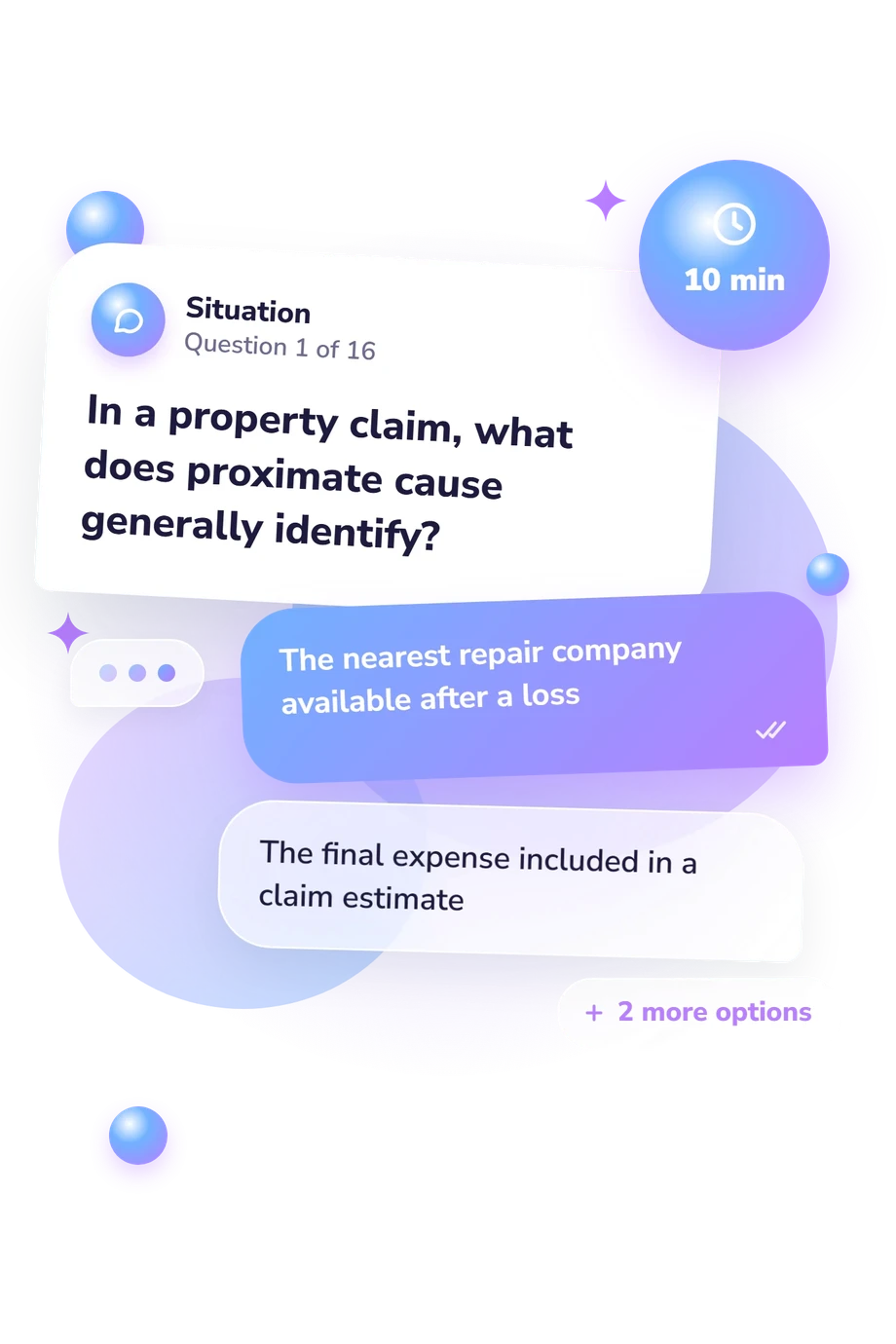
- Claims handling shows whether you recognize notice, mitigation, documentation, proximate cause, and subrogation.
- Liability concepts measure understanding of negligence, bodily injury, property damage, and responsibility limits.
- Auto and property applications test whether you match common losses with the coverage designed to respond.
- Property and Casualty Knowledge reports 0-16: Foundation to build (0-6) means core ideas need review; Developing knowledge (7-12) reflects many essentials with gaps; Strong knowledge (13-16) indicates command of foundational concepts.
Methodology and Evidence Base
Each item presents a short insurance scenario or definition with four answer choices and one best response. The set moves between recall, distinctions, application, and basic arithmetic, including actual cash value, deductibles, liability limits, and coverage selection. The displayed result reports performance across this educational set and helps you identify missed concepts for targeted review.
The questionnaire is conceptually consistent with the insurance-literacy survey by Sharon Tennyson. The terminology and general principles also correspond with Rejda, McNamara, and Rabel, while the NAIC glossary supports distinctions among peril, hazard, endorsement, subrogation, and insurable interest. It uses terminology found in these references, but should not be presented as an adaptation of those works unless that relationship is verified.
Its value as a property and casualty knowledge test lies in reviewing missed concepts against applicable policy wording and local rules. Performance may shift with recent study, terminology familiarity, guessing, and current context, while laws and policy forms vary by jurisdiction and insurer. The displayed bands are educational and do not establish licensing readiness.
- Tennyson, Sharon. Consumers' insurance literacy: evidence from survey data. Financial Services Review, 20(3), 165-179, 2011. 10.61190/fsr.v20i3.4701.
- Rejda, George E., Michael J. McNamara, and William H. Rabel. Principles of Risk Management and Insurance. 14th ed. Pearson, 2020. ISBN 9780135180860.
- National Association of Insurance Commissioners. Glossary of Insurance Terms. NAIC, n.d.
Updated: