
Prepositional Phrase Quiz
How the Scales are Structured
Who Usually Takes This Test?
See How You Compare
Below is a preview of how scores are typically distributed across each scale.
Example Questions From the Test
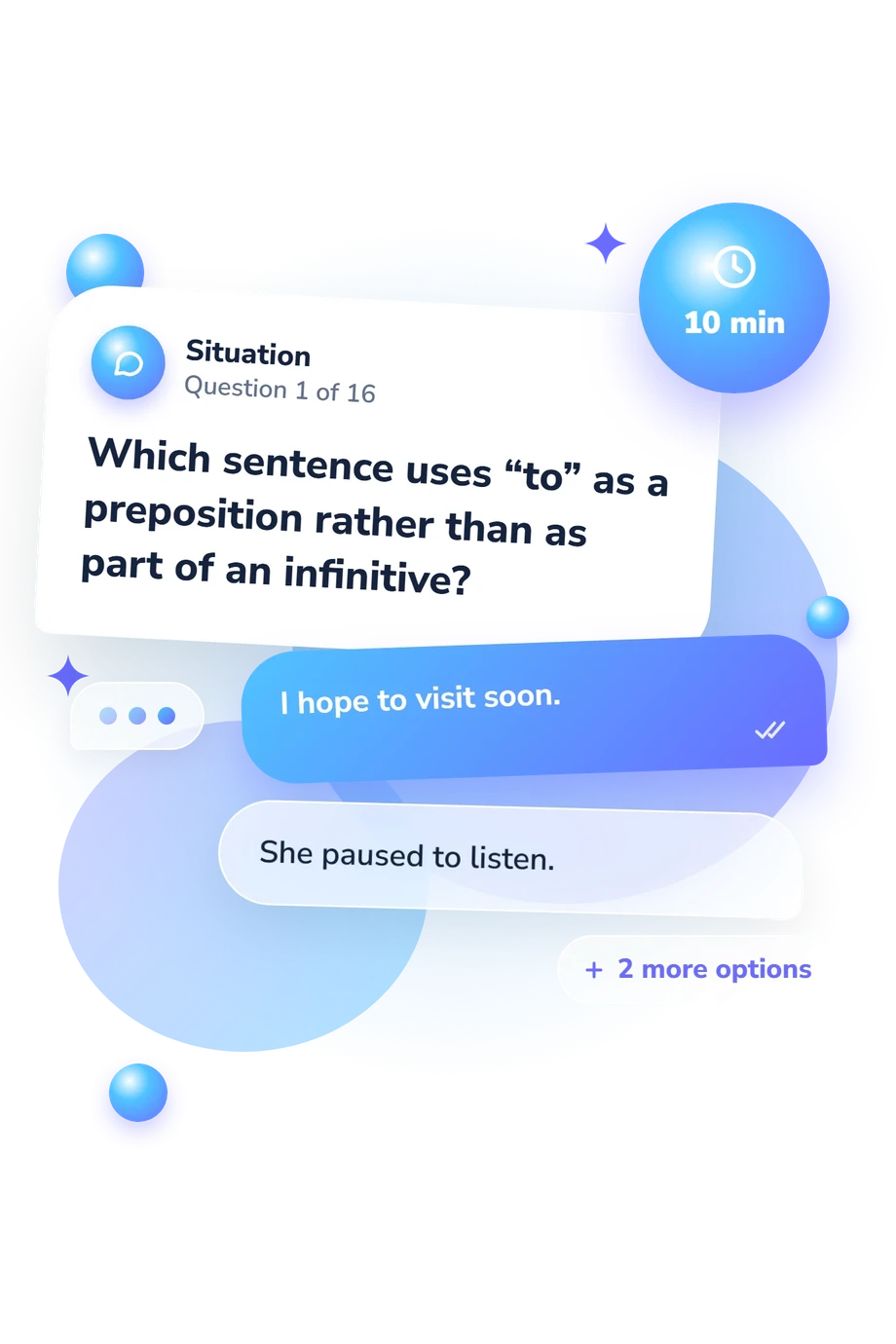
- I hope to visit soon.
- She paused to listen.
- They drove to the coast.
- We agreed to wait.
- He answered “with patience.”
- We met “after class.”
- The book “on the desk” belongs to Kim.
- They stayed “until noon.”
- Nora, on paper plates, served sandwiches to the guests.
- Nora served on paper plates the guests sandwiches.
- Nora served sandwiches on paper plates to the guests.
- On the guests, Nora served sandwiches with paper plates.
Prepositional Phrase Quiz - Description and methodology of the test
For learners checking their command of sentence structure, the prepositional phrase quiz offers a focused way to examine how they identify, interpret, and place these units in context. Learners can use this prep phrases quiz to spot whether errors arise from recognizing the phrase itself, locating its object, or understanding the word or clause it modifies. The emphasis is practical grammar awareness.
What This Assessment Explores
These questions examine how prepositional phrases work in sentences. They ask you to locate the complete phrase and its object, identify what it modifies, and distinguish a preposition from a look-alike structure. The result describes practical grammar performance, not general English ability. The result from this prepositional phrase online quiz makes the outcome useful for targeted review.
The tested abilities fall into three practical areas:
- Phrase boundaries and objects show whether you can locate the complete unit and its governed noun.
- Grammatical function shows whether a phrase describes a noun or adds place, time, manner, or direction.
- Attachment and context show whether you can connect modifiers correctly and distinguish prepositions from look-alike structures.
The displayed scale is Prepositional Phrase Knowledge: 0-16. Foundations to strengthen (0-6) calls for review of phrase formation and function; Developing command (7-12) shows partial control; Strong command (13-16) indicates consistent identification, interpretation, and placement.
Methodology and Evidence Base
Each item uses selected response: a sentence or context is followed by four choices. The tasks ask you to identify, count, complete, or revise phrases; locate an object; recognize noun, adverbial, or manner functions; and resolve attachment. This variety samples several kinds of grammar decision.
The result is read through the displayed scale and its descriptive bands. It describes performance on these tasks, including phrase boundaries, objects, functions, attachment, and ambiguity, and can guide practice in those areas.
Conceptually, the distinctions align with Huddleston and Pullum (2002), especially their treatment of complements, modification, phrase structure, and ambiguity. Huddleston, Pullum, and Reynolds (2022) support the accessible terminology, but these works are reference frameworks, not evidence that this questionnaire is an adaptation or validated version of either source.
That distinction matters here because this test is a preposition and prepositional phrases quiz about how these forms function. Attention, interpretation, and current learning context may affect responses, so use the band to choose what to practise rather than as a diagnosis of overall language ability.
- Huddleston, Rodney, and Geoffrey K. Pullum. The Cambridge Grammar of the English Language. Cambridge University Press, 2002. 10.1017/9781316423530
- Huddleston, Rodney, Geoffrey K. Pullum, and Brett Reynolds. A Student's Introduction to English Grammar. 2nd ed. Cambridge University Press, 2022. 10.1017/9781009085748
Updated: