
Plural Nouns Quiz
How the Scales are Structured
Who Usually Takes This Test?
See How You Compare
Below is a preview of how scores are typically distributed across each scale.
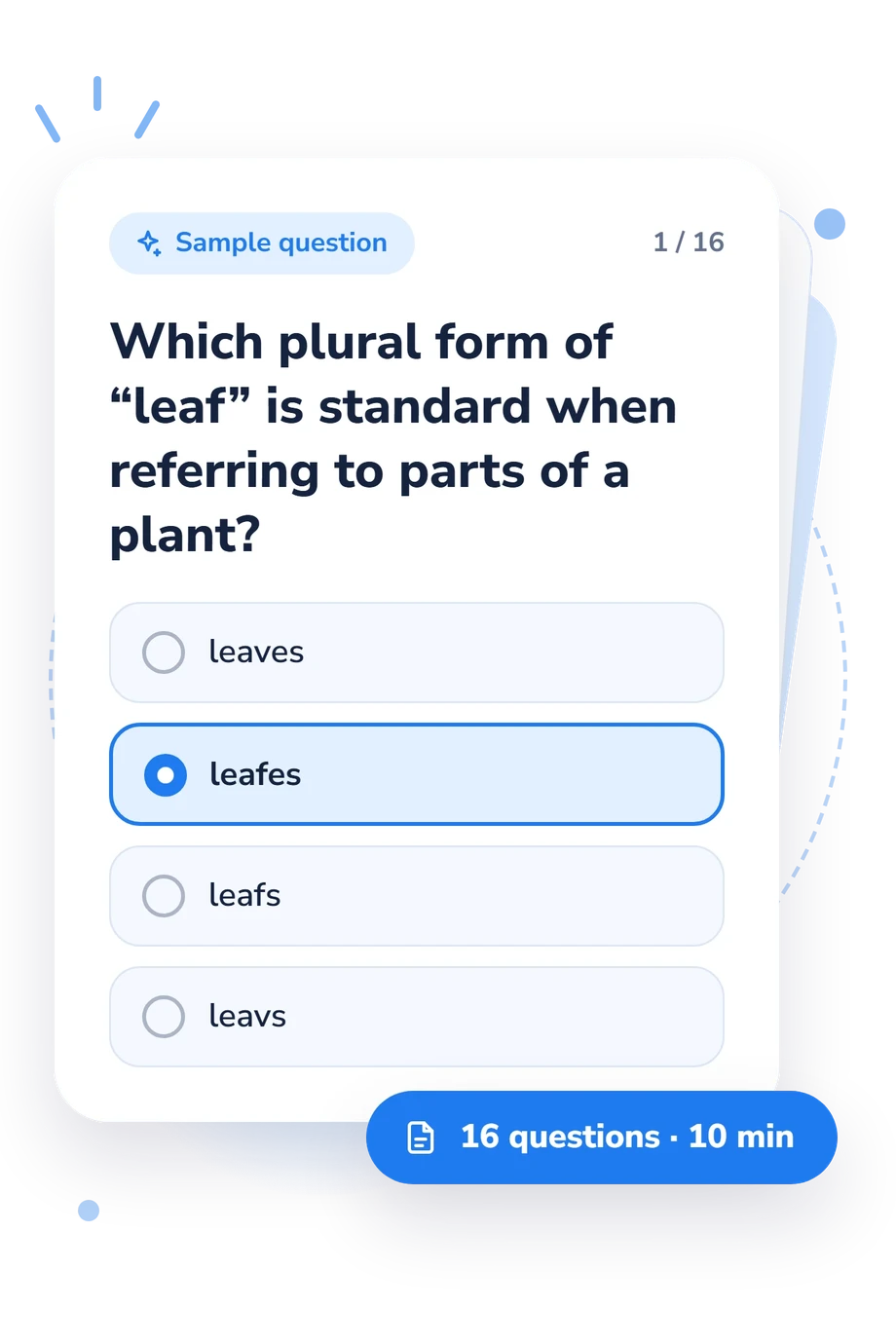
Example Questions From the Test
- leaves
- leafes
- leafs
- leavs
- caties
- cates
- cat
- cats
- passerbys
- passerbies
- passersbys
- passersby
Plural Nouns Quiz - Description and methodology of the test
Readers who want to strengthen English spelling and usage can use this plural nouns quiz to examine decisions about endings, exceptions, possession, and context. The exercise is useful for learners, teachers, and anyone revising everyday grammar because it focuses attention on forms that are easy to confuse. Taken as a focused check, this English plural quiz presents practical choices across common and less familiar words.
What This Assessment Measures
Questions range from familiar endings to forms shaped by convention, context, or word history. By contrasting those cases, this plural form of nouns quiz tests movement between singular and plural forms, asking a learner to distinguish ordinary endings from exceptions.
The question themes include:
- Regular spelling patterns are applied to forms such as boxes, tomatoes, and cities.
- Irregular plurals are recognized when a word changes substantially, as with child, goose, or phenomenon.
- Unchanged and less predictable forms are handled when deer stays the same and roof becomes roofs.
- Compound and classical forms are interpreted accurately in mother-in-law, passerby, analysis, and criterion.
The displayed scale is Plural Nouns Knowledge (0-16). Its bands describe Foundations to Review (0-6), Developing Command (7-12), and Strong Command (13-16), indicating how consistently the tested forms are applied.
Methodology and Evidence Base
Each item presents a word or sentence context followed by four answer choices. Each item asks the respondent to select or identify the standard plural form, spelling rule, or usage option in context, and one point is awarded for each correct answer, producing the total shown above. For learners practising English plural forms, this singular and plural noun quiz tests both recognition and application: some prompts ask for a form directly, while others require it to fit a sentence or express a plural without possession.
As an online educational check, the questionnaire uses no named diagnostic scale. Huddleston and Pullum describe standard inflection and usage; Bauer, Lieber, and Plag describe regular, irregular, compound, and borrowed formations in English morphology. The questionnaire is conceptually consistent with these grammatical descriptions and is not an adaptation of either work.
Results reflect performance on selected examples at the time of completion. The categories are descriptive, not population norms, and vocabulary familiarity or attention to context can affect the outcome. Use the profile to target review rather than infer complete mastery of English morphology.
- Huddleston, Rodney, and Geoffrey K. Pullum. The Cambridge Grammar of the English Language. Cambridge University Press, 2002. 10.1017/9781316423530.
- Bauer, Laurie, Rochelle Lieber, and Ingo Plag. The Oxford Reference Guide to English Morphology. Oxford University Press, 2013. 10.1093/acprof:oso/9780198747062.001.0001.
Updated: