
Pirate Quiz
How the Scales are Structured
Who Usually Takes This Test?
See How You Compare
Below is a preview of how scores are typically distributed across each scale.
Example Questions From the Test
- Pressing
- Sounding
- Warping
- Careening
- Edward Teach, known as Blackbeard
- John Rackham, known as Calico Jack
- William Kidd, known as Captain Kidd
- Bartholomew Roberts, known as Black Bart
- To request formal entry into the nearest harbor
- To intimidate the crew into surrendering without a costly fight
- To prove that their cargo had passed a customs inspection
- To indicate that disease made boarding impossible
Pirate Quiz - Description and methodology of the test
For readers who enjoy maritime history, the Pirate Quiz offers a focused way to check factual knowledge rather than personality or identity. Its multiple-choice questions make this a quiz on historical piracy for learners, history fans, and anyone curious about how people, places, practices, and institutions fit together. The result places performance in a broad knowledge band and points to historical subjects worth exploring further.
What This Assessment Explores
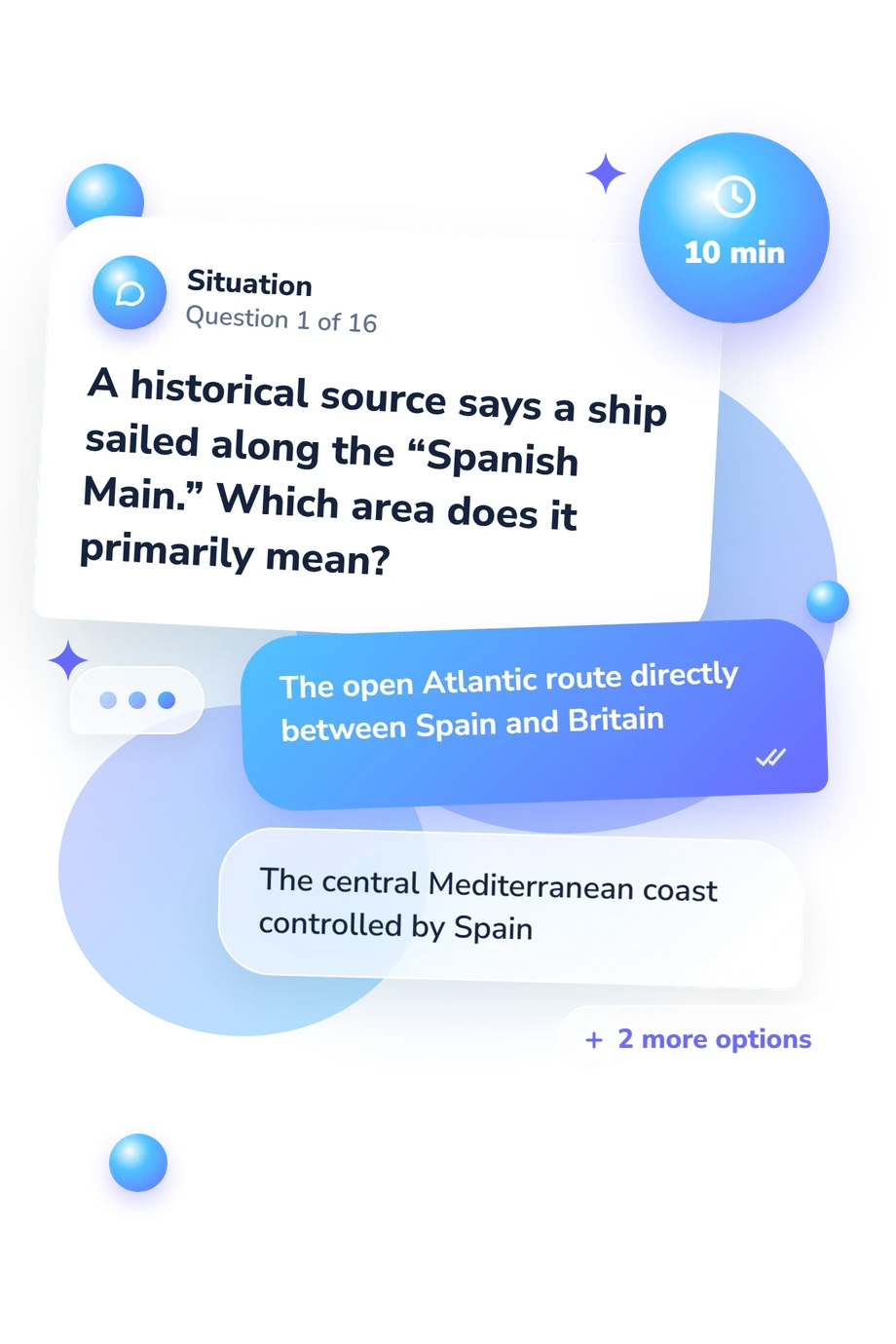
The score is the total number of correct answers to the 16 historical items; the displayed Pirate History Knowledge scale runs from 0 to 16. The questions cover ships, law, crews, geography, and maritime context, including the Spanish Main, seamanship, notable crews, shipboard roles, prizes, privateering, courts, trade routes, and the decline of Atlantic piracy.
This pirate history quiz therefore summarizes demonstrated performance across the covered material rather than a separate ability or personality trait.
The result is divided into these performance bands:
- Beginning Explorer (0-6) indicates familiar themes alongside important gaps in ships, law, crews, and geography.
- Capable Navigator (7-12) shows solid working knowledge with some details left to strengthen.
- Maritime Historian (13-16) reflects strong, wide-ranging command of historical piracy and its maritime setting.
This profile suits general readers and learners; it describes performance on the tested material, not personality, character, or sailing ability.
Methodology and Evidence Base
Each item presents a historical scenario or fact with four answer choices. Selecting the best answer produces a count of correct responses, not an agreement or self-rating score. Taken together, the items form a structured knowledge assessment: this pirate trivia quiz tests recall across connected topics rather than personality.
The content is conceptually consistent with Wilson’s study of early-eighteenth-century piracy, which examines piracy through maritime commerce, imperial authority, enforcement, and changing opportunities for raiders. Johnson’s period account supplies descriptions of pirates, crews, vessels, and customs. Leeson and Rogers’ analysis provides a useful framework for shipboard rules, incentives, compensation, and internal organization as coordinated collective behavior. These sources support the subject matter and context; they do not make this online questionnaire an adaptation of a published instrument.
Correct answers contribute to the displayed total, which is matched to the three descriptive bands. Those bands describe performance on these questions rather than population norms; results can also reflect prior reading, cultural familiarity, guessing, and item wording. Use the result to identify knowledge strengths and topics for further study.
- Wilson, David. Suppressing Piracy in the Early Eighteenth Century: Pirates, Merchants and British Imperial Authority in the Atlantic and Indian Oceans. Woodbridge: Boydell Press, 2021. 10.2307/j.ctv1850j4g.
- Leeson, Peter T., and Douglas Bruce Rogers. “Organizing Crime.” Supreme Court Economic Review 20, no. 1 (2012): 89-123. 10.1086/668520.
- Johnson, Charles. A General History of the Pyrates, from Their First Rise and Settlement in the Island of Providence, to the Present Time. 2nd ed. London: T. Warner, 1724.
Updated: