
Organic Chemistry Quiz
How the Scales are Structured
Who Usually Takes This Test?
See How You Compare
Below is a preview of how scores are typically distributed across each scale.
Example Questions From the Test
- The cyclopropenyl anion, with four π electrons
- Cyclobutadiene, with four π electrons
- Planar cyclooctatetraene, with eight π electrons
- The cyclopentadienyl anion, with six π electrons
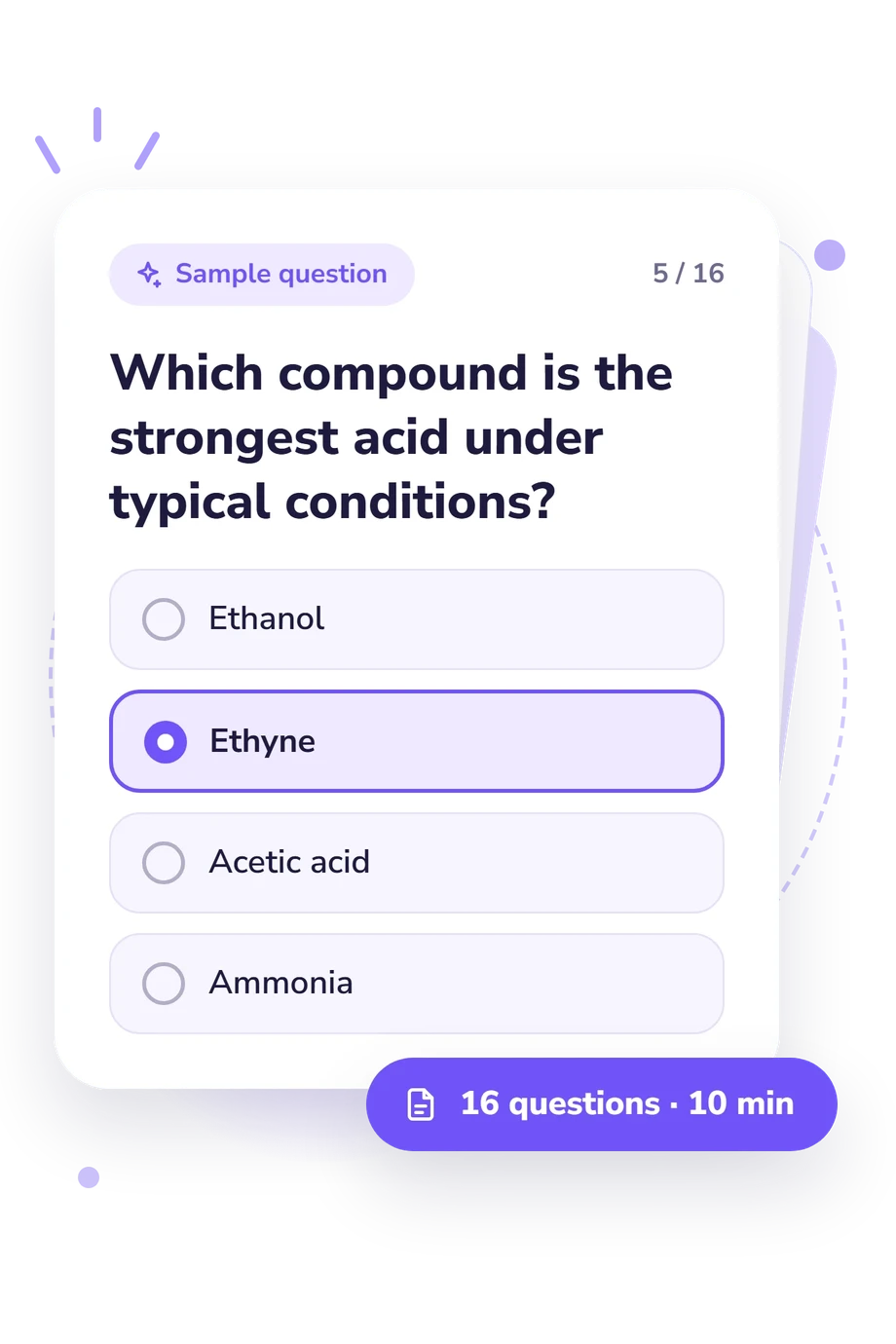
- Ethanol
- Ethyne
- Acetic acid
- Ammonia
- Ethanal and methanol
- Ethene and ethanoic acid
- Ethanol and ethanal
- Ethanol and ethanoic acid
Organic Chemistry Quiz - Description and methodology of the test
Students reviewing core organic chemistry and instructors seeking a quick topic check can use this organic chemistry quiz to see how well fundamental ideas work together. It is intended for learners who want focused feedback before further study, not for assigning a course grade. Taken as an online quiz in organic chemistry, it offers a compact snapshot of strengths and revision priorities after a unit or before an exam.
What This Assessment Explores
Rather than isolating one chapter, the assessment samples connected concepts in introductory organic reasoning. The questions ask respondents to identify structures, predict transformations, interpret basic spectra, compare acidity and basicity, and recognize stereochemical relationships. For learners applying definitions to short problem-solving decisions, an organic chemistry practice quiz can reveal where recall transfers successfully to a new example.
The main thematic groups are:
- Structure and bonding examines aromaticity, hybridization, resonance, and functional groups.
- Reactions and mechanisms tests oxidation, hydrolysis, addition, substitution, and elimination.
- Spectroscopy and identification connects infrared or proton NMR observations with structures.
- Acidity and stereochemistry distinguishes proton stability, chirality, and mirror-image relationships.
The result is one educational scale, Organic Chemistry Knowledge, 0-16: Foundations to build (0-6), Developing knowledge (7-12), and Strong knowledge (13-16). These bands point to review priorities rather than a course grade or formal academic judgment.
Methodology and Scientific Basis
Each item is a four-choice prompt asking for the option that best fits a chemical principle or outcome. With four choices per item, the organic chem quiz checks recognition and application, not intelligence or laboratory skill. It asks for the best-supported option, so distractors show which principle needs review. The format is a quiz on organic chemistry with answers to choose from, not an open-ended exercise.
The score summarizes performance across answered items through the displayed scale. Lower results suggest rebuilding foundations, middle results point to targeted review, and higher results indicate stronger command of sampled concepts. No norm-referenced standardization or course-specific grading scale is implied.
Its content is conceptually consistent with FC-ORMI (Nedungadi et al., 2021) and the ACS Exams Institute organic chemistry content map described by Raker, Holme, and Murphy (2013). It is not an adaptation or validation of either instrument. Towns (2014) stresses alignment among stems, distractors, and intended knowledge.
Preparation, attention, guessing, and topic familiarity can affect performance. Use the result to choose revision targets, then check understanding with worked problems or broader assessment.
- Nedungadi, Sachin, Michael D. Mosher, Sue Hyeon Paek, Richard M. Hyslop, and Corina E. Brown. “Development and psychometric analysis of an inventory of fundamental concepts for understanding organic reaction mechanisms.” Chemistry Teacher International 3, no. 4 (2021): 377-390. 10.1515/cti-2021-0009
- Raker, Jeffrey, Thomas A. Holme, and Kristen L. Murphy. “The ACS Exams Institute Undergraduate Chemistry Anchoring Concepts Content Map II: Organic Chemistry.” Journal of Chemical Education 90, no. 11 (2013): 1443-1445. 10.1021/ed400175w
- Raker, Jeffrey R., and Thomas A. Holme. “A Historical Analysis of the Curriculum of Organic Chemistry Using ACS Exams as Artifacts.” Journal of Chemical Education 90, no. 11 (2013): 1437-1442. 10.1021/ed400327b
- Towns, Marcy H. “Guide To Developing High-Quality, Reliable, and Valid Multiple-Choice Assessments.” Journal of Chemical Education 91, no. 9 (2014): 1426-1431. 10.1021/ed500076x
Updated: