
Modals Quiz
How the Scales are Structured
Who Usually Takes This Test?
See How You Compare
Below is a preview of how scores are typically distributed across each scale.
Example Questions From the Test
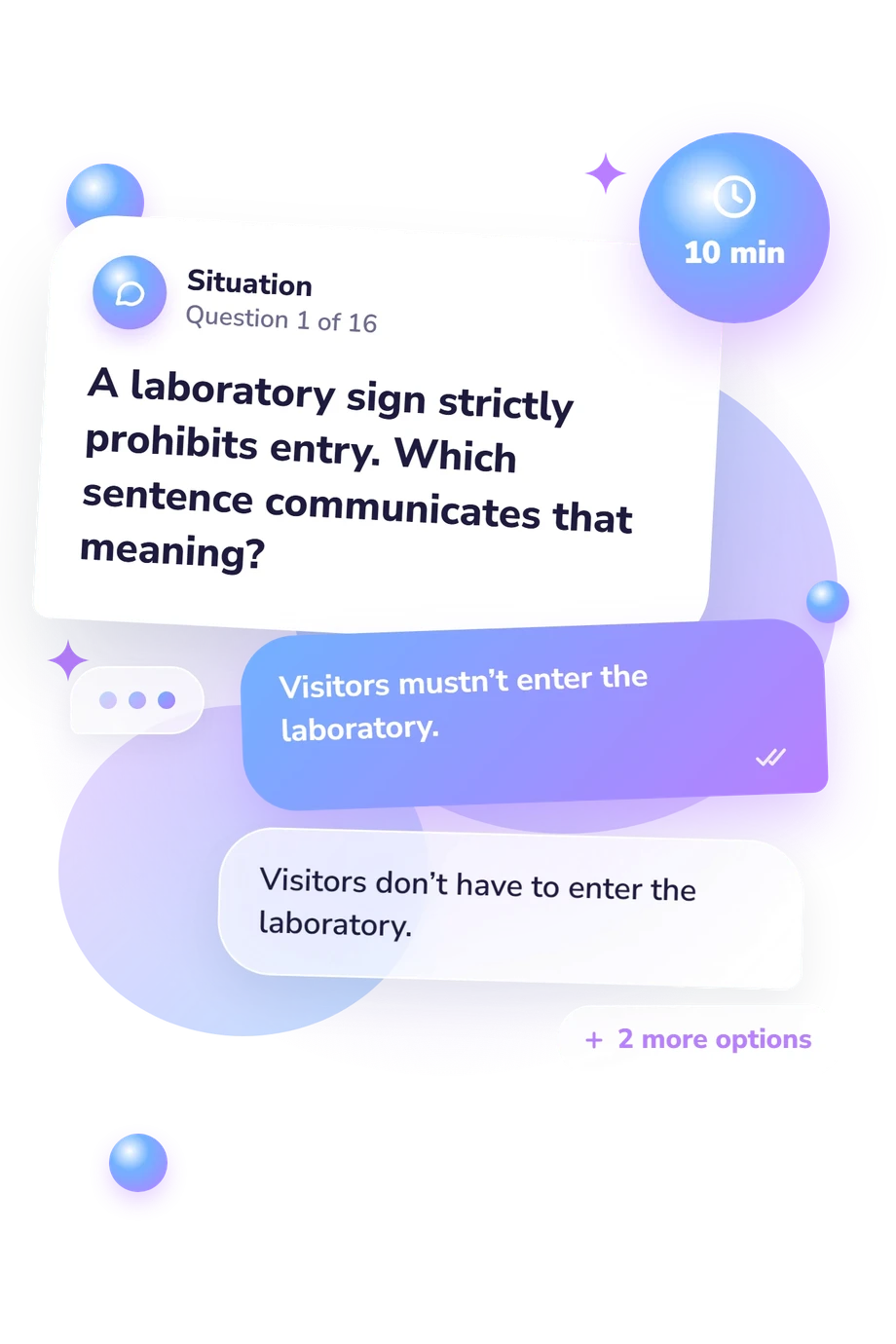
- Visitors mustn’t enter the laboratory.
- Visitors don’t have to enter the laboratory.
- Visitors couldn’t enter the laboratory.
- Visitors might not enter the laboratory.
- The manager said we had to leave early that day.
- The manager said we could leave early that day.
- The manager said we should leave early that day.
- The manager said we must leave early that day.
- should to
- ought to
- ought
- must to
Modals Quiz - Description and methodology of the test
Students and independent learners can use this assessment to connect grammar with situations and identify where modal meanings cause uncertainty. The modals quiz suits people reviewing English grammar who want a focused picture of their modal command. Questions in the modal auxiliary verbs quiz test how grammar choices work in context. Its result shows the learner’s overall level of modal knowledge and points to areas for targeted revision.
What This Assessment Measures
At its core, the assessment checks whether a learner can match modal forms with meanings required by context. This assessment is an English modal verbs test that focuses on obligation, advice, permission, uncertainty, ability, and deduction-not overall English ability.
The items sample four practical areas, while the displayed result provides one overall level of modal knowledge:
- Obligation and necessity show whether requirements and recommendations are distinguished.
- Permission and prohibition show whether approval and restriction are expressed correctly.
- Ability and form show whether past or future ability patterns are recognized.
- Possibility and deduction show whether uncertainty and evidence-based conclusions are interpreted accurately.
The displayed scale is Modals Knowledge (0-16): Foundations to Review, 0-6; Developing Command, 7-12; and Strong Command, 13-16. These bands indicate the level of command shown by the selected answers and suggest where review may help.
Methodology and Evidence Base
Each item presents a short context, a sentence or completion, and four answer choices. The learner selects the option that best matches the intended meaning and grammatical pattern. Items cover bare verbs after modals, have to, be able to, modal perfects, negatives, requests, and deductions. This questionnaire, presented as a modal grammar quiz, can reveal which contrasts merit review through its item pattern.
The questionnaire does not specify how many points an individual answer contributes. The displayed bands provide descriptive interpretation of the learner’s level rather than documented norm-referenced meaning.
The question themes are conceptually consistent with the modal-form and meaning issues discussed in Li (2022), but this questionnaire is not an adaptation of that work. Larsen-Freeman and colleagues frame grammar through form, meaning, and use; Huddleston and Pullum and Palmer clarify modality.
Attention, context, and prior instruction can affect performance, so the result is a focused snapshot rather than a certificate of general proficiency.
- Li, Lexi Xiaoduo. "Improving Modal Verb Treatment in English Textbooks Used by Chinese Learners: A Corpus-Based Approach." SAGE Open 12, no. 1 (2022): 1-16. 10.1177/21582440221079918
- Larsen-Freeman, Diane, Marianne Celce-Murcia, Jan Frodesen, Benjamin White, and Howard Alan Williams. The Grammar Book: Form, Meaning, and Use for English Language Teachers. 3rd ed. Boston: National Geographic Learning, 2016.
- Huddleston, Rodney, and Geoffrey K. Pullum. The Cambridge Grammar of the English Language. Cambridge: Cambridge University Press, 2002. 10.1017/9781316423530
- Palmer, Frank R. Mood and Modality. 2nd ed. Cambridge: Cambridge University Press, 2001.
Updated: