
Light Quiz
How the Scales are Structured
Who Usually Takes This Test?
See How You Compare
Below is a preview of how scores are typically distributed across each scale.
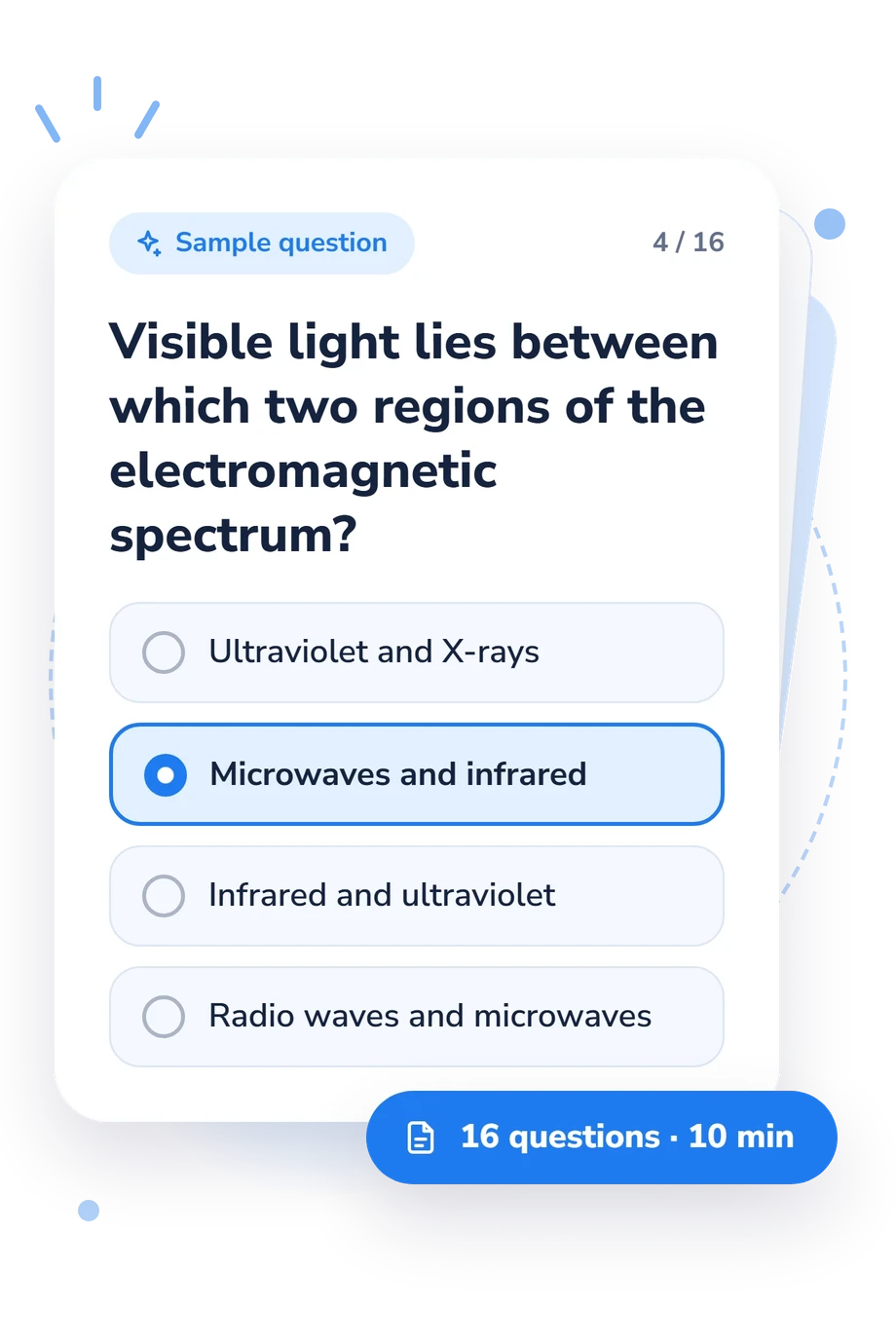
Example Questions From the Test
- Very dark or nearly black
- Bright green
- White
- Bright blue
- Ultraviolet and X-rays
- Microwaves and infrared
- Infrared and ultraviolet
- Radio waves and microwaves
- Its speed
- Its direction in every case
- Its wavelength
- Its frequency
Light Quiz - Description and methodology of the test
For learners, curious adults, and anyone revisiting introductory physics, this assessment provides a focused way to connect familiar optical effects with the principles behind them. The light quiz can help you identify secure knowledge before studying a lesson or revisiting an everyday example. Its result offers a broad view of your performance across foundational light concepts and a starting point for reviewing the questions. This science quiz about light links classroom ideas with observable situations.
What This Assessment Explores
The questionnaire checks understanding of how light passes through materials, changes direction, forms images, and combines into colors. It suits learners and adults reviewing introductory optics. This optics knowledge quiz gives an overall indication of performance across those concepts.
The questions address short situations and direct concepts. They cover:
- Materials and transmission show how well you connect transparency with light passage and shadow darkness.
- Spectrum and color show whether you can explain visible light, colored illumination, mixing, and dispersion.
- Images and shadows show whether you understand reflection, refraction, lenses, mirrors, eclipses, and image geometry.
Together, these responses form Light Knowledge, scored from 0-16 as the number of correct answers. Foundations to build (0-6) marks core ideas to review; Developing knowledge (7-12) indicates many essentials with room to practise; Strong knowledge (13-16) indicates a consistent grasp of foundational concepts and applications.
Methodology and Scientific Basis
Each item presents a short question or situation with four answer choices and asks for the best answer. The score is a straightforward count of correct answers; no separate weighting rule is applied.
The closest published comparison is Light Phenomena Conceptual Assessment, a measure of conceptual understanding in light phenomena. This questionnaire is conceptually consistent with that instrument, but it is not the published instrument and does not inherit its calibration or validation evidence.
A later analysis of the same assessment examined it with complementary psychometric models. The analysis underscores the importance of item difficulty and response patterns when evaluating a light-phenomenon measure, but does not establish reliability estimates, standardized norms, or external cutoffs for this online version. As a light concepts quiz, it is best read as a focused self-check against the displayed bands.
Performance can vary with prior study, wording familiarity, guessing, and concentration. A high or low result describes these selected questions, not complete mastery of optics.
- Ndihokubwayo, Kizito, Uwamahoro, Jean, Ndayambaje, Irénée, and Ralph, Michael. Light Phenomena Conceptual Assessment: An Inventory Tool for Teachers. Physics Education, 55(3), 035009 (2020). 10.1088/1361-6552/ab6f20
- Santoso, Purwoko Haryadi, Istiyono, Edi, Haryanto, and Retnawati, Heri. Validating Light Phenomena Conceptual Assessment Through the Lens of Classical Test Theory and Item Response Theory Frameworks. Physics Education, 59(2), 025002 (2024). 10.1088/1361-6552/ad183b
Updated: