
Indian Cricket Quiz
How the Scales are Structured
Who Usually Takes This Test?
See How You Compare
Below is a preview of how scores are typically distributed across each scale.
Example Questions From the Test
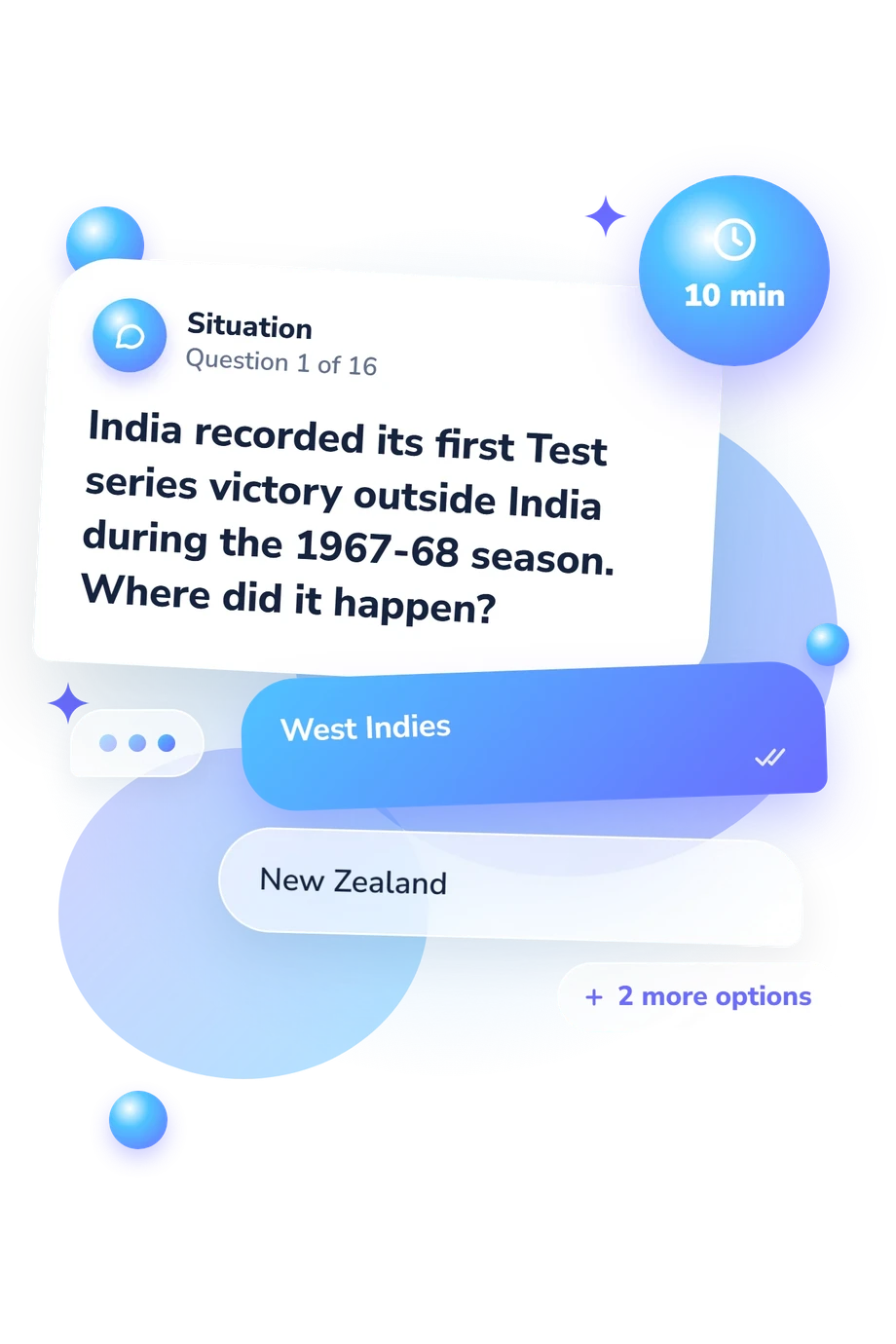
- West Indies
- New Zealand
- England
- Australia
- Anil Kumble
- Javagal Srinath
- Harbhajan Singh
- Narendra Hirwani
- England at Lord's
- England at Old Trafford
- Australia at the Melbourne Cricket Ground
- West Indies at Eden Gardens
Indian Cricket Quiz - Description and methodology of the test
Readers who want a focused way to check what they know about India’s cricket story can use the Indian Cricket Quiz as a structured knowledge exercise. It suits fans, students, and anyone revisiting famous matches, players, and competitions through this India cricket quiz. The broad mix of history and match facts gives an overall sense of familiarity rather than topic-specific feedback.
What This Assessment Explores
It measures recall of Indian cricket across eras, formats, players, competitions, venues, and landmark results. Items span the first Test in 1932, the 1967-68 overseas victory, World Cup triumphs, the 2001 Kolkata Test, women’s cricket, domestic tournaments, and notable records. Together, these questions assess factual knowledge of Indian cricket history and its major competitions.
The questions mainly cover:
- Historical milestones show whether you can place firsts, breakthroughs, and famous turning points in context.
- Players and captains reveal whether you can connect individuals with roles, records, and defining matches.
- Competitions and venues test recognition of tournaments, grounds, opponents, and their significance.
Together, these themes feed the Indian Cricket Knowledge scale. Foundation (0-6) reflects recognition of names or moments; Developing (7-12) indicates a solid grasp with gaps around eras, formats, or teams; Strong (13-16) signals broad knowledge across achievements, players, venues, and competitions.
Methodology and Scientific Basis
Each item uses a four-option multiple-choice format and asks for one factual connection, such as an opponent, venue, captain, tournament, role, or player. The task rewards accurate recall rather than open-ended explanation. The result is reported on the displayed 0-16 scale; the questionnaire does not state its response-weighting method or provide standardization information, norm groups, reliability estimates, or diagnostic thresholds.
The questionnaire is an original Indian cricket knowledge test built as a factual exercise rather than an adaptation of a published instrument. Historical records from the ICC and Wisden can verify the chronology, players, competitions, and match details represented by the questions; they provide factual background, not validation of the questionnaire. Its format does not claim a published psychometric basis.
Interpret the result as a snapshot of remembered cricket knowledge. Familiarity with a particular era, format, team, or cultural context can influence performance, and selected answers may reflect guessing as well as knowledge. The score indicates an overall knowledge level, but the aggregate result cannot isolate strengths by era, format, team, or topic.
- Sundaram, Venkat, ed. Indian Cricket: Then and Now. Gurugram: Harper Sport, 2023. ISBN 9789356994195.
- Majumdar, Boria. The Illustrated History of Indian Cricket. New Delhi: Lustre Press, Roli Books, 2006. ISBN 9788174364494.
- Malcolm, Dominic, Jon Gemmell, and Nalin Mehta, eds. The Changing Face of Cricket: From Imperial to Global Game. London: Routledge, 2010. ISBN 9780415443296.
- Malcolm, Dominic, Jon Gemmell, and Nalin Mehta. "Cricket and Modernity: International and Interdisciplinary Perspectives on the Study of the Imperial Game." Sport in Society 12, no. 4-5 (2009): 431-446. 10.1080/17430430802702715
Updated: