
Horror Movie Emoji Quiz
How the Scales are Structured
Who Usually Takes This Test?
See How You Compare
Below is a preview of how scores are typically distributed across each scale.
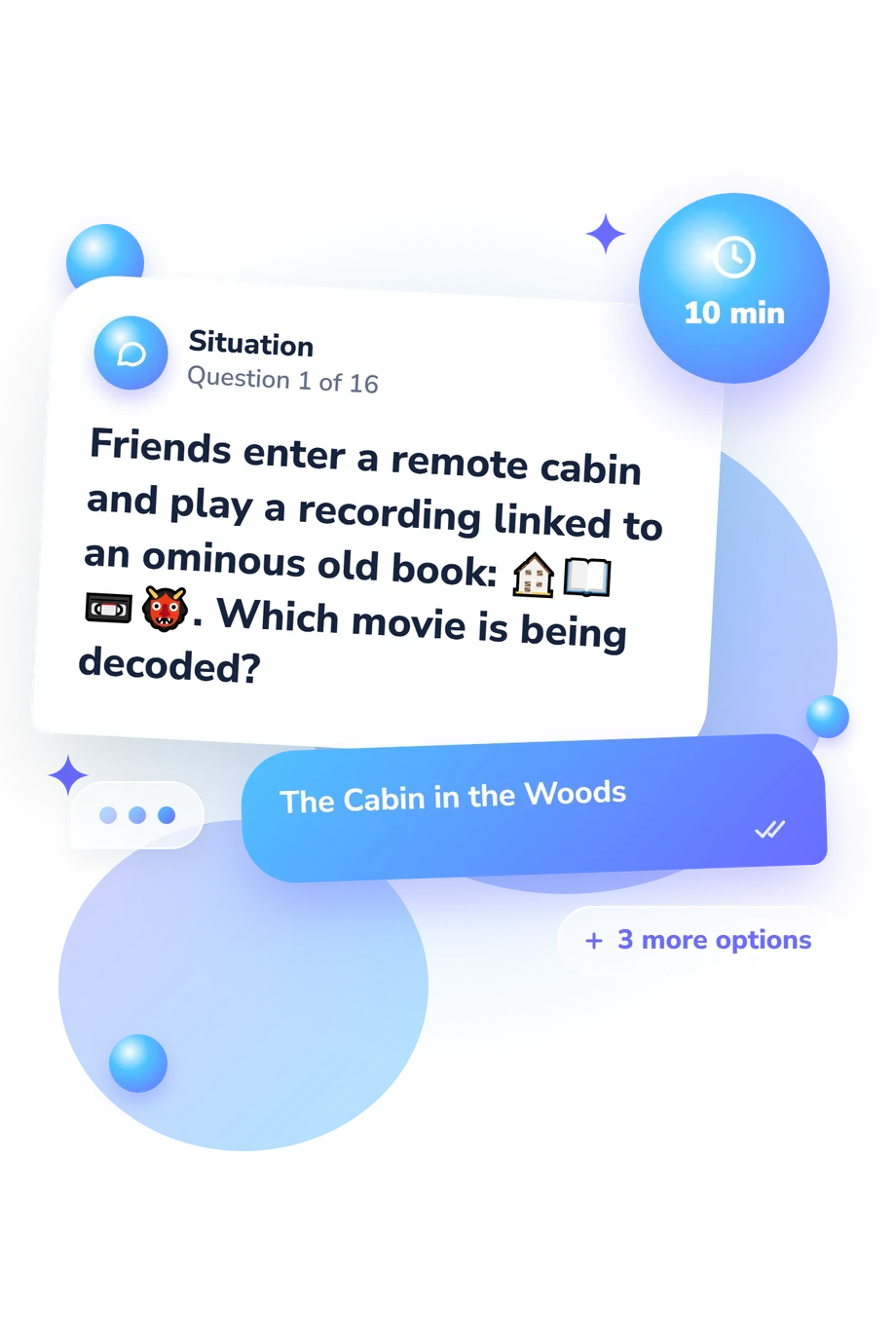
Example Questions From the Test
- The Cabin in the Woods
- The Evil Dead
- The Cabin at the End of the World
- The Ritual
- Scream
- When a Stranger Calls
- The Black Phone
- The Purge
- It
- Killer Klowns from Outer Space
- Terrifier
- Clown
Horror Movie Emoji Quiz - Description and methodology of the test
Viewers who enjoy classic franchises, modern thrillers, and visual wordplay can use this assessment to explore their horror-film knowledge and identify areas of the genre they know best. The horror movie emoji quiz is intended for people who want a quick profile of genre knowledge rather than a personality reading. As a horror film recognition quiz, it can make a film-night discussion interactive by turning shared memories into a friendly challenge.
What This Assessment Explores
The questionnaire measures recognition of horror-film references rather than personality or symptoms. Clues use memorable characters, settings, objects, creatures, franchise symbols, and story moments, asking whether a compressed visual cue leads to the right title. It suits viewers exploring genre memory without treating the result as a measure of intelligence.
Three practical groups organize the clue types:
- Film symbols show whether a mask, creature, object, or signature image brings a title to mind.
- Settings and premises show whether a cabin, motel, woods, camp, or isolated house narrows identification.
- Atmosphere and story moments show whether danger, possession, pursuit, or a famous scene completes the association.
Horror Movie Emoji Knowledge runs 0-16: Emerging Decoder is 0-6, Developing Expert is 7-12, and Fright-Film Expert is 13-16. Comparing the four displayed choices with the clue can explain a missed title in this horror movie trivia quiz; the result still reflects correct recognition within this set.
Methodology and Evidence Base
Each item presents a rebus or scene description with four title choices. Selecting a match tests recognition and retrieval from partial cues, not agreement with a psychological statement. The displayed choices help distinguish a missed title from an unfamiliar reference in this emoji movie quiz.
The score totals one point for each correct answer. Its bands describe performance within this 16-item clue set rather than overall knowledge of horror cinema.
That retrieval focus is conceptually consistent with Arguello et al. (2021), whose work examines identifying movies from incomplete cues. This questionnaire is a separate online knowledge quiz; that study does not establish its standardization or scoring. Carroll (1990) provides genre context rather than evidence validating this questionnaire.
Self-administration means performance can shift with viewing history, cultural familiarity, attention, and interpretation of an emoji. Reviewing the displayed clues may support recall, but it does not change the score. The result is a snapshot of recognition, showing accuracy within this clue set rather than general horror knowledge.
- Jaime Arguello, Adam Ferguson, Emery Fine, Bhaskar Mitra, Hamed Zamani, and Fernando Diaz. “Tip of the Tongue Known-Item Retrieval: A Case Study in Movie Identification.” In Proceedings of the 2021 ACM SIGIR Conference on Human Information Interaction and Retrieval (CHIIR ’21), pp. 5-14, 2021. 10.1145/3406522.3446021
- Hank Davis and Andrea Javor. “Religion, Death and Horror Movies: Some Striking Evolutionary Parallels.” Evolution and Cognition, vol. 10, no. 1, 2004, pp. 11-18.
- Noël Carroll. The Philosophy of Horror: Or, Paradoxes of the Heart. Routledge, 1990.
Updated: