
Hitler Quiz
How the Scales are Structured
Who Usually Takes This Test?
See How You Compare
Below is a preview of how scores are typically distributed across each scale.
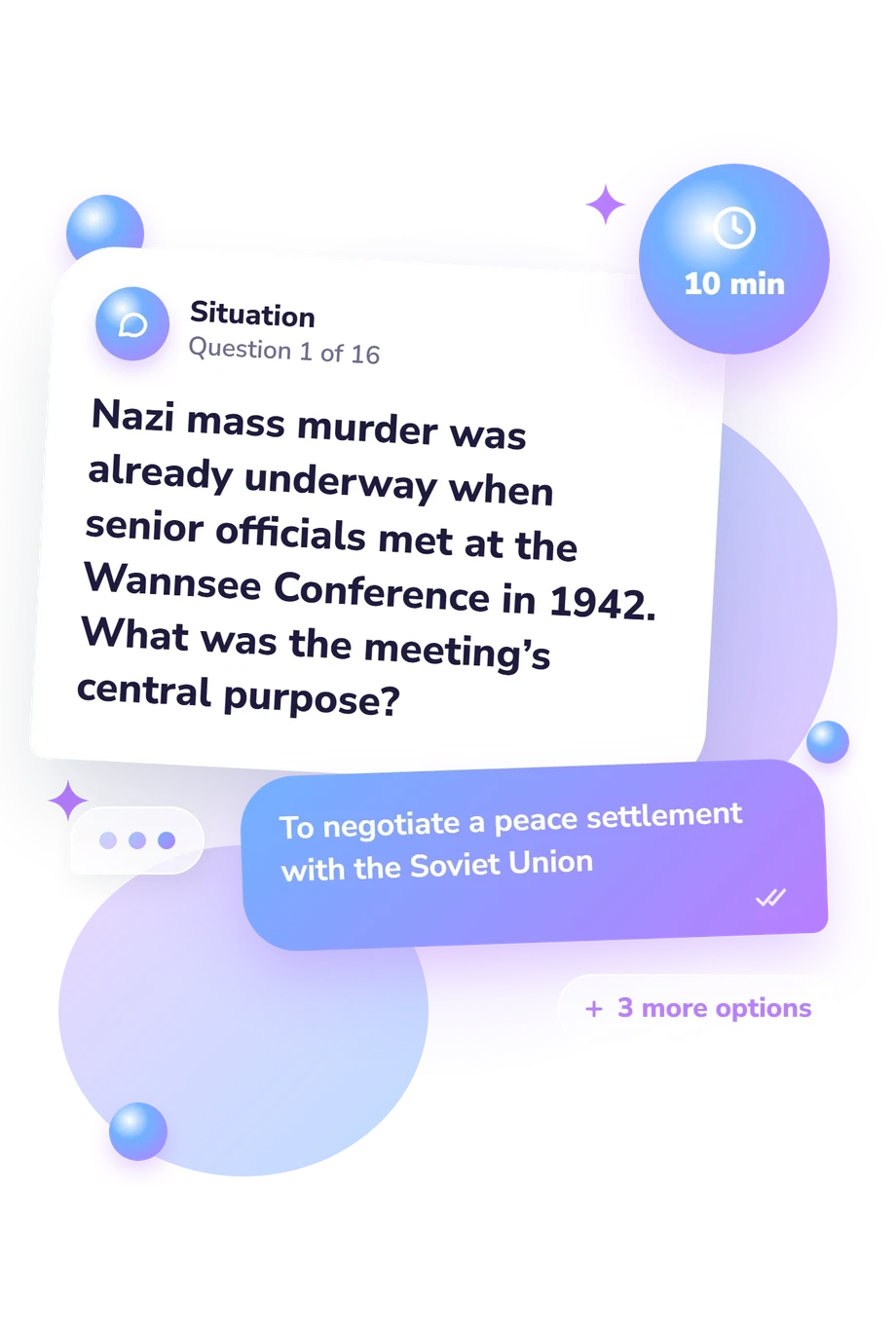
Example Questions From the Test
- He surrendered to the Western Allies and was imprisoned
- He escaped to Austria and led a postwar political movement
- He was captured by Soviet troops and placed on trial
- He died by suicide in his Berlin bunker
- To seize power through a coup against the Weimar Republic
- To separate Bavaria permanently from Germany
- To gain seats through an early parliamentary election
- To restore the prewar German emperor to the throne
- The Soviet offensive that captured Berlin
- Germany’s planned invasion of Britain
- The Allied invasion of Normandy
- Germany’s invasion of the Soviet Union
Hitler Quiz - Description and methodology of the test
Readers who want to check their understanding of twentieth-century history can use the Hitler Quiz as a structured review. As a quiz about Adolf Hitler, it is intended for learners and anyone revisiting the period who wants to distinguish secure knowledge from topics that merit further study. It focuses on historical knowledge and relationships rather than opinion.
What This Assessment Explores
Questions connect major events with Nazi ideology, law, persecution, military decisions, and mass violence. They cover Hitler’s rise, constitutional collapse, antisemitic policy, the Holocaust, and European war. Questions about Nazi history ask why decisions mattered, not only what happened.
One overall Hitler Knowledge scale runs 0-16. Foundation to build (0-6) means you recognize some key elements; reviewing the chronology of Hitler’s rise, Nazi rule, World War II, and the Holocaust would strengthen understanding. Developing knowledge (7-12) reflects understanding of major events and policy-consequence links, though details remain unclear. Strong knowledge (13-16) shows a well-developed grasp of the events, policies, and relationships covered.
The questions cover these thematic areas:
- Political ascent tracks your recognition of the steps enabling dictatorship.
- Persecution links law, organized violence, and mass murder in your understanding.
- War and expansion connects military decisions with major turning points.
Methodology and Evidence Base
Each item presents a historical prompt with four choices. Some ask for a direct fact; others connect an event with its purpose, legal effect, or consequence. This selected-response structure tests recall and basic historical reasoning.
Scoring produces one educational result, with the achieved score mapped to the displayed bands. These are educational levels rather than population comparisons. Guessing, prior exposure, or attention can affect performance, so the result is a topic-specific snapshot rather than a complete measure of historical expertise.
The closest conceptual reference is Holocaust knowledge questions (Pew Research Center, 2020), a precedent for questions about persecution, mass murder, and historical context. This questionnaire is conceptually consistent with that work, not presented as an adaptation. Golub and Cohen’s 1993 study provides an earlier example of measuring Holocaust knowledge.
Kershaw’s biography and Weinberg’s essays support the chronology and connections among ideology, state power, expansion, and wartime consequences. The questionnaire is best used for a structured Hitler knowledge review: it can identify topics to revisit, while broader reading is needed for interpretation, argument, and source criticism.
- Pew Research Center. What Americans Know About the Holocaust. Washington, DC: Pew Research Center, 2020.
- Golub, Jennifer, and Renae Cohen. What Do Americans Know About the Holocaust? New York: American Jewish Committee, 1993.
- Kershaw, Ian. Hitler: A Biography. New York: W. W. Norton & Company, 2008.
- Weinberg, Gerhard L. Germany, Hitler, and World War II: Essays in Modern German and World History. Cambridge: Cambridge University Press, 1995. 10.1017/CBO9780511665172.
Updated: