
What Horse Breed Should I Get Quiz
How the Scales are Structured
Who Usually Takes This Test?
See How You Compare
Below is a preview of how scores are typically distributed across each scale.
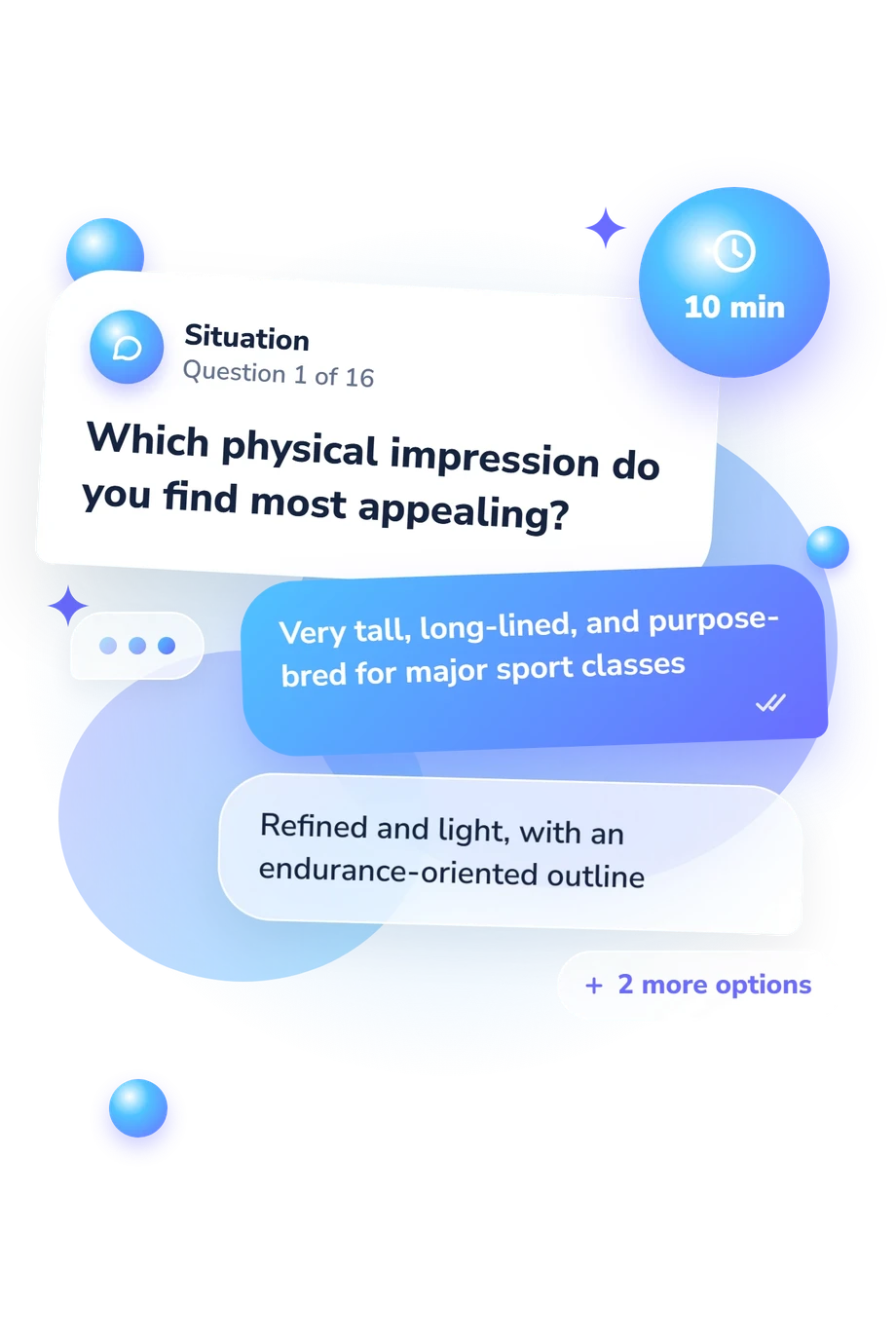
Example Questions From the Test
- Very tall, long-lined, and purpose-bred for major sport classes
- Refined and light, with an endurance-oriented outline
- Compact yet substantial, with an upright and versatile presence
- Low-set and strongly muscled in a classic stock-horse type
- Building fitness for long trail days or endurance rides
- Learning cattle work and short, powerful maneuvers
- Preparing for an assortment of recreational classes
- Developing a formal jumping or dressage specialization
- Reining patterns, ranch obstacles, or working cattle
- Relaxed trails with occasional arena schooling
- Long-distance conditioning over varied terrain
- General flatwork with a mix of casual activities
What Horse Breed Should I Get Quiz - Description and methodology of the test
People choosing a horse, changing disciplines, or defining a long-term partnership can organize preferences before taking a what horse breed should i get quiz or discussing options with a trainer or seller. For anyone taking a what horse should I get quiz, the result connects desired activities, movement, build, and partnership style with four profiles. It focuses the next conversation while leaving final choice to careful evaluation of each horse.
What This Assessment Explores
Choices compare build, movement, responsiveness, activities, training, versatility, and partnership. A what breed of horse should I get quiz links these preferences with distance work, all-around use, Western activity, and technical sport.
These are profile scales:
- Arabian Affinity (0-12) measures endurance, efficient movement, refined build, responsiveness, and engaged partnership; bands: 0-4 Different Direction, 5-8 Possible Fit, 9-12 Strong Affinity.
- Morgan Affinity (0-12) measures compact versatility for trails, arenas, showing, and driving; bands: 0-4 Different Direction, 5-8 Possible Fit, 9-12 Strong Affinity.
- Quarter Horse Affinity (0-12) measures Western disciplines, practical versatility, compact power, and direct riding style; bands: 0-4 Different Direction, 5-8 Possible Fit, 9-12 Strong Affinity.
- Warmblood Affinity (0-12) measures elastic movement, larger sport-horse types, dressage, jumping, eventing, sustained technical training; bands: 0-4 Different Direction, 5-8 Possible Fit, 9-12 Strong Affinity.
Highest affinity is strongest; scores within one point blend.
Methodology and Evidence Base
Each item presents four contrasting choices about build, movement, activities, responsiveness, training, or partnership. Responses act as preference indicators, and the questionnaire does not publish a points-per-answer rule beyond displayed ranges. Thus, a what kind of horse should I get quiz produces a pattern-based reflection rather than a single recommendation.
Conceptually, the design is consistent with the Ideal Horse Questionnaire (IHQ), a rider-preference measure, and related surveys of equine personality. It is not presented as an adaptation or validation of those instruments. Lloyd and colleagues examine breed variation, while Sackman and Houpt discuss associations between personality, breed, use, and husbandry; these studies provide context, not predictions about individuals.
The result can organize goals and preferences around a what horse breed is right for me quiz, while selection also depends on facilities, intended use, health, soundness, training, temperament, and current interests. Self-report reflects current context and self-awareness. No population standardization is claimed; its bands are questionnaire-specific labels, so close profiles merit repeated trials with qualified trainer and veterinary input.
- Górecka-Bruzda, A., Chruszczewski, M. H., Jaworski, Z., Golonka, M., Jezierski, T., Długosz, B., & Pieszka, M. (2011). Looking for an Ideal Horse: Rider Preferences. Anthrozoös, 24(4), 379-392. 10.2752/175303711X13159027359827
- Suwała, M., Górecka-Bruzda, A., Walczak, M., Ensminger, J., & Jezierski, T. (2016). A desired profile of horse personality - A survey study of Polish equestrians based on a new approach to equine temperament and character. Applied Animal Behaviour Science, 180, 65-77. 10.1016/j.applanim.2016.04.011
- Lloyd, A. S., Martin, J. E., Bornett-Gauci, H. L. I., & Wilkinson, R. G. (2008). Horse personality: Variation between breeds. Applied Animal Behaviour Science, 112(3-4), 369-383. 10.1016/j.applanim.2007.08.010
- Sackman, J. E., & Houpt, K. A. (2019). Equine Personality: Association With Breed, Use, and Husbandry Factors. Journal of Equine Veterinary Science, 72, 47-55. 10.1016/j.jevs.2018.10.018
Updated: