
Wedding Quiz for Couples
How the Scales are Structured
Who Usually Takes This Test?
See How You Compare
Below is a preview of how scores are typically distributed across each scale.
Example Questions From the Test
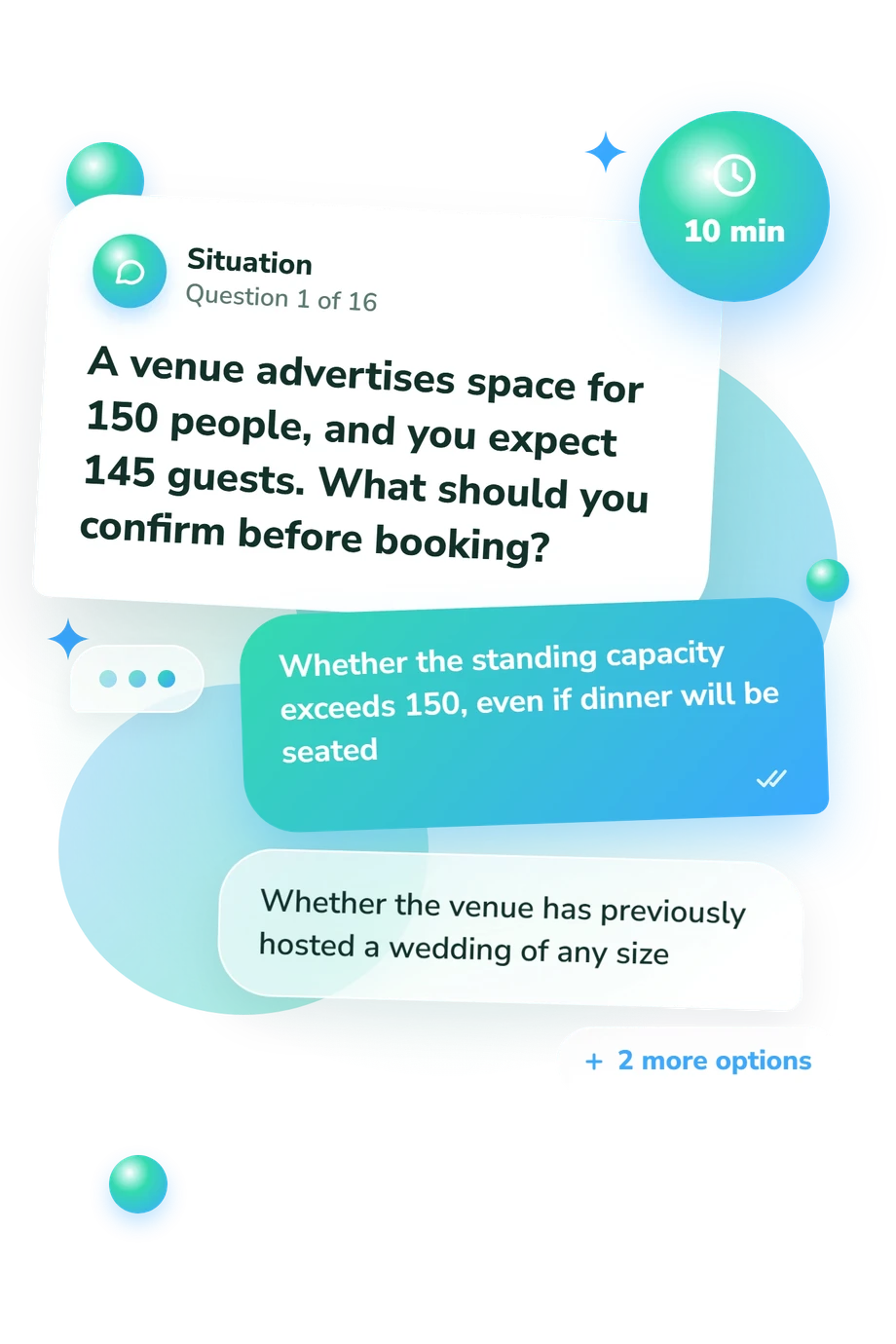
- Whether the standing capacity exceeds 150, even if dinner will be seated
- Whether the venue has previously hosted a wedding of any size
- Whether unused ceremony chairs can be stored after guests arrive
- Whether the planned layout safely accommodates guests, vendors, furniture, and needed access routes
- Delay fixed printed assignments until late updates are processed and keep a method for corrections
- Assign only table sizes and let all guests choose their own seats on arrival
- Print the final seating display before the RSVP deadline to avoid rush fees
- Seat every unconfirmed guest and remove empty chairs during dinner
- To calculate the deposits due before the wedding
- To reserve money that must be divided equally among vendors
- To cover unexpected costs or necessary last-minute changes
- To track gifts received from invited guests
Wedding Quiz for Couples - Description and methodology of the test
Couples who want a practical way to examine planning judgment can use this wedding quiz for couples when comparing options, dividing responsibilities, or reviewing decisions together. The wedding quiz questions focus on situations where careful preparation affects money, safety, timing, and guest experience. It is suited to partners at different planning stages who want a shared starting point for discussion rather than a measure of romance or compatibility.
What This Assessment Explores
These scenarios examine applied wedding-planning knowledge across contracts, budgets, guests, vendors, accessibility, weather, family boundaries, and timelines. They ask what a careful planner should verify, compare, document, or decide before a commitment. The result concerns practical preparedness, not relationship quality or event success.
The single scale, Wedding Planning Knowledge (0-16), uses three bands: Foundations to build (0-6) marks ideas to review; Developing planner (7-12) shows many essentials with details to check; Strong planning knowledge (13-16) reflects broad command of the covered principles. This practical format gives couples a concrete way to discuss overlooked tasks that a wedding planning checklist may leave unexamined.
The result can be read through three connected areas:
- Contract and budget judgment shows how terms, fees, and contingencies are handled.
- Guest and accessibility planning shows whether needs and routes are anticipated.
- Coordination and contingencies show how timelines, weather, vendors, and boundaries are managed.
Methodology and Evidence Base
Each item presents a planning situation with four response options, and the respondent selects the answer that best fits sound practice. Topics include venue capacity, seating, contracts, fees, licenses, accessibility, allergies, family decisions, and day-of timing. For couples preparing together, this wedding planning questionnaire turns informal discussion into a structured review of responsibilities. Its questions can prompt comparison without making the score a precise prediction.
Daniels and Loveless (2007) provide the closest framework for contracts, budgets, vendors, logistics, and contingencies. McKenzie and Davies (2010) place the planner in the context of organizing information and decisions in everyday life, while EMBOK connects people, resources, timing, and risk. This questionnaire is conceptually consistent with those works but is not identified as an adaptation of a cited published instrument.
The displayed total summarizes selected responses, but individual weighting is not explained. Its score should be read educationally rather than as a precise prediction: self-report, current circumstances, and incomplete knowledge may shape results. Use the outcome to choose topics for discussion and verification, including contracts, guest needs, vendor terms, weather plans, and timeline buffers, rather than treating one total as a complete account of readiness.
- Daniels, Maggie, and Carrie Loveless. Wedding Planning and Management: Consultancy for Diverse Clients. Butterworth-Heinemann, 2007.
- McKenzie, Pamela J., and Elisabeth Davies. “Documentary tools in everyday life: the wedding planner.” Journal of Documentation 66, no. 6 (2010): 788-806. 10.1108/00220411011087814
- Silvers, Julia Rutherford, Glenn Bowdin, William O'Toole, and Kathleen Beard Nelson. “Towards an International Event Management Body of Knowledge (EMBOK).” Event Management 9, no. 4 (2006): 185-198. 10.3727/152599506776771571
Updated: