
Alphabet Quiz
How the Scales are Structured
Who Usually Takes This Test?
See How You Compare
Below is a preview of how scores are typically distributed across each scale.
Example Questions From the Test
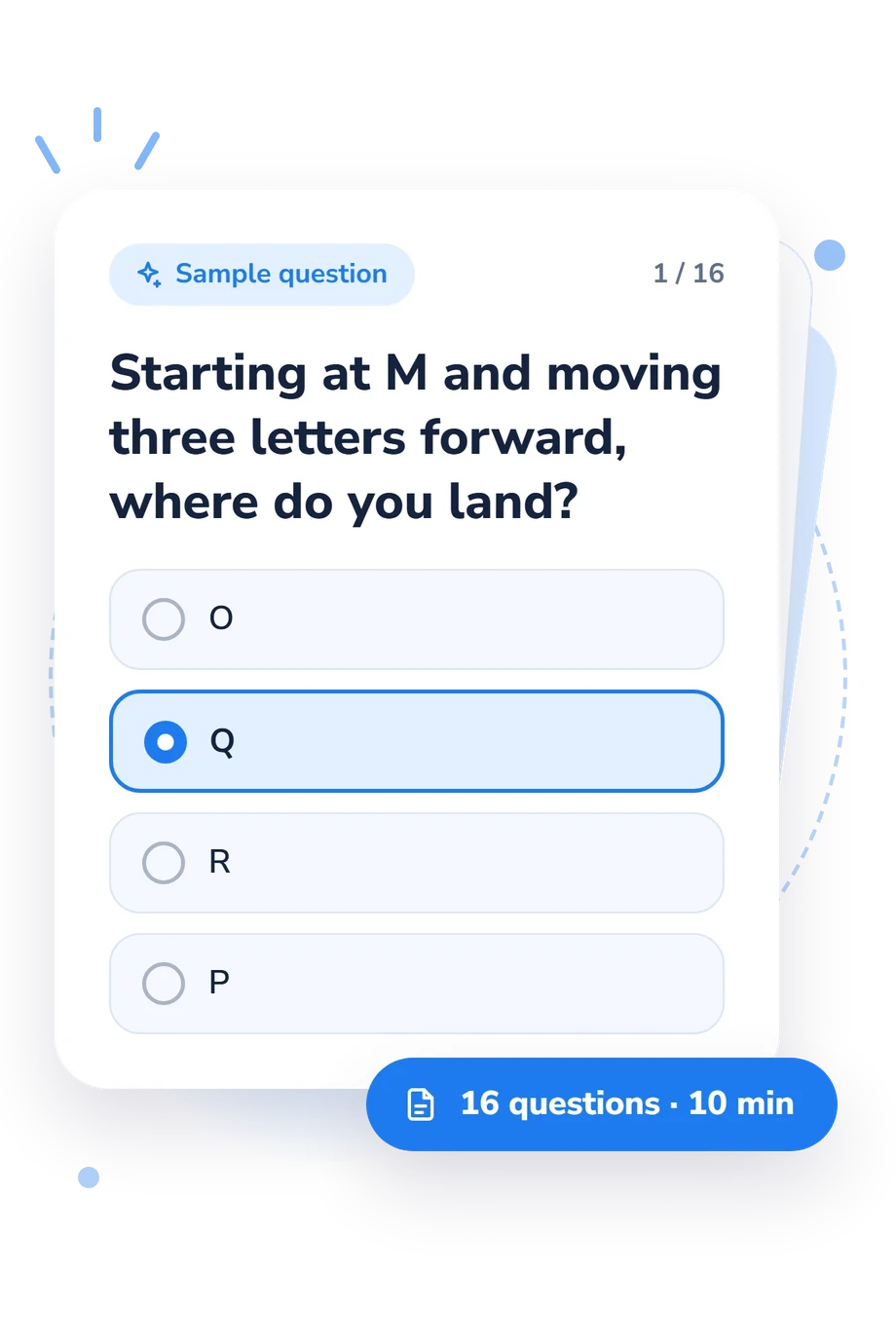
- O
- Q
- R
- P
- DPH
- ENH
- EPH
- EOG
- S
- U
- T
- V
Alphabet Quiz - Description and methodology of the test
People seeking a clear check of practical English letter knowledge can use this alphabet quiz to examine order, position, sequences, codes, and word sorting. It suits learners, parents, and educators who want a focused activity rather than a broad reading assessment. The result shows which operations feel secure and which may need practice. It can function as an abc quiz for kids when an adult discusses missed patterns.
What This Assessment Explores
The questions treat alphabet knowledge as usable knowledge, not mere recitation. They ask respondents to move forward or backward, identify positions, continue sequences, apply a next-letter code, recognize vowels, and alphabetize words. Together, these tasks connect letter facts with practical relationships and sorting conventions.
The task groups are:
- Letter order and position show how accurately a respondent locates letters in sequence.
- Sequences and codes show how well a respondent applies repeated steps or transformations.
- Sorting and structural facts show recognition of word order, alphabet length, vowels, and matching positions.
These activities make the questionnaire useful as a quiz about the alphabet for kids, especially when an adult discusses the reasoning behind an answer. Alphabet Knowledge spans 0-16: Foundation is 0-6, Developing is 7-12, and Strong is 13-16. The bands describe command of English alphabet order, positions, and practical patterns, rather than broader reading ability.
Methodology and Scientific Basis
Each item presents a prompt with four answer choices. The respondent selects the option completing a factual, sequential, coding, or sorting task. Scoring is direct: one point is awarded for each correct answer, so the total reflects successful responses rather than weighted subscales.
The design is conceptually consistent with Drouin et al. (2012), which treats alphabet knowledge as measurable knowledge of letter names, order, and related operations. Perlmuter and Lively (1976) provide relevant evidence that letters are processed through ordered relationships. Anthony et al. (2021) distinguish acquisition, conceptualization, and measurement, while Horner and Shaffer (2021) stress transparent reporting for researcher-developed measures.
This online educational knowledge check is not a documented adaptation of any cited instrument; it has no established normative comparison, reliability estimate, or clinical cutoff, and results may reflect schooling, language experience, attention, guessing, and recent practice.
For younger learners, it can work as a preschool quiz on the alphabet when instructions are read aloud and mistakes are reviewed constructively. The score can guide practice or conversation while remaining a snapshot rather than a complete measure of literacy.
- Drouin, M., Horner, S. L., & Sondergeld, T. A. (2012). Alphabet knowledge in preschool: A Rasch model analysis. Early Childhood Research Quarterly, 27(3), 543-554. 10.1016/j.ecresq.2011.12.008
- Perlmuter, L. C., & Lively, B. L. (1976). Processing sets of letters for order: Evidence from reaction time experiments. Memory & Cognition, 4(1), 67-74. 10.3758/BF03213257
- Anthony, J. L., Chen, Y.-J. I., Williams, J. M., Cen, W., & Erazo, N. A. (2021). U.S. Children's Understanding of the English Alphabet: Its Acquisition, Conceptualization, and Measurement. Journal of Educational Psychology, 113(6), 1073-1087. 10.1037/edu0000534
- Horner, S. L., & Shaffer, S. A. (2021). Evaluating the Reporting Quality of Researcher-Developed Alphabet Knowledge Measures: How Transparent and Replicable Is It? Frontiers in Psychology, 12, 601849. 10.3389/fpsyg.2021.601849
Updated: