
Life Path Quiz
How the Scales are Structured
Who Usually Takes This Test?
See How You Compare
Below is a preview of how scores are typically distributed across each scale.
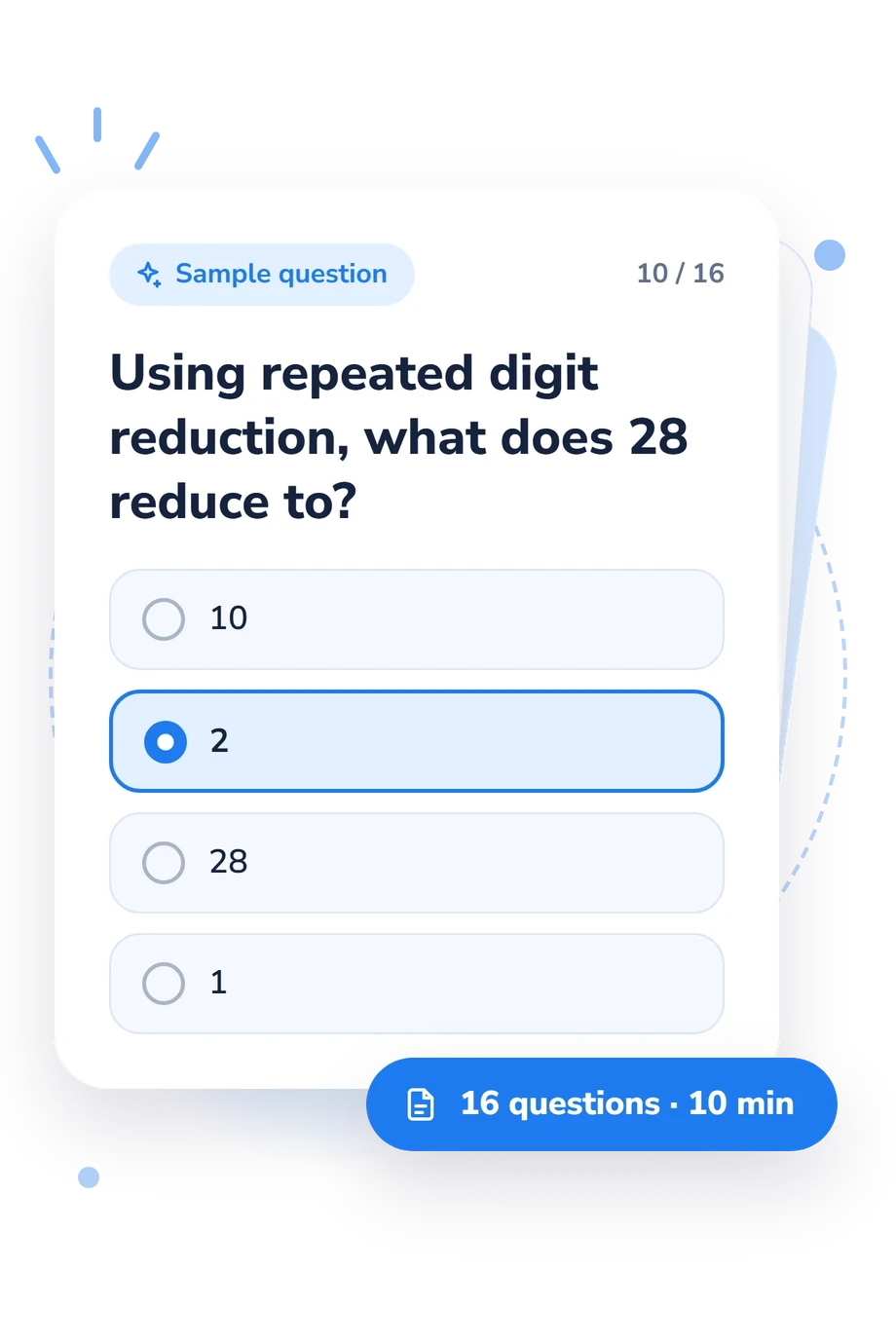
Example Questions From the Test
- 14
- 18
- 20
- 22
- 6
- 11
- 23
- 5
- A broad symbolic life theme derived from a birth date
- A snapshot of someone’s current mood based on quiz answers
- An astrological sign determined by birthplace
- A forecast calculated from the current calendar year alone
Life Path Quiz - Description and methodology of the test
For readers who want to understand the calculation convention behind numerology, the life path quiz is a focused knowledge check rather than a prediction of personal destiny. It suits anyone reviewing birth-date reduction, master numbers, and the symbolic meanings assigned to final totals. As a life path number quiz, it places your overall knowledge of the convention in a displayed band.
What This Assessment Explores
This questionnaire measures knowledge of one stated Life Path convention: reducing a birth date, preserving component totals such as 11, 22, or 33, and interpreting the final number symbolically. It tests whether you can apply those rules without turning them into claims about a fixed career, personality, or future.
For readers asking what their life path number is, this quiz addresses the practical question-what is my life path number?-and suits curious learners or anyone checking the calculation before using numerology reflectively and keeping its symbolism in perspective.
The displayed scale is Life Path Numerology Knowledge (0-16), divided into these bands:
- Foundations to build (0-6) means the basic reductions, master-number rules, or interpretive limits need review.
- Developing knowledge (7-12) means you understand the main ideas but may miss some calculations or distinctions.
- Strong knowledge (13-16) means you apply this convention accurately and keep its symbolism in perspective.
Methodology and Evidence Base
Each item presents four choices and asks which option follows the stated convention. Responses form a knowledge score; bands describe familiarity with these rules, not probability. Wording rewards restraint by favoring symbolic interpretation over guaranteed prediction.
The calculation approach matches Decoz and Monte (2001) and Goodwin (1981): month, day, and year are reduced separately, master numbers are preserved when instructed, and the combined total is then reduced under the stated convention. The questionnaire is conceptually consistent with those sources, not an adaptation of either book.
Hartmann, Reuter, and Nyborg (2006) report a separate study of birth dates and individual differences; it does not validate this online knowledge measure or numerology as a personality predictor. The questionnaire has no reported standardization or population norms; its bands are descriptive catalogue ranges.
Readers asking what their life number is can use this quiz to see how they answered under the convention; it works through the practical question-what is my life number?-rather than claiming that a birth date determines intelligence, relationships, or occupation. Guessing, attention, and prior exposure can affect answers. Review items and treat symbolic conclusions as prompts for reflection rather than fixed facts.
- Decoz, Hans, and Tom Monte. Numerology: Key to Your Inner Self. Tarcher, 2001. ISBN 9780399527326.
- Goodwin, Matthew Oliver. Numerology: The Complete Guide, Volume 1. Newcastle Publishing Company, 1981. ISBN 9780878770533.
- Hartmann, Peter, Martin Reuter, and Helmuth Nyborg. The relationship between date of birth and individual differences in personality and general intelligence: A large-scale study. Personality and Individual Differences, 40(7), 1349-1362, 2006. 10.1016/j.paid.2005.11.017.
Updated: