
Am I Athletic Quiz
How the Scales are Structured
Who Usually Takes This Test?
See How You Compare
Below is a preview of how scores are typically distributed across each scale.
Example Questions From the Test
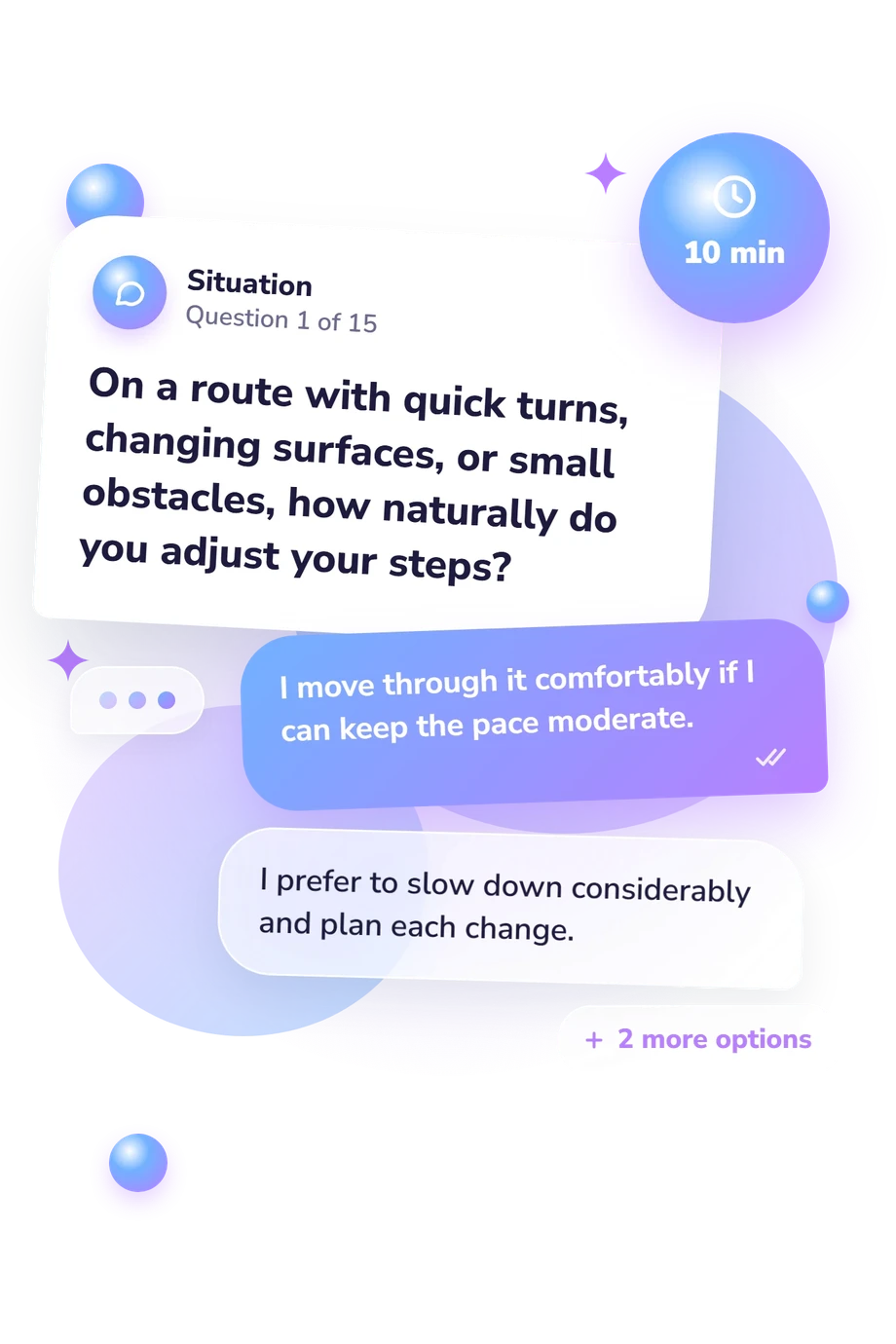
- I move through it comfortably if I can keep the pace moderate.
- I prefer to slow down considerably and plan each change.
- I alter stride, direction, and balance smoothly without losing much momentum.
- I usually choose a simpler route when one is available.
- I can carry it steadily and adjust my grip or posture as needed.
- I manage it, but I usually need to pause or reposition it.
- I prefer to split the load or ask someone to take one side.
- I generally choose a lighter item or a different way to move it.
- I need a simplified version before the movement feels manageable.
- I understand parts of it, but coordinating force and position takes several tries.
- I reproduce the main pattern and refine smaller details with feedback.
- I complete the pattern reasonably well, though one or two parts feel awkward.
Am I Athletic Quiz - Description and methodology of the test
People who want a clearer picture of everyday physical demands can use the Am I Athletic Quiz as a structured self-reflection tool. It suits readers curious about movement confidence, stamina, and strength-related habits, whether they train regularly or are becoming more active. The result highlights patterns across abilities instead of reducing athleticism to one label. Framed as a how athletic am i quiz, it identifies areas to practice.
What This Assessment Explores
The questions describe changing surfaces, unfamiliar movement sequences, repeated activity, stairs, carrying, bodyweight movements, and maintaining form as fatigue appears. Together, these situations examine everyday movement demands rather than sport-specific performance or a single definition of athleticism.
For someone using it as an am i an athlete quiz, the profile separates three tendencies. The displayed dimensions are:
- Coordination & Adaptability (0-15) reflects how readily you adjust timing, direction, balance, and unfamiliar movement patterns: Developing familiarity (0-5), Adaptable mover (6-10), or Responsive mover (11-15).
- Endurance & Pacing (0-15) reflects sustained effort and workable rhythm: Building capacity (0-5), Everyday endurance (6-10), or Sustained engine (11-15).
- Strength & Movement Control (0-15) reflects producing and controlling force across tasks: Emerging Foundation (0-5), Functional Capacity (6-10), or Strong Command (11-15).
Together, the bands show where current experiences feel more comfortable or demanding, rather than assigning a permanent athletic identity.
Methodology and Evidence Base
Each item presents a physical situation with four response options describing different levels of ease, adaptation, pacing, control, or recovery. You choose the description closest to your usual experience, making this a self-report method rather than a controlled performance test.
The scoring groups responses within three profile dimensions and presents each as a banded result. It shows relative tendencies within this questionnaire, not a norm-referenced ranking. As a how athletic are you quiz, it can make differences between coordination, stamina, and force control easier to notice.
Its evidence base is conceptually consistent with the Physical Self-Description Questionnaire (PSDQ), a multidimensional physical self-concept model examined by Marsh and colleagues. Marsh and Redmayne linked physical self-beliefs with fitness components, while later work examined PSDQ stability and discriminant validity. This Freudly questionnaire is not presented as an adaptation of PSDQ; its online profile is an unstandardized reflective format.
For an are you an athlete quiz, read the result as a snapshot shaped by training history, movement familiarity, fatigue, pain, and self-perception. It does not establish cardiovascular health or medical fitness, so those concerns require broader assessment.
- Marsh, Herbert W., Garry E. Richards, Steven Johnson, Lawrence A. Roche, and Patsy Tremayne. (1994). Physical Self-Description Questionnaire: Psychometric Properties and a Multitrait-Multimethod Analysis of Relations to Existing Instruments. Journal of Sport & Exercise Psychology, 16(3), 270-305. 10.1123/jsep.16.3.270
- Marsh, Herbert W., and Robyn Sutherland Redmayne. (1994). A Multidimensional Physical Self-Concept and Its Relations to Multiple Components of Physical Fitness. Journal of Sport & Exercise Psychology, 16(1), 43-55. 10.1123/jsep.16.1.43
- Marsh, Herbert W. (1996). Physical Self-Description Questionnaire: Stability and Discriminant Validity. Research Quarterly for Exercise and Sport, 67(3), 249-264. 10.1080/02701367.1996.10607952
Updated: