
Blood Quiz
How the Scales are Structured
Who Usually Takes This Test?
See How You Compare
Below is a preview of how scores are typically distributed across each scale.
Example Questions From the Test
- White blood cells and platelets
- Hemoglobin and albumin
- Red blood cells and fibrin
- Plasma water and electrolytes
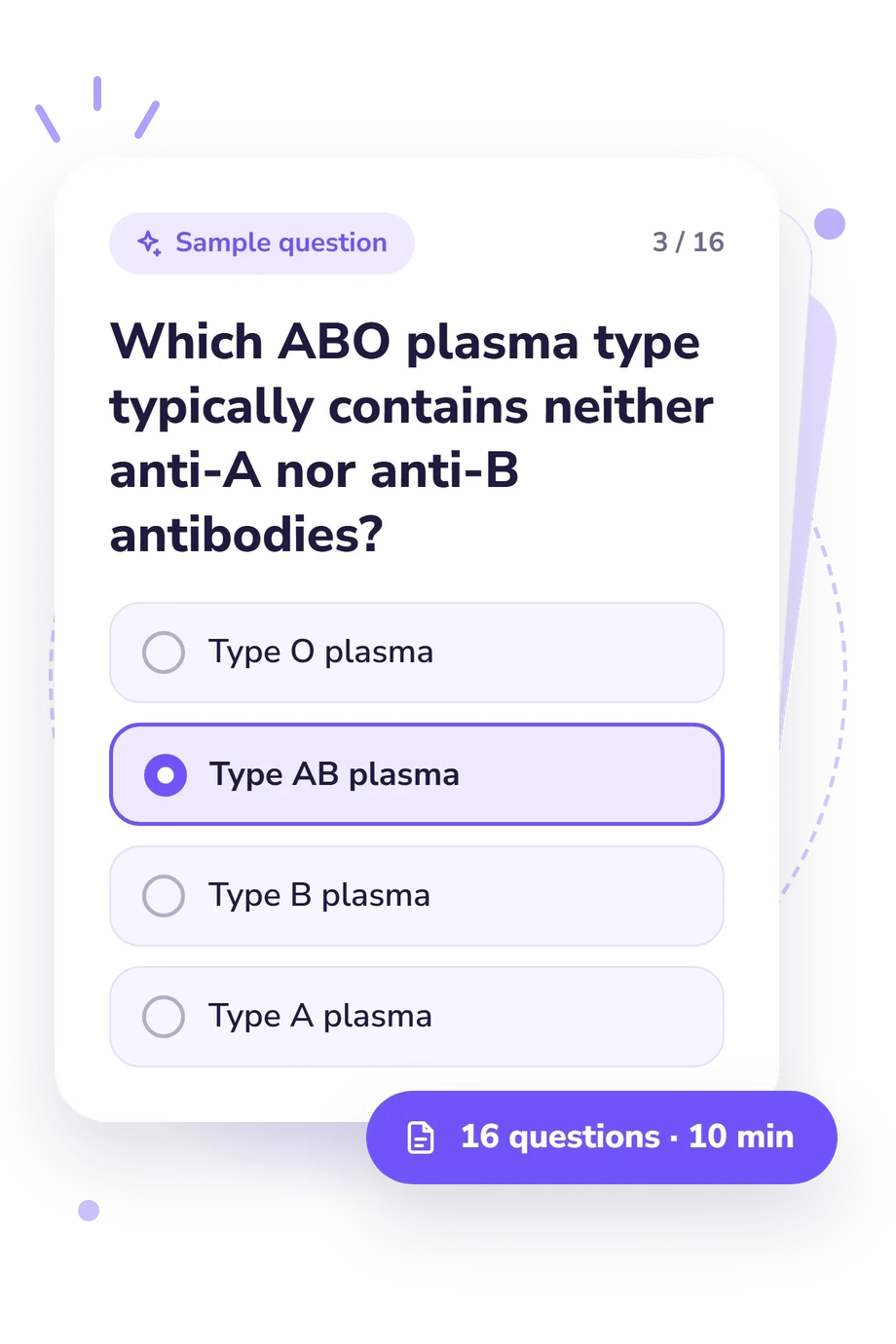
- Type O plasma
- Type AB plasma
- Type B plasma
- Type A plasma
- Inferring it from one parent's reported blood type
- Reading the values on a routine complete blood count
- Matching personality traits to blood-type descriptions
- Testing red blood cells with appropriate typing reagents
Blood Quiz - Description and methodology of the test
For learners reviewing core anatomy and physiology, this blood quiz offers a focused way to connect structures with their roles in transport, defense, clotting, and compatibility. It suits students, revising adults, and curious readers who want to test understanding through applied questions rather than memorized labels. As an anatomy and physiology quiz about blood, it points to concepts that may deserve another look.
What This Assessment Explores
Questions examine plasma, blood cells, oxygen transport, immune defense, clotting, blood-cell production, and ABO/Rh typing. Some items distinguish related terms; others use short situations about transfusion safety, laboratory methods, or reduced red-cell numbers. The result reflects conceptual knowledge and application, not a personal blood-type reading.
Scores show how securely you connect components with their functions. Blood Knowledge runs from 0-16 and is divided into three educational bands:
- Foundations to build (0-6) means the main components and basic typing concepts need review.
- Developing knowledge (7-12) means many essentials are understood, though antigens, antibodies, or component roles may still be confused.
- Strong knowledge (13-16) means you show a solid grasp of formed elements, blood groups, and compatibility principles.
Questions in this blood-knowledge quiz support focused study, not a judgment about health.
Methodology and Scientific Basis
Each item offers four answer options and asks for the best response to a fact or short scenario. You must distinguish plasma from serum, identify formed elements, match antigens with antibodies, and recognize that actual typing depends on laboratory reagents. An A&P quiz about blood therefore links terminology with basic anatomy, physiology, and transfusion reasoning.
Scoring is a bounded total of selected answers. No separate weighting rule, normative sample, reliability estimate, or clinical cutoff is stated, so the displayed bands are educational summaries rather than population-based classifications. A quiz on blood physiology can show what to review, but it cannot establish a person’s ABO or Rh type.
Betts et al. (2022) supplies the framework for blood components, transport, defense, and hematopoiesis. Dean (2005) and Cohn et al. (2023) support ABO and Rh antigens, antibodies, typing, and compatibility; Cooling (2015) adds context for blood-group biology. The questionnaire is conceptually consistent with these works, not an adaptation or validation of them.
Performance can vary with prior study, attention, guessing, and interpretation of each item. Personal blood-type or transfusion decisions require laboratory testing and qualified guidance.
- Betts, J. Gordon; Young, Kelly A.; Wise, James A.; Johnson, Eddie; Poe, Brandon; Kruse, Dean H.; Korol, Oksana; Johnson, Jody E.; Womble, Mark; DeSaix, Peter. Anatomy and Physiology 2e. Houston, TX: OpenStax, Rice University, 2022.
- Cohn, Claudia; Delaney, Meghan; Johnson, Susan T.; Katz, Louis M.; Schwartz, Joseph, editors. Technical Manual. 21st ed. Bethesda, MD: AABB, 2023. ISBN 978-1-56395-464-1.
- Dean, Laura. Blood Groups and Red Cell Antigens [Internet]. Bethesda (MD): National Center for Biotechnology Information (US), 2005. NCBI Bookshelf.
- Cooling, Laura. Blood Groups in Infection and Host Susceptibility. Clinical Microbiology Reviews. 2015;28(3):801-870. 10.1128/CMR.00109-14
Updated: