
Night by Elie Wiesel Quiz
How the Scales are Structured
Who Usually Takes This Test?
See How You Compare
Below is a preview of how scores are typically distributed across each scale.
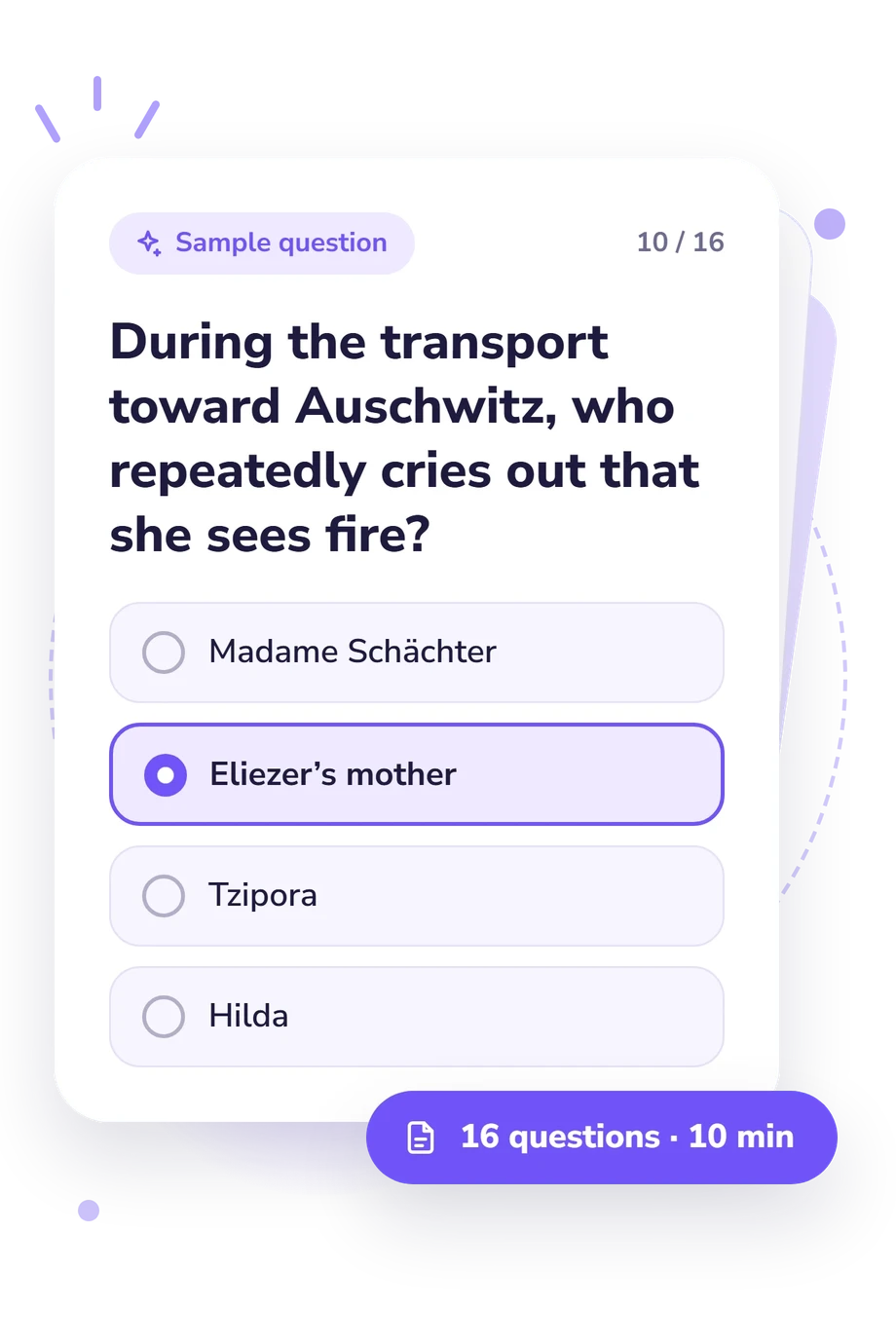
Example Questions From the Test
- Eliezer should say 16, and his father should say 45
- Eliezer should say 18, and his father should say 40
- Eliezer should say 21, and his father should say 35
- Eliezer should say 15, and his father should say 50
- Moshe the Beadle’s
- Rabbi Eliahu’s
- Juliek’s
- Stein’s
- Rabbi Eliahu
- Akiba Drumer
- Stein of Antwerp
- Meir Katz
Night by Elie Wiesel Quiz - Description and methodology of the test
Readers who want to check their grasp of Eliezer’s story can use the Night by Elie Wiesel Quiz as a focused reading review. It is intended for students, educators, book-club members, and anyone revisiting the memoir. The result shows how securely you connect characters, events, relationships, and themes, while indicating where closer reading may be useful. This night book quiz links remembered details with broader meaning.
What This Assessment Explores
The questionnaire checks whether a reader can connect people, events, and symbols across the memoir rather than recall isolated names. The four-choice structure makes this Night Elie Wiesel quiz useful for study, discussion, teaching, or personal reflection because the prompts move from factual recognition to relationships and literary meaning.
The items examine three areas:
- Character knowledge shows whether you can identify people and place their actions in context.
- Event and relationship tracking shows whether you can follow selections, transports, losses, and changing responsibilities.
- Theme and literary meaning shows whether you can interpret night as an image of spiritual crisis, terror, memory, and the altered self.
Your result is reported as Night by Elie Wiesel Knowledge, scored from 0-16. Starting Point covers 0-6, Developing Knowledge covers 7-12, and Strong Knowledge covers 13-16. These bands describe familiarity with the memoir, not general intelligence or literary ability.
Methodology and Evidence Base
Each prompt presents a scene, character, relationship, or image followed by four answer choices. The format combines factual recognition with interpretation: some items ask who acted or what happened, while others ask what a recurring image or relationship change signifies. It measures familiarity with this memoir rather than broad reading aptitude.
The score is a descriptive measure of familiarity with the memoir and should not be treated as a norm-referenced or diagnostic result. Afterward, reviewing relevant passages can clarify missed answers in this memoir knowledge quiz, especially when an item turns on a character’s motive, event sequence, or recurring image.
Questions refer directly to Elie Wiesel’s memoir Night. Culp’s 1981 analysis offers a lens for spiritual rupture, while Simon and colleagues’ 2014 study links creative and educational inquiry with Holocaust memoir reading. These works provide literary and educational context for the questions, rather than validation of this online knowledge assessment.
Results may vary with memory, translation or edition differences, and the scenes sampled, so they are best read as a focused measure of familiarity with this memoir.
- Wiesel, Elie. Night. Translated by Marion Wiesel, revised edition, Hill and Wang, 2006.
- Culp, Mildred L. "Wiesel's Memoir and God Outside Auschwitz." Explorations in Ethnic Studies, vol. 4, no. 1, 1981, pp. 62-74. 10.1525/ees.1981.4.1.62
- Simon, Rob; Bailey, Ashley; Brennan, Jason; Calarco, Antonino; Clarke, Kevin; Edwards, Will; Fujiwara, Catherine; Kalan, Amir; Kruja, Julia; McInnes-Greenberg, Emily; Pisecny, Anna. "In the Swell of Wandering Words": The Arts as a Vehicle for Youth and Educators' Inquiries into the Holocaust Memoir "Night." Penn GSE Perspectives on Urban Education, vol. 11, no. 2, 2014, pp. 90-106.
Updated: