
Favorite Movie Quiz
How the Scales are Structured
Who Usually Takes This Test?
See How You Compare
Below is a preview of how scores are typically distributed across each scale.
Example Questions From the Test
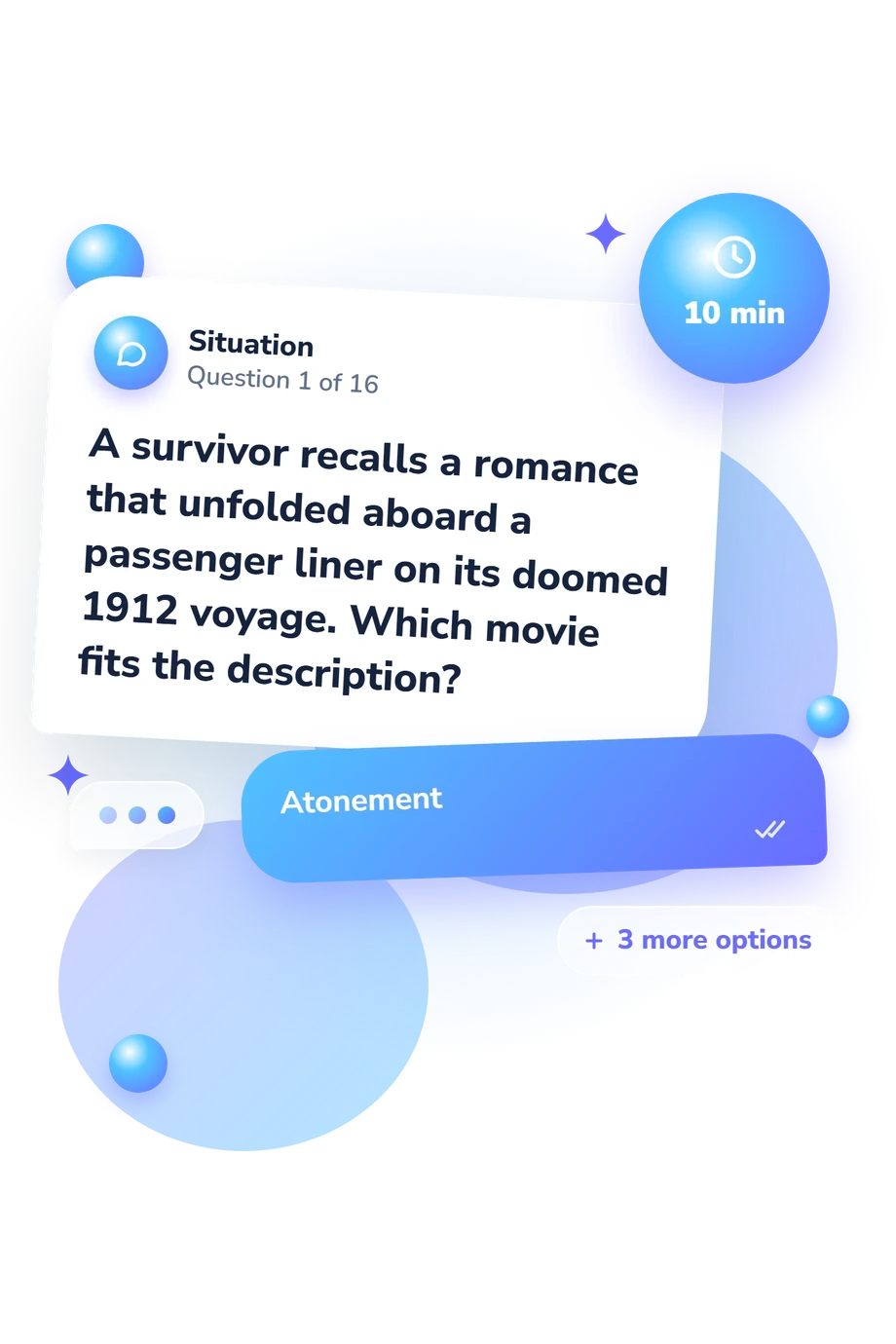
- Atonement
- The English Patient
- Master and Commander: The Far Side of the World
- Titanic
- Francis Ford Coppola — Goodfellas
- Steven Spielberg — Schindler's List
- Martin Scorsese — The Godfather
- Peter Jackson — Gladiator
- It functions as a map leading to the aliens' home world
- It allows humans to control the alien spacecraft
- Learning it changes Louise's perception of time
- It reveals that the aliens have been secretly living on Earth
Favorite Movie Quiz - Description and methodology of the test
People who enjoy recognizing movies by story, character, director, and theme can use this favorite movie quiz to check their knowledge of the films and details represented in its questions. It also works as a movie knowledge challenge for casual viewers, dedicated film fans, or anyone interested in a single score covering plot, character, director, and theme details represented in the questions. The result summarizes overall performance on the selected questions.
What This Assessment Explores
Rather than asking for a personal ranking, the assessment measures factual recognition of acclaimed cinema. As a film recognition test, it asks respondents to connect titles with plots, characters, directors, historical context, or central themes. The items sample nominees and winners across genres and periods, so the result reflects knowledge of the selected films, not the quality or originality of someone's taste.
The single displayed scale, Favorite Movie Knowledge, runs from 0-16 and has these result bands:
- Opening Credits (0-6) indicates recognition of some major films while leaving room for exploration.
- Film Fan (7-12) shows developing to strong knowledge across plots, characters, and cinematic themes.
- Picture Expert (13-16) reflects excellent command of notable Best Picture nominees represented here.
The result summarizes overall performance on the selected questions; it does not report separate strengths by theme or category.
Methodology and Scientific Basis
Every prompt is multiple-choice with four answer options. The respondent selects the option that best matches the plot detail, character, director, or thematic clue in the question. The objective, item-based format makes this a movie trivia test rather than a self-report rating. Scoring is direct: the displayed result counts correct answers, and the bands turn that total into an accessible description.
MovieQA provides a precedent for testing movie understanding through questions about story information. This quiz is conceptually consistent with that question format and with questionnaire approaches to cinema knowledge, but it is not an adaptation of MovieQA or another published instrument. The Academy's official awards database supplies a factual frame for Best Picture references.
The questionnaire is not standardized or normed. Its bands are descriptive labels for performance on these questions, not population norms. Research on trivia suggests that interest can affect memory for trivia, but that finding provides context rather than validation and does not make this score a measure of memory ability. The result remains a snapshot of the selected material, not a complete measure of personal taste or film expertise.
- Zubiaur-Gorozika, Nekane E., Ainhoa Fernández de Arroyabe, and Carmen Arocena-Badillos. "In the dark. The lack of knowledge about Spanish cinema among the students of the University of the Basque Country." Arte, Individuo y Sociedad, 35(1), 103-120, 2023. 10.5209/aris.80655
- Tapaswi, Makarand, Yukun Zhu, Rainer Stiefelhagen, Antonio Torralba, Raquel Urtasun, and Sanja Fidler. "MovieQA: Understanding Stories in Movies through Question-Answering." Proceedings of the IEEE Conference on Computer Vision and Pattern Recognition, 4631-4640, 2016. 10.1109/CVPR.2016.501
- Academy of Motion Picture Arts and Sciences. "The Official Academy Awards Database." 2026
- Fastrich, Greta M., Tyson Kerr, Alan D. Castel, and Kou Murayama. "The Role of Interest in Memory for Trivia Questions: An Investigation With a Large-Scale Database." Motivation Science, 4(3), 227-250, 2018. 10.1037/mot0000087
Updated: