
Am I a Good Kisser Quiz
How the Scales are Structured
Who Usually Takes This Test?
See How You Compare
Below is a preview of how scores are typically distributed across each scale.
Example Questions From the Test
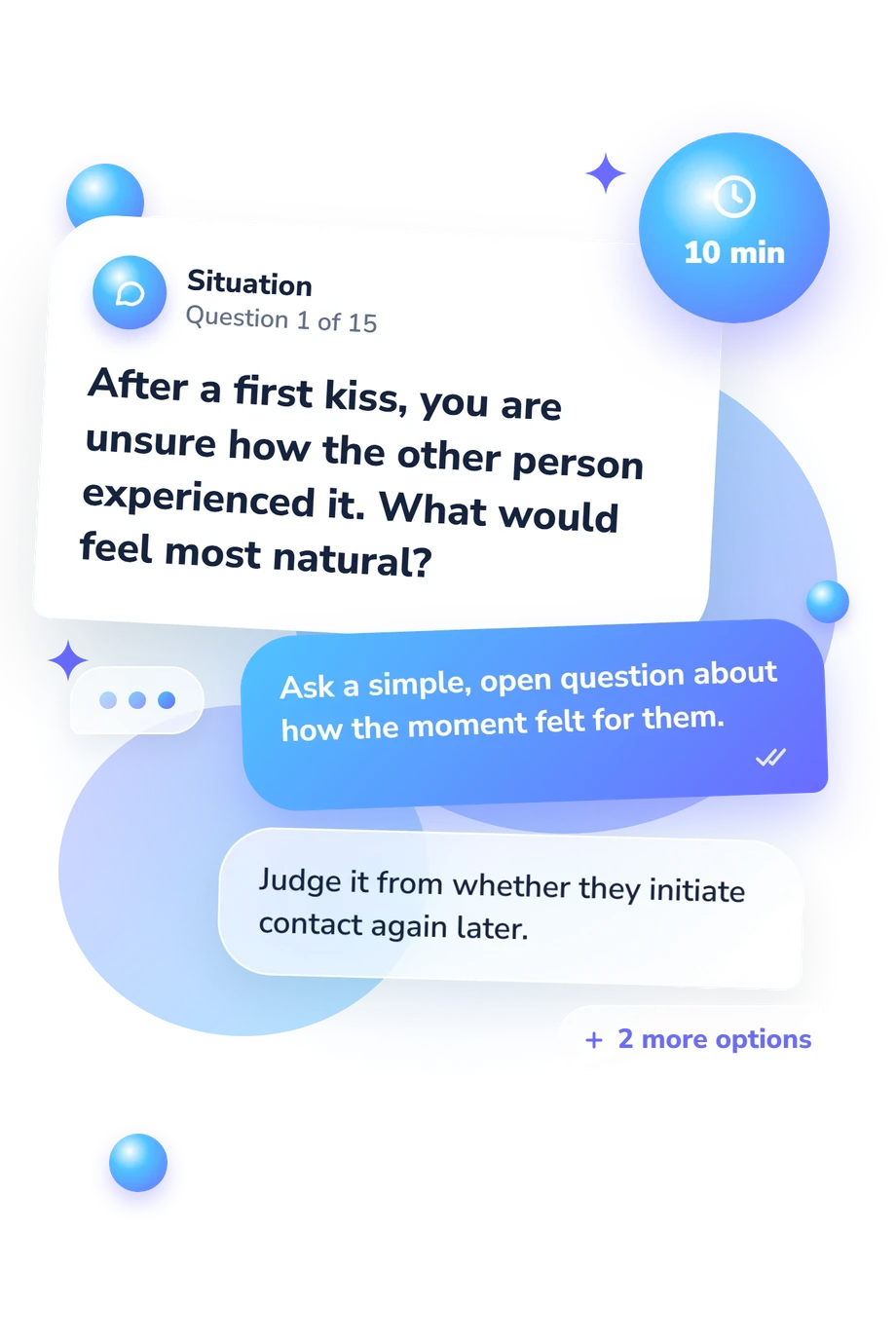
- Ask a simple, open question about how the moment felt for them.
- Judge it from whether they initiate contact again later.
- Share that I enjoyed it and give them room to respond.
- Wait for them to bring it up because asking may feel too intense.
- Change my technique to see whether their enthusiasm returns.
- Keep the kiss brief and finish the moment naturally.
- Pull back and ask how they are feeling.
- Pause and wait for a clear sign that they want more.
- Hope they discover it from my reactions over time.
- Give subtle physical hints without putting it into words.
- Mention what I enjoy in a light, non-demanding way.
- Keep the preference to myself so the moment stays spontaneous.
Am I a Good Kisser Quiz - Description and methodology of the test
People reflecting on intimate habits can use this assessment to examine how they notice comfort, communicate preferences, and adapt in real time. The Am I a Good Kisser Quiz is intended for anyone who wants to understand the relational side of kissing rather than receive a technique score. This kissing self-assessment turns uncertainty about kissing into specific, observable interaction habits that can be reflected on and discussed.
What This Assessment Explores
Kissing is reciprocal, not a fixed collection of techniques. Scenarios ask how someone notices hesitation, checks comfort, shares preferences, responds to feedback, and adjusts pace, pressure, movement, or intensity. The assessment measures interactional habits, not technical talent. Consent in kissing remains ongoing: no score certifies consent; participation and comfort require attention in the moment.
The result has three dimensions:
- Boundary Attunement (0-15) measures attention to boundaries: Assumption-Led (0-5), Generally Attentive (6-10), and Clearly Attuned (11-15) show increasing responsiveness.
- Connection and Communication (0-15) measures presence and preference-sharing: Mostly Unspoken (0-5), Emerging Openness (6-10), and Connected Communicator (11-15) show increasing openness.
- Physical Adaptability (0-15) reflects adjustment to pace, pressure, movement, and comfort: Personal Default (0-5), Responsive Range (6-10), and Flexible Approach (11-15) show increasing flexibility.
Together, the scales describe tendencies in interaction, not a partner’s experience or one universally preferred style.
Methodology and Evidence Base
The scenario-based self-report format presents four response options describing ways of checking in, slowing down, adapting, or relying on assumptions. Responses contribute to three dimensions, but the questionnaire does not state how many points each choice adds; weights cannot be inferred from score ranges.
The resulting profile focuses on kissing communication and physical adjustment, describing current habits rather than offering a universal verdict.
Rota and Watkins (2025) offer the closest subject-specific comparison by examining what people associate with a satisfying kiss. The questionnaire is conceptually consistent with Vowels et al. (2022) on sexual need responsiveness and Moazami et al. (2023) on sexual communication, but it is not an adaptation, standardized version, or validation of those instruments.
Current kissing habits and responsiveness are the focus, so the result highlights patterns for reflection and areas to notice in future interactions. As self-report, scores can reflect recall, self-awareness, honesty, and context; use them as reflection prompts, not fixed judgments.
- Rota, Milena V., and Christopher D. Watkins. “Proclivity for sexual fantasy accounts for differences in the perceived components of a ‘good kiss’.” Sexual and Relationship Therapy. Advance online publication, December 30, 2025. 10.1080/14681994.2025.2608188
- Vowels, Laura M., Carla A. Roos, Jasmina Mehulić, Siobhan M. O’Dean, and M. Dolores Sánchez-Hernández. “What Does It Mean to Be Responsive to a Partner’s Sexual Needs? Toward a Definition of Sexual Need Responsiveness.” Archives of Sexual Behavior, 51(8), 3735-3747, 2022. 10.1007/s10508-022-02432-2
- Moazami, Sara, Marilyn Ashley, Konrad Czechowski, Erin Leigh Courtice, and Krystelle Shaughnessy. “The Sexual Communication Scale (SeCS).” Journal of Sex Research, 60(1), 71-90, 2023. 10.1080/00224499.2022.2129558
Updated: