
What Artist Am I Quiz
How the Scales are Structured
Who Usually Takes This Test?
See How You Compare
Below is a preview of how scores are typically distributed across each scale.
Example Questions From the Test
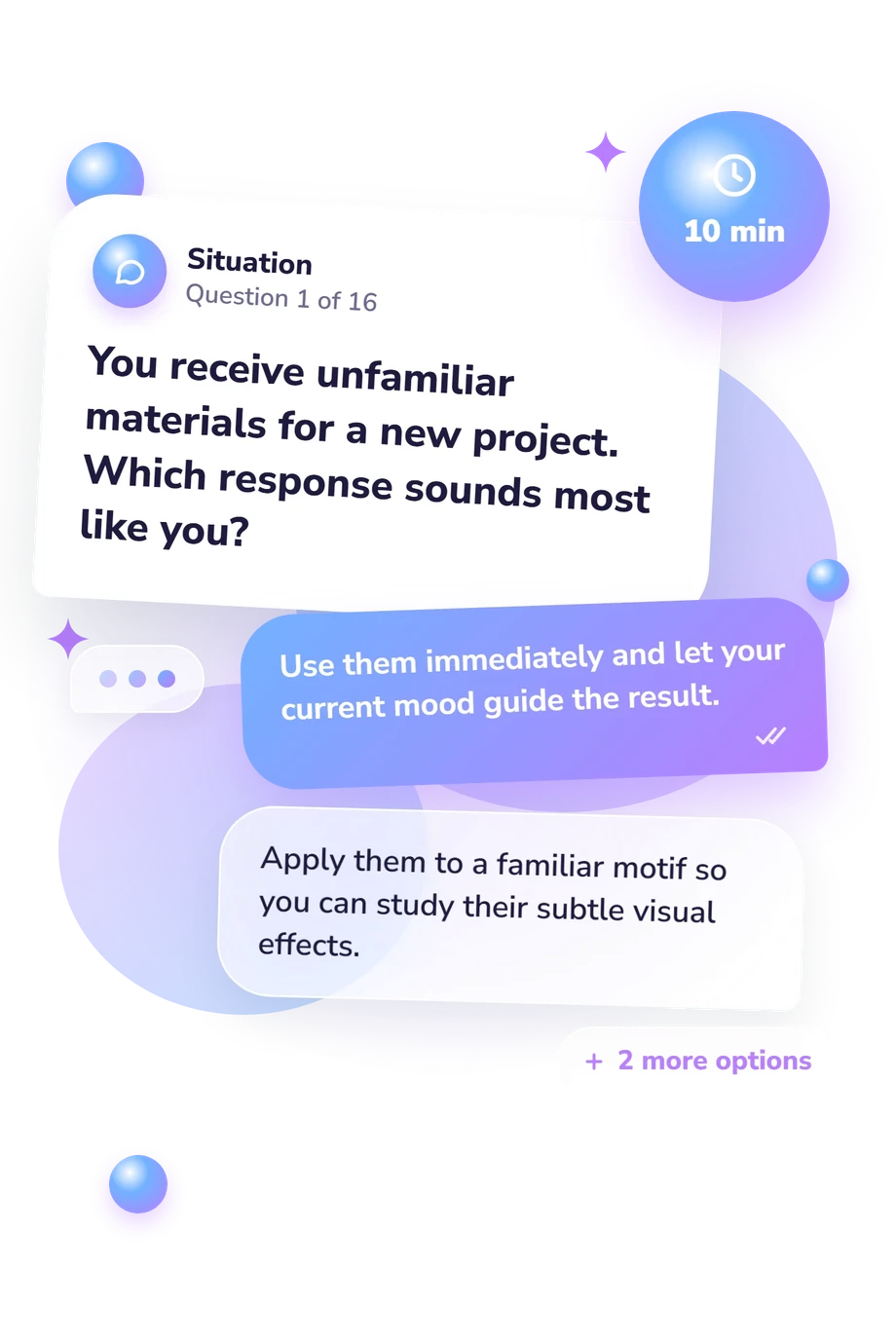
- Use them immediately and let your current mood guide the result.
- Apply them to a familiar motif so you can study their subtle visual effects.
- Connect them with symbols from your own history or background.
- Combine them in an unexpected process that changes how the image is constructed.
- Challenging the basic rules by which objects are represented.
- Preserving the atmosphere of a moment before it changes.
- Exploring how identity and personal history shape experience.
- Revealing dignity, movement, or emotion within ordinary life.
- The sensation of witnessing a brief, luminous moment.
- A new understanding of how familiar objects can be constructed.
- The emotional current carried by the colors and marks.
- The intimate truth suggested by its recurring personal symbols.
What Artist Am I Quiz - Description and methodology of the test
For readers exploring their creative instincts, the What Artist Am I Quiz offers a reflective profile of artistic affinity rather than a measure of skill. It suits curious beginners, practicing makers, and art lovers who want language for reactions to light, symbolism, structure, and expressive color. Read as a what artist are you quiz, it connects those preferences with four recognizable artistic sensibilities.
What This Assessment Explores
This assessment compares preferences for light, symbolism, formal disruption, and emotional color. It describes creative orientation rather than ability, making it useful as an am I an artist quiz for identifying a profile.
These four profiles show which orientation your responses most closely reflect.
- Claude Monet (0-12) reflects sensitivity to light, atmosphere, repeated observation, and fleeting change: Different muse (0-4), Impressionist connection (5-8), Strong Monet affinity (9-12).
- Frida Kahlo (0-12) reflects symbolic autobiography, identity, resilience, and culturally rooted imagery: Different muse (0-4), Symbolic connection (5-8), Strong Kahlo affinity (9-12).
- Pablo Picasso (0-12) reflects formal experimentation, multiple viewpoints, reinvention, and challenges to convention: Different muse (0-4), Experimental connection (5-8), Strong Picasso affinity (9-12).
- Vincent van Gogh (0-12) reflects emotional color, energetic mark-making, and meaning found in everyday subjects: Different muse (0-4), Expressive connection (5-8), Strong van Gogh affinity (9-12).
Methodology and Scientific Basis
Each prompt describes a creative situation and offers four responses representing sensory observation, personal symbolism, structural experimentation, or emotional intensity. In practical terms, it works as a what kind of artist am I quiz: preference patterns matter more than skill.
The result assigns a score to each profile and compares the totals. The highest is the strongest affinity; scores within one point form a blend. Bands indicate increasing resemblance, not diagnostic cutoffs. As a what type of artist am I quiz, it gives a comparative snapshot rather than a fixed identity.
Conceptually, the questionnaire is consistent with the Aesthetic Judgment Style Scale (Bahrami-Ehsan et al., 2015), which distinguishes responses to aesthetic experience; it is not a standardized administration or adaptation of that scale. Chamorro-Premuzic et al. (2009) link artistic preferences with openness, while Afhami and Mohammadi-Zarghan (2018) examine personality, aesthetic response patterns, and art interest. These sources support reflective interpretation, not a claim that this questionnaire has their norms or validation.
Self-reporting makes mood, cultural experience, art familiarity, and self-presentation relevant influences. A close or blended result is best read as a snapshot of current preferences.
- Bahrami-Ehsan, H., Mohammadi-Zarghan, S., & Atari, M. (2015). Aesthetic Judgment Style: Conceptualization and Scale Development. International Journal of Arts, 5(2), 33-39.
- Chamorro-Premuzic, T., Reimers, S., Hsu, A., & Ahmetoglu, G. (2009). Who art thou? Personality predictors of artistic preferences in a large UK sample: The importance of openness. British Journal of Psychology, 100(3), 501-516. 10.1348/000712608X366867
- Afhami, R., & Mohammadi-Zarghan, S. (2018). The Big Five, Aesthetic Judgment Styles, and Art Interest. Europe's Journal of Psychology, 14(4), 764-775. 10.5964/ejop.v14i4.1479
Updated: