
Is My Boss Attracted to Me Quiz
How the Scales are Structured
Who Usually Takes This Test?
See How You Compare
Below is a preview of how scores are typically distributed across each scale.
Example Questions From the Test
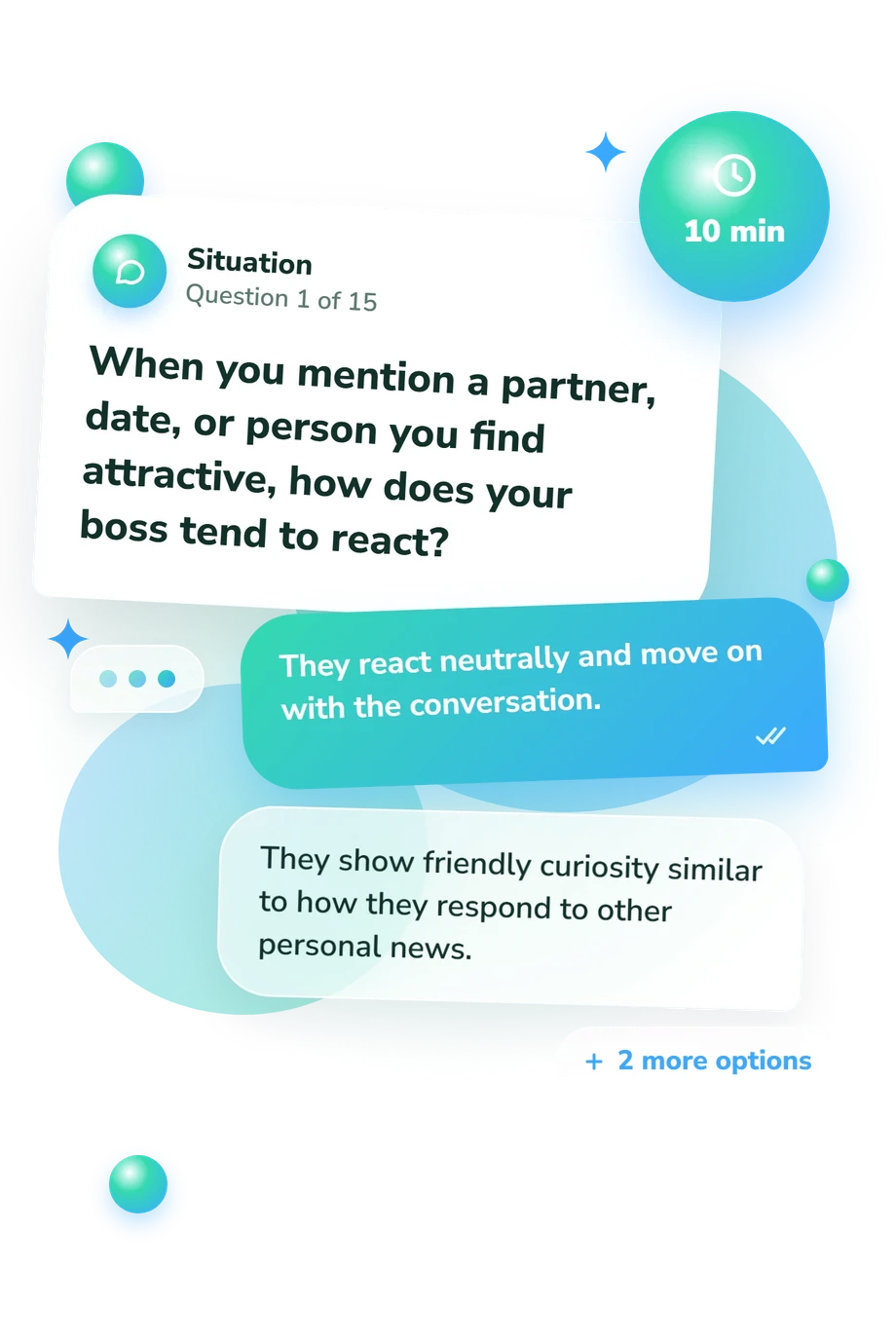
- They react neutrally and move on with the conversation.
- They show friendly curiosity similar to how they respond to other personal news.
- They tease, probe, or act noticeably disappointed in a way that feels personally charged.
- They express jealousy, compete with the person, or suggest that you should choose them instead.
- They generally maintain ordinary professional space.
- There has been occasional welcome contact, such as a culturally typical greeting, without pressure.
- They repeatedly move unusually close or initiate unnecessary contact that leaves me uncertain or uncomfortable.
- They have touched, cornered, blocked, restrained, or otherwise physically approached me against my wishes.
- Occasionally; the interaction is friendly but brief.
- Frequently, and the contact often becomes personal or unusually attentive.
- Rarely; most contact has a clear work purpose.
- Fairly often, with no clear operational reason for choosing me.
Is My Boss Attracted to Me Quiz - Description and methodology of the test
People who feel singled out, pressured, or uncertain around a supervisor can use the Is My Boss Attracted to Me Quiz to organize what they have noticed. In a does my boss have a crush on me quiz, attraction is only part of the concern; boundaries, unequal treatment, and job-related leverage may matter more. The result offers a profile of patterns that may affect comfort and professional choices.
What This Assessment Explores
The questions examine workplace situations rather than personality. They cover unwanted contact, romantic or appearance-focused attention, being singled out, boundary responses, unequal opportunities, and fear of consequences. For readers considering an is my boss flirting with me quiz, this structure separates personal signals from conduct that can affect safety or freedom; it does not claim to read a supervisor’s private motives.
The three displayed scales cover these result dimensions:
- Boundary and Power Concerns (0-15) reads pressure, unwanted contact, retaliation, and job-linked leverage: Limited strain (0-5), Boundaries under strain (6-10), Action-worthy concern (11-15).
- Differentiated Attention (0-15) reads whether a supervisor singles the respondent out compared with coworkers: Mostly role-based (0-5), Noticeably different (6-10), Strongly differentiated (11-15).
- Personal and Flirtatious Signals (0-15) reads personal questions, appearance-focused compliments, suggestive messages, and invitations: Predominantly professional (0-5), Personally suggestive (6-10), Repeatedly flirtatious (11-15).
Methodology and Scientific Basis
Each prompt presents a workplace scenario with four response options, from ordinary professional conduct to pressure, explicit flirtation, or retaliation. This format compares concrete events with personal experience rather than rating a personality trait.
Five item scores feed each scale, producing a total from 0 to 15. The answer-to-point mapping belongs to the questionnaire and should not be inferred from the range. A does my boss like me quiz result cannot prove another person’s motives; read the band with coworker comparison, consent, and context.
The structure is conceptually consistent with situation-specific assessment in SEQ-SE (Mazzeo et al., 2001), which emphasizes concrete behaviors and settings. Fitzgerald et al. (1995) supports a multidimensional view; McLaughlin et al. (2012) addresses authority and reporting, and Gutek et al. (2004) emphasizes context in self-report.
This online questionnaire is not a documented standardized administration or adaptation of SEQ-SE, so its bands are not published norms, clinical thresholds, or legal findings. An is my male boss attracted to me quiz result may reflect memory, stress, or uncertainty about intent; threats, forced contact, retaliation, or job-linked demands warrant attention regardless of total.
- Mazzeo, Suzanne E., Mindy E. Bergman, NiCole T. Buchanan, Fritz Drasgow, and Louise F. Fitzgerald. (2001). Situation-Specific Assessment of Sexual Harassment. Journal of Vocational Behavior, 59(1), 120-131. 10.1006/jvbe.2000.1781
- Fitzgerald, Louise F., Michele J. Gelfand, and Fritz Drasgow. (1995). Measuring Sexual Harassment: Theoretical and Psychometric Advances. Basic and Applied Social Psychology, 17(4), 425-445. 10.1207/s15324834basp1704_2
- McLaughlin, Heather, Christopher Uggen, and Amy Blackstone. (2012). Sexual Harassment, Workplace Authority, and the Paradox of Power. American Sociological Review, 77(4), 625-647. 10.1177/0003122412451728
- Gutek, Barbara A., Ryan O. Murphy, and Bambi Douma. (2004). A Review and Critique of the Sexual Experiences Questionnaire (SEQ). Law and Human Behavior, 28(4), 457-482. 10.1023/B:LAHU.0000039335.96042.26
Updated: