
Crossword Quiz
How the Scales are Structured
Who Usually Takes This Test?
See How You Compare
Below is a preview of how scores are typically distributed across each scale.
Example Questions From the Test
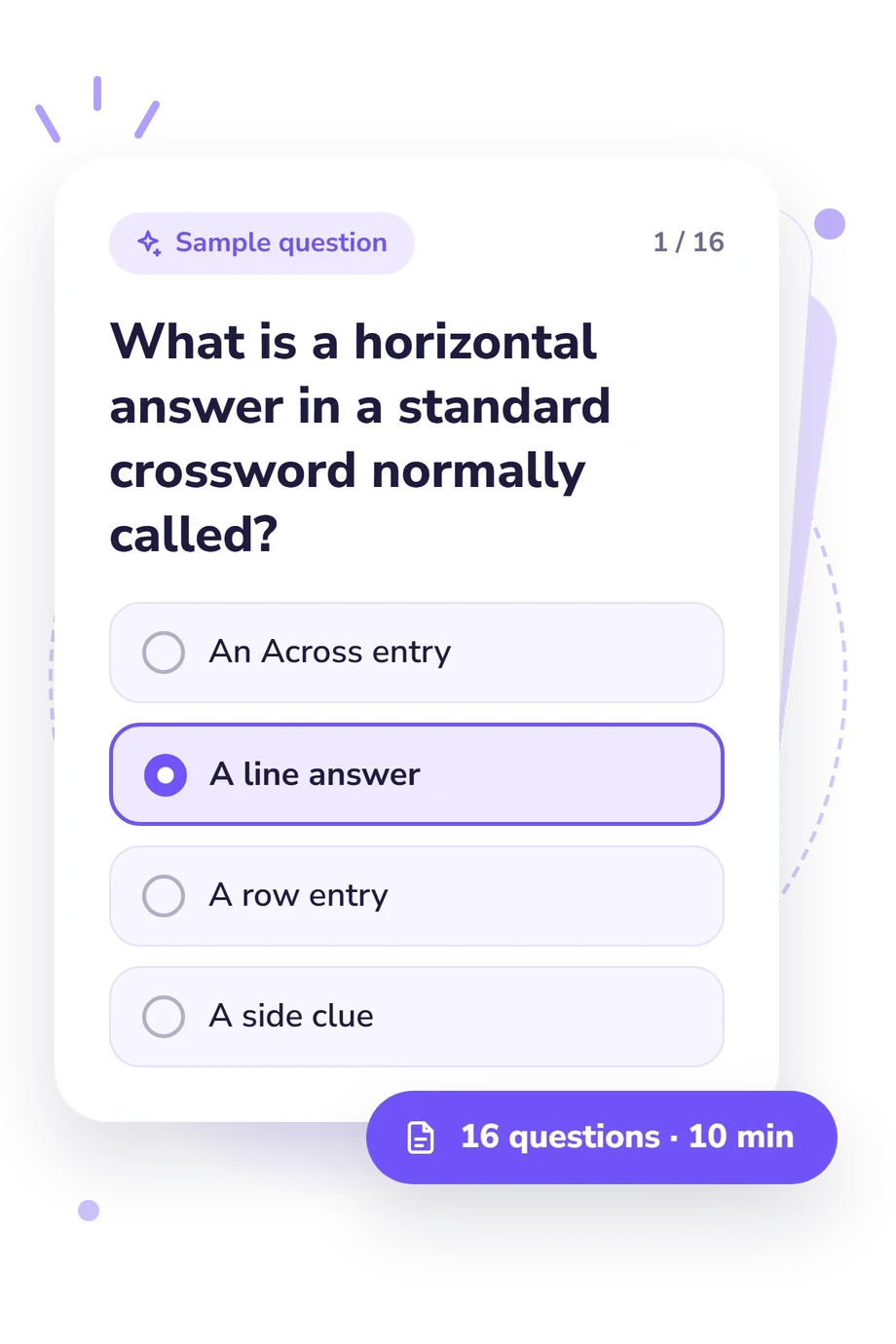
- An Across entry
- A line answer
- A row entry
- A side clue
- RAT
- BAT
- HAT
- CAT
- AWAY
- MISSING
- ABSENT
- OMITTED
Crossword Quiz - Description and methodology of the test
For readers who want to sharpen everyday solving decisions, this online crossword assessment checks how well they connect clue wording with answer length, crossings, and familiar grid conventions. The crossword quiz is suitable for learners, casual solvers, and experienced players reviewing basic technique. It offers a focused snapshot of practical knowledge, helping readers decide which solving conventions deserve more practice rather than testing obscure trivia.
What This Assessment Measures
The questions focus on knowledge used to move from clue to entry. They sample definitions, answer length, crossings, abbreviations, compass points, punctuation, themes, anagrams, rebus squares, and black-square functions. The result reflects recognition of signals and clues.
The question-content themes are:
- Clue interpretation shows how grammar, definitions, punctuation, and playful wording narrow answers.
- Grid logic shows how checked letters, enumerations, entries, and black squares organize solving.
- Themes and wordplay show how categories, anagrams, rebus features, and structural twists affect answers.
These skills suit learners, casual solvers, and people using this crossword skills test to review their solving. Crossword Knowledge is scored from 0-16: Foundation Builder (0-6) indicates basic conventions need practice; Developing Solver (7-12) reflects useful command with room to broaden technique; Strong Crossword Knowledge (13-16) indicates confident command of sampled clues, signals, crossings, themes, and grid terminology.
Methodology and Evidence Base
Each item presents a clue or grid situation with four answer choices. The respondent selects the option best supported by clue meaning, enumeration, crossings, and standard conventions. The displayed result uses one scale rather than separate subscores, while the items sample several puzzle situations.
The questionnaire is an online skills check covering practical crossword conventions and clue-solving decisions. Hambrick et al. (1999) provides the closest evidence base for viewing crossword proficiency as performance involving knowledge and cognitive demands. Thanasuan and Mueller (2014) connect crossword expertise with recognitional decision-making, while Manley’s manual supplies terminology for clue types and grid mechanics. These sources are conceptually consistent with the questionnaire; they do not establish its norms or validation.
Interpret the result as a snapshot of the sampled conventions. Using the result from this online crossword test can support practice tracking, but performance may vary with language knowledge, prior puzzle exposure, attention, and current confidence. The bands are catalogue categories, not population norms, and the score cannot represent every form of crossword ability.
- Hambrick, D. Z., Salthouse, T. A., & Meinz, E. J. (1999). Predictors of crossword puzzle proficiency and moderators of age-cognition relations. Journal of Experimental Psychology: General, 128(2), 131-164. 10.1037/0096-3445.128.2.131
- Thanasuan, K., & Mueller, S. T. (2014). Crossword expertise as recognitional decision making: An artificial intelligence approach. Frontiers in Psychology, 5, 1018. 10.3389/fpsyg.2014.01018
- Manley, D. (2006). Chambers Crossword Manual: A Guide for the Novice and the Enthusiast (4th ed.). Chambers.
Updated: