
Feminine Energy Quiz
How the Scales are Structured
Who Usually Takes This Test?
See How You Compare
Below is a preview of how scores are typically distributed across each scale.
Example Questions From the Test
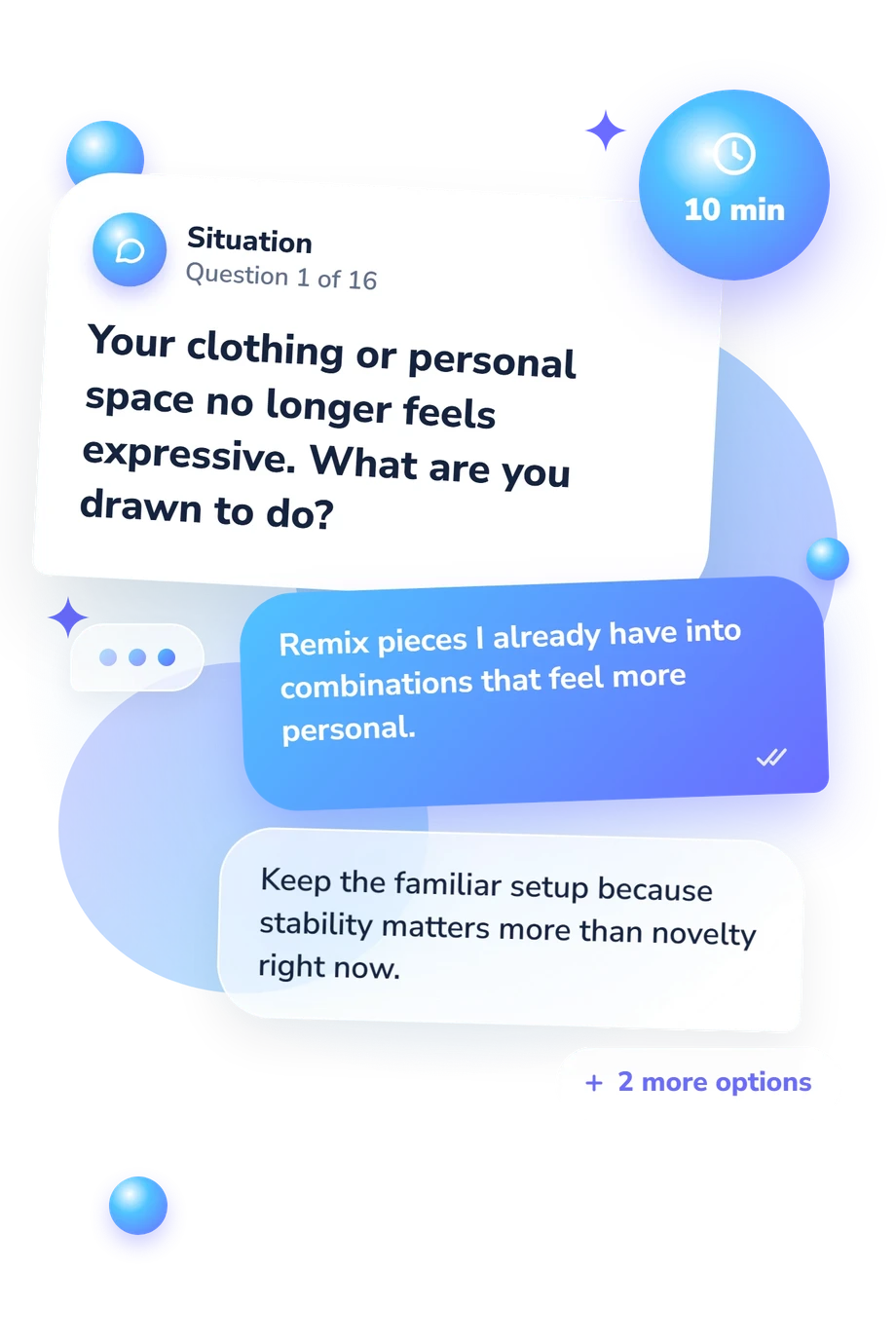
- Remix pieces I already have into combinations that feel more personal.
- Keep the familiar setup because stability matters more than novelty right now.
- Reimagine it around a fresh concept, mood, or visual story.
- Introduce one new detail and see whether it changes the overall feeling.
- Shaping the details so each person feels noticed, comfortable, and included.
- Setting up a relaxed, self-serve space where people can choose what suits them.
- Keeping the event centered on its planned activity or purpose.
- Checking preferences beforehand and adjusting a few details accordingly.
- “You made something unmistakably your own.”
- “You brought warmth and consideration to everyone involved.”
- “You saw possibilities that other people had overlooked.”
- “You were steady and dependable from beginning to end.”
Feminine Energy Quiz - Description and methodology of the test
Readers exploring creativity, intuition, care, and self-direction can use this assessment as a structured reflection exercise. The feminine energy quiz presents everyday choices without treating femininity as a fixed identity or standard to pass. Read as a how feminine are you quiz, it offers a nuanced profile of current preferences rather than a single label.
What This Assessment Explores
The situations cover style, hosting, boundaries, uncertainty, relationships, group decisions, and reflective practices. Responses point to qualities that currently feel available or satisfying; they do not determine talent, worth, or gender identity. A result from this feminine energy level quiz is therefore a snapshot of tendencies rather than a permanent label.
The profile is organized around four affinities:
- The Creator (0-12) reflects imaginative expression and making ideas tangible: Background affinity (0-4), Present affinity (5-8), or Leading affinity (9-12).
- The Mystic (0-12) reflects inward attention, intuition, symbolism, and personal meaning: Background affinity (0-4), Present affinity (5-8), or Leading affinity (9-12).
- The Nurturer (0-12) reflects attentive connection, welcoming care, and helping relationships grow: Background affinity (0-4), Present affinity (5-8), or Leading affinity (9-12).
- The Sovereign (0-12) reflects self-definition, purposeful direction, and boundaries: Background affinity (0-4), Present affinity (5-8), or Leading affinity (9-12).
Methodology and Evidence Base
Each item presents a situation with four response options. Your choices create a forced-choice profile across four affinities. The result gives a separate 0-12 score for each, but the item-level point allocation is not specified.
Conceptually, the questionnaire is consistent with the Hudson Archetypal Goddess Scale (Hudson, 2004) and Jean Shinoda Bolen’s discussions of archetypal energies. It is not a direct adaptation or restandardization of those works. The questionnaire has no stated standardization or population norms; the PMAI framework offers a related lens, not validation of these scores.
A free feminine-energy quiz can support self-observation when you compare the profile with recent choices instead of treating one score as a verdict. Mood, social expectations, self-presentation, and the wish to choose a pleasing answer can influence self-report. These influences make context important when you revisit the result.
The profile should not be read as an am I feminine enough quiz: no band represents superior femininity, and a lower affinity is not a deficit. Interpretation is descriptive and contextual; results may reflect a temporary state as well as a preference.
- Hudson, Peggy Alexander. Measurement of the Dominant Goddess Archetypes: Development of the Hudson Archetypal Goddess Scale (HAGS). Doctoral dissertation, Oklahoma State University, 2004.
- Bolen, Jean Shinoda. “From Penis Envy to Goddesses in Everywoman: Revising Theory to Fit Experience.” Women & Therapy, vol. 11, no. 1, 1991, pp. 35-53. 10.1300/J015V11N01_04.
- Bolen, Jean Shinoda. Goddesses in Everywoman: A New Psychology of Women. San Francisco: Harper & Row, 1984.
- Blandin, Kesstan, Hugh K. Marr, and Carol S. Pearson. PMAI Manual. Gainesville, FL: Center for Applications of Psychological Type, 2021. ISBN 978-0-935652-05-5.
Updated: