
Can You Vote in 1870 Quiz
How the Scales are Structured
Who Usually Takes This Test?
See How You Compare
Below is a preview of how scores are typically distributed across each scale.
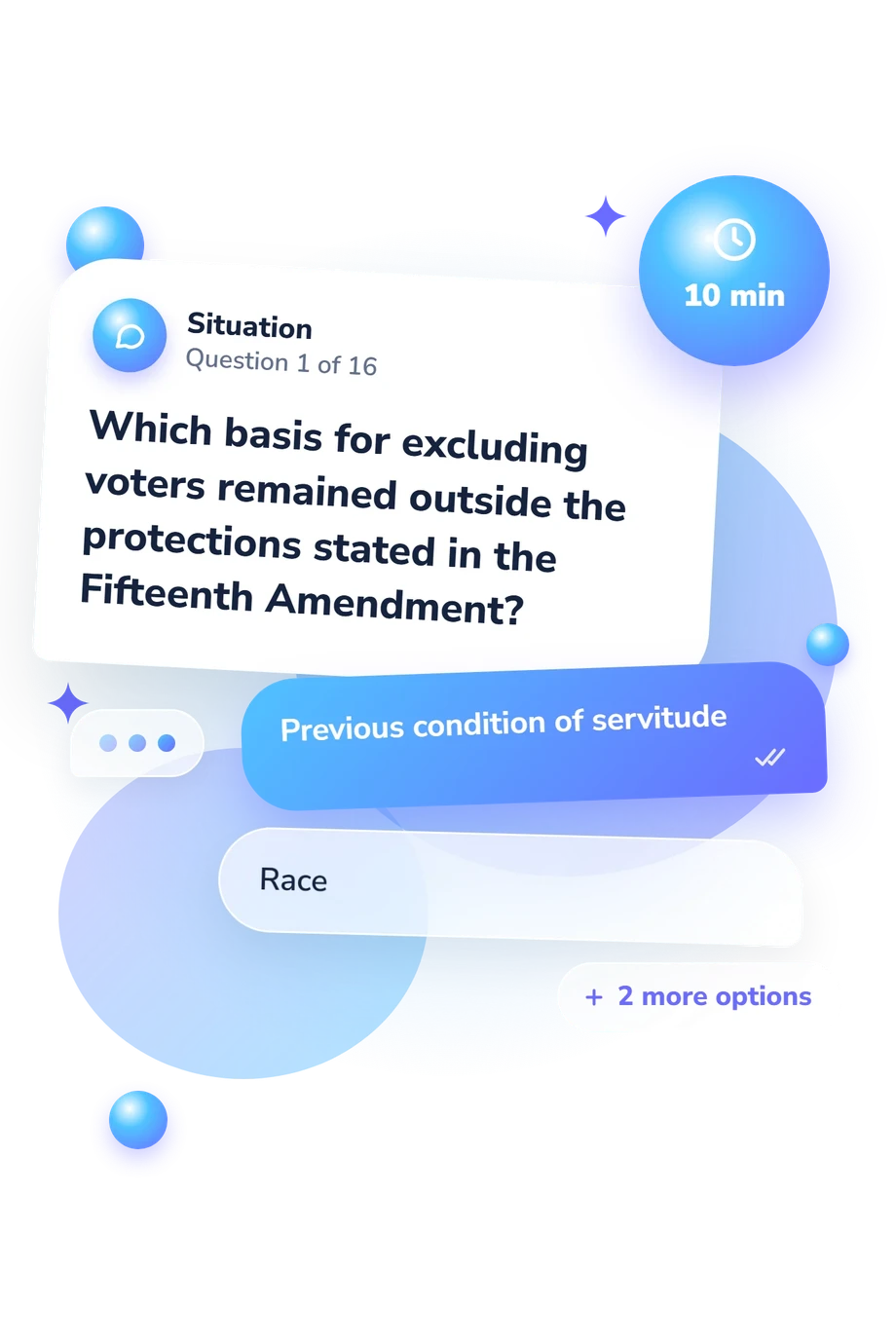
Example Questions From the Test
- Previous condition of servitude
- Race
- Sex
- Color
- The law is impossible because voting rules could never differ by type of election
- Voting eligibility could vary by jurisdiction and election, and the Fifteenth Amendment did not prohibit sex-based limits
- Any school-election vote automatically qualified a woman for every federal election
- The Fifteenth Amendment required women’s suffrage only in local elections
- The president through executive orders
- The U.S. Supreme Court through a single national voter code
- Individual states and, in territories, their governing laws
- Political parties through their national platforms
Can You Vote in 1870 Quiz - Description and methodology of the test
Readers interested in constitutional history can use the Can You Vote in 1870 Quiz to apply period rules to specific cases rather than judge eligibility from one personal fact. The test turns historical knowledge into an evaluation of hypothetical circumstances. When an individual case appears in the can i vote in 1870 quiz, interpretation requires a specific date, jurisdiction, and election.
What This Assessment Explores
The questionnaire measures historical knowledge of the conditions that shaped voting access in 1870, rather than a timeless personal entitlement. It asks readers to separate constitutional prohibitions from qualifications left to states, territories, or particular elections.
These themes explain results:
- Constitutional boundaries show what the Fifteenth Amendment prohibited and left unsettled.
- Jurisdiction and election type explain why voting rules varied across places and contests.
- Citizenship and qualifications cover naturalization, age, sex, and legal status.
- Enforcement and intimidation show how formal rights could be obstructed.
The result requires applying the period's rules to a hypothetical person's circumstances in the could you vote in 1870 quiz question, including poll-tax rules, Native American status, and local access. U.S. Voting in 1870 Knowledge runs 0-16: Foundation (0-6) marks review needs, Developing (7-12) reflects a partial framework, and Strong (13-16) indicates accurate application of rules and context.
Methodology and Scientific Basis
Each item presents a historical situation or constitutional question with four choices. Choosing the best-supported conclusion tests application rather than personal narrative. The format requires attention to date, jurisdiction, election type, citizenship, age, constitutional limits, and practical access.
The would you be able to vote in 1870 quiz item asks readers to evaluate eligibility under local and constitutional rules. The Fifteenth Amendment, ratified February 3, 1870, supplies the constitutional anchor. Crum (2024) provides the closest framework; this questionnaire is conceptually consistent with that work. The questionnaire is an original historical knowledge quiz, not an adaptation of a published instrument. Re and Re (2012) place Reconstruction restrictions in context, while Greenberger and Smith (2025) support the distinction between formal rights and effective political representation.
The displayed result is a structured knowledge summary with catalogue-defined bands, not a clinical threshold. Results may vary with prior study, wording, or uncertainty between plausible choices. This result indicates historical understanding: the could i vote in 1870 quiz item cannot decide an individual's eligibility without the relevant date, jurisdiction, and election. Formal eligibility depended on applicable rules; practical access also depended on enforcement and intimidation.
- Crum, Travis. The Unabridged Fifteenth Amendment. Yale Law Journal 133, no. 4 (2024): 1039-1161. 10.2139/ssrn.4390108.
- Re, Richard M., and Christopher M. Re. Voting and Vice: Criminal Disenfranchisement and the Reconstruction Amendments. Yale Law Journal 121, no. 7 (2012): 1584-1670.
- United States Constitution. Amendment XV, ratified February 3, 1870.
- Greenberger, Michael, and Jasmine Carrera Smith. Federal Enforcement and Black Political Representation: Evidence from Reconstruction and the Voting Rights Act. Journal of Race, Ethnicity, and Politics 10, no. 3 (2025): 742-765. 10.1017/rep.2025.33.
Updated: