
Baby Quiz
How the Scales are Structured
Who Usually Takes This Test?
See How You Compare
Below is a preview of how scores are typically distributed across each scale.
Example Questions From the Test
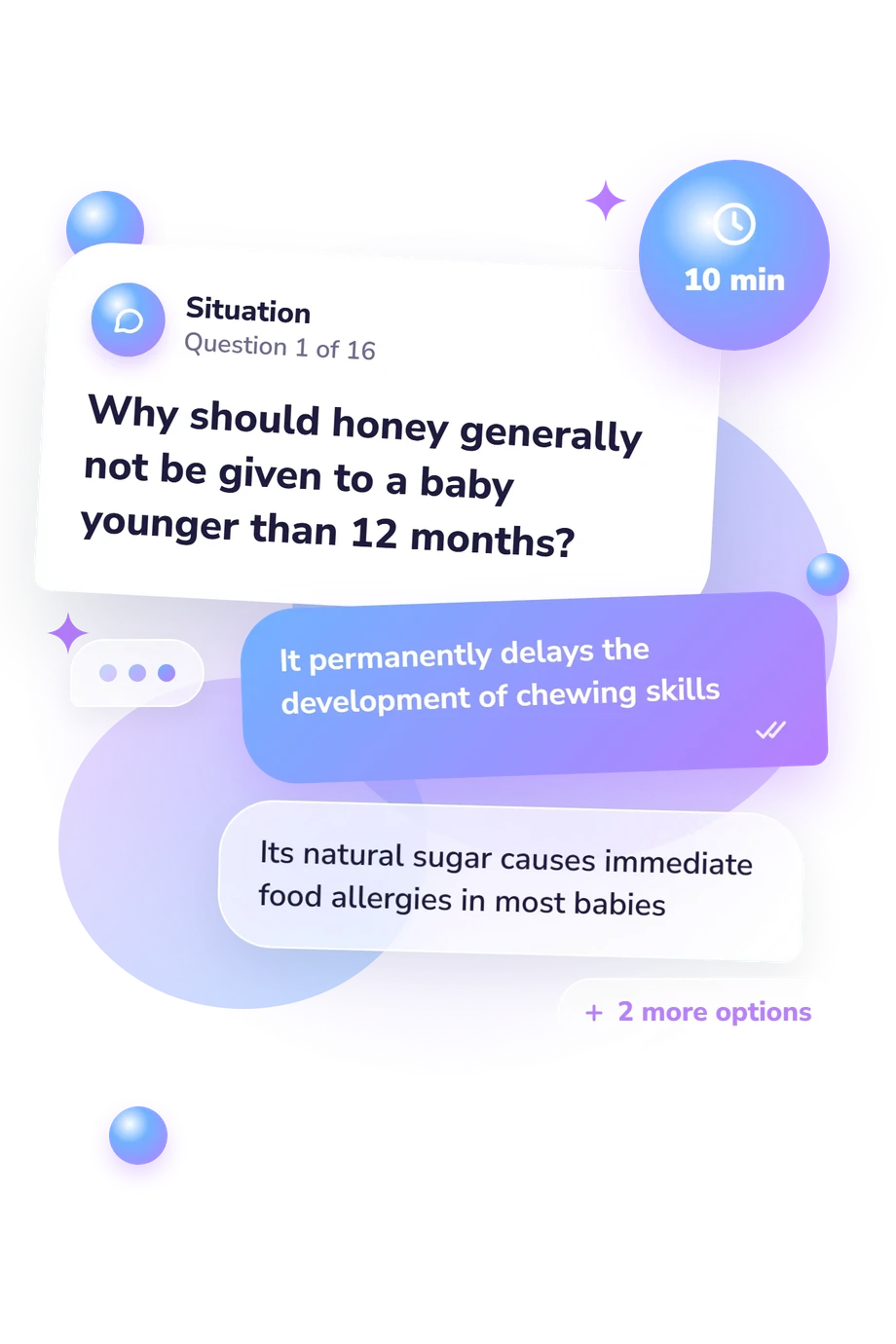
- It permanently delays the development of chewing skills
- Its natural sugar causes immediate food allergies in most babies
- It can contain spores associated with infant botulism
- It prevents the body from absorbing iron from milk
- Peel them but leave them whole so they remain easy to grasp
- Cut them lengthwise into quarters
- Slice them crosswise into round coin shapes
- Flatten them slightly while keeping the skin and shape intact
- Try another feed and reassess after the baby sleeps
- Seek emergency medical help immediately
- Use a common colic remedy and monitor for the rest of the day
- Record the symptoms for discussion at the next routine visit
Baby Quiz - Description and methodology of the test
Parents, relatives, babysitters, and other caregivers can use this baby quiz to check whether everyday infant-care guidance feels familiar before a real decision arises. It is intended for people who want to judge their readiness to respond calmly when a caregiving decision requires practical judgment. As a quiz about babies, this assessment helps turn broad concern into focused preparation by showing overall knowledge rather than evaluating an infant.
What This Assessment Explores
Rather than assessing an infant directly, the questionnaire examines caregiver knowledge in practical situations. Items cover feeding, safe sleep, transport, choking response, medicine measurement, developmental readiness, responsive care, and warning signs. The emphasis is on choosing an appropriate action, not recalling technical terms.
Practical content makes this a baby facts quiz about applying infant-care guidance, not trivia. The questions form these thematic groups:
- Feeding questions cover age-appropriate choices, hunger cues, and risks.
- Safety questions cover sleep, transport, choking, and medicine.
- Development questions cover readiness and milestones.
- Warning-sign questions test whether symptoms prompt timely advice.
- Responsive-care questions test cues and safe stress management.
These form one Baby Knowledge score (0-16). Foundations to build (0-6) calls for core-guidance review; Developing knowledge (7-12) reflects understanding of many essentials with some details to refresh; Strong knowledge (13-16) reflects broad understanding of common infant-care principles.
Methodology and Evidence Base
Each question describes a caregiving situation and offers four answer choices; the respondent selects the best answer. The total awards one point for each correct response, so it reflects knowledge shown on these items rather than a child’s condition. It identifies subjects for review without representing every real-life decision.
The method is conceptually consistent with Knowledge of Infant Development Inventory (MacPhee, 1981), which organizes parenting knowledge into practical domains. This online questionnaire is not a standardized adaptation of that instrument. Bornstein, Yu, and Putnick (2020) support interpreting parenting knowledge as specific to the domain and context. The American Academy of Pediatrics guide supplies clinical background for infant care, while Joyner et al. (2025) supports emergency-response content.
Before caring for a new baby, respondents answer this quiz when preparing for a new baby; unfamiliar items may invite guesses. Results can be influenced by memory, experience, changing guidance, and the pressure of an actual event. The educational score is not a validated health assessment and cannot evaluate an individual baby; follow local professional guidance and seek urgent help for breathing difficulty, unresponsiveness, or other severe symptoms.
- MacPhee D. Knowledge of Infant Development Inventory Manual. Unpublished manual; 1981.
- Bornstein MH, Yu J, Putnick DL. Mothers' parenting knowledge and its sources in five societies: Specificity in and across Argentina, Belgium, Italy, South Korea, and the United States. International Journal of Behavioral Development. 2020;44(2):135-145. 10.1177/0165025419861440
- American Academy of Pediatrics. Caring for Your Baby and Young Child: Birth to Age 5. 7th ed. Edited by Tanya Remer Altmann, David L. Hill, Steven P. Shelov, and Robert E. Hannemann. American Academy of Pediatrics; 2019. 10.1542/9781610023443
- Joyner BL Jr, Dewan M, Bavare A, de Caen A, DiMaria K, Donofrio-Odmann J, Fosse G, Haskell S, Mahgoub M, Meckler G, Requist J, Schexnayder SM, Olech Smith M, Werho D, Raymond TT. Part 6: Pediatric Basic Life Support: 2025 American Heart Association and American Academy of Pediatrics Guidelines for Cardiopulmonary Resuscitation and Emergency Cardiovascular Care. Circulation. 2025;152(suppl 2):S424-S447. 10.1161/CIR.0000000000001370
Updated: