
Academic Integrity Quiz
How the Scales are Structured
Who Usually Takes This Test?
See How You Compare
Below is a preview of how scores are typically distributed across each scale.
Example Questions From the Test
- Acceptable paraphrasing because the wording was changed
- Permitted research because the student entered the prompt personally
- Unauthorized assistance because the prohibited tool contributed to the answer
- Independent work because the final answer was typed by the student
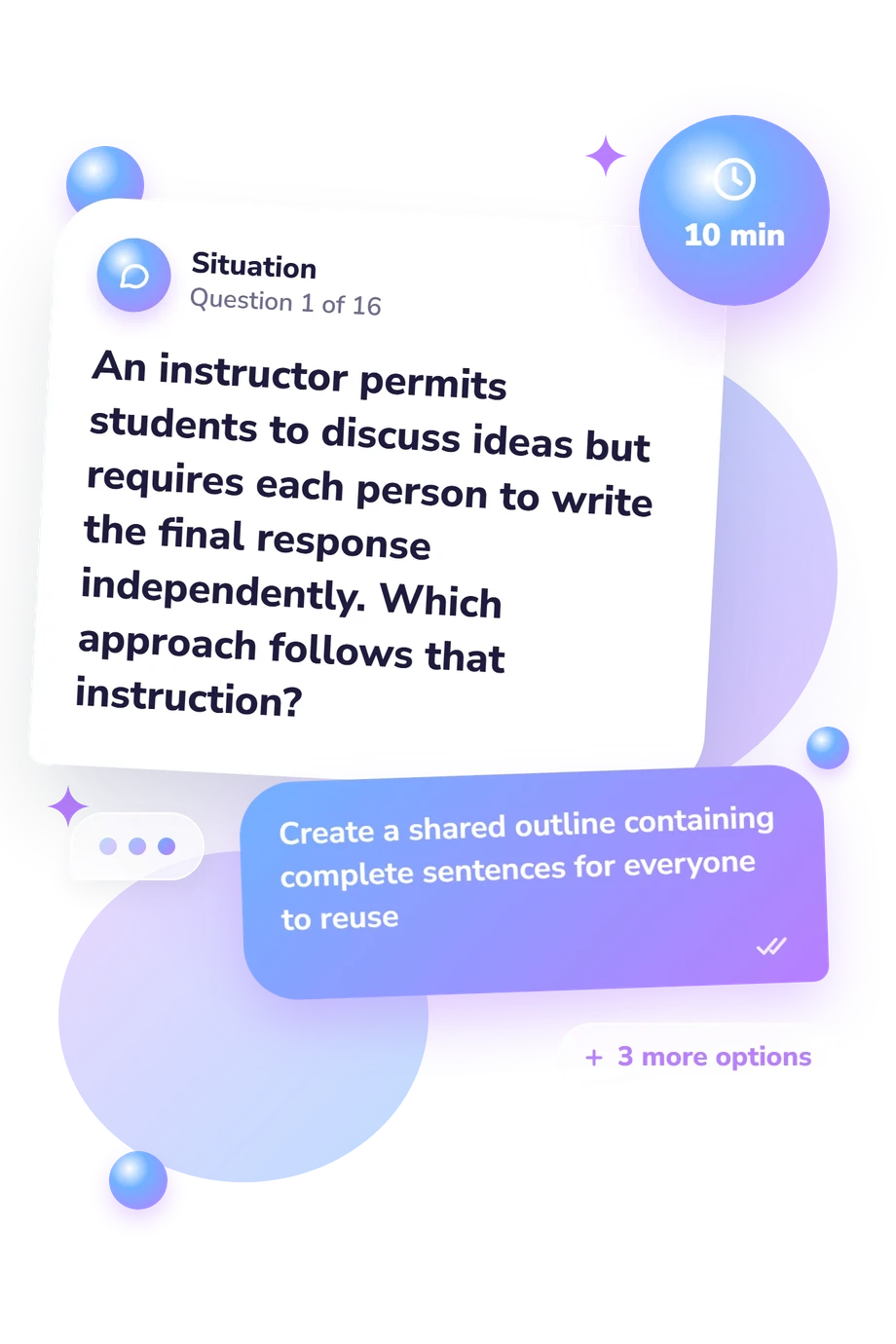
- Create a shared outline containing complete sentences for everyone to reuse
- Discuss possible approaches, then separate and independently compose each response
- Exchange finished responses and rewrite sections for one another
- Have one student prepare a model response that the others closely follow
- Reuse it without disclosure because a writer cannot misuse their own work
- Change a few words so the earlier submission no longer matters
- Ask a classmate to insert the paragraph into the new assignment
- Disclose the prior submission and seek permission, citing it if the applicable rules require
Academic Integrity Quiz - Description and methodology of the test
Designed for learners who want to examine their judgment in everyday academic-work situations, this academic integrity quiz focuses on choices involving sources, collaboration, research records, and fairness. It is useful when you want a clear starting point for reviewing expectations rather than a label about your character. The score indicates which principles deserve closer attention, while your quiz answers about academic integrity can guide review.
What This Assessment Explores
The questions examine whether a respondent can recognize responsible conduct when rules meet practical pressure. The scenario structure asks learners to apply academic-integrity rules to practical situations, so this integrity quiz tests applied understanding rather than recall of definitions. Situations cover source use, independent work, research reporting, grading fairness, and suspected violations.
The item themes are:
- Attribution and citation credit ideas, distinguish quotation from paraphrase, and let readers trace evidence.
- Independent work and collaboration show whether assistance stays within stated boundaries.
- Research conduct and records distinguish honest documentation from fabrication or misleading alteration.
- Fairness and reporting emphasize consistent treatment, responsible escalation, and avoiding public accusations.
The result reflects recognition of common principles, not a ruling under a particular school’s code, whose rules may differ on tools, disclosure, appeals, and procedures.
Methodology and Evidence Base
Each item presents a short academic scenario with four answer choices. The respondent selects the best action or classification, and each correct answer adds one point. The result is an item-based knowledge tally rather than a weighted personality profile.
Across scenarios, this quiz about academic integrity for students asks respondents to apply the relevant academic-integrity principles to attribution, collaboration, citations, research records, fairness, and reporting rather than merely recalling definitions. The Academic Integrity Knowledge, Behaviors, and Attitudes study examines knowledge, behaviors, and attitudes related to academic integrity. This questionnaire is conceptually consistent with that work, not a reproduction or validation of it. Work by Kim and Wise adds context on plagiarism beliefs and moral judgment; Hayes and Introna connect plagiarism with fairness and learning, while the 2000 OSTP research-misconduct standard distinguishes fabrication and falsification.
Academic Integrity Knowledge runs 0-16: Foundations to build (0-6), Developing knowledge (7-12), and Strong knowledge (13-16). These are educational categories for this item set, not norm-referenced or standardized population standards or universal institutional cutoffs. Local rules may differ, so course or school policies take precedence when they set a different standard.
- Wise, Jean-Marc, Shu-Hsiang (Ava) Chen, Praweenya Suwannatthachote, and Pornsook Tantrarungroj. (2013). International Plagiarism: Comparing Thai, Taiwanese, and American University Students’ Knowledge, Behaviors, and Attitudes towards Academic Integrity. In AECT Annual Convention Proceedings (pp. 239-247). Anaheim, CA: Association for Educational Communications and Technology.
- Kim, Aaron, and Jean-Marc Wise. (2009). Measuring College Students’ Perceptions and Attitudes toward Anti-Plagiarism Detection Tools and Their Behaviors, Beliefs, and Moral Judgment regarding Plagiarism. In Proceedings of the Annual Convention of the Association for Educational Communications and Technology (Vol. 1, pp. 256-264).
- Hayes, Niall, and Luciano D. Introna. (2005). Cultural Values, Plagiarism, and Fairness: When Plagiarism Gets in the Way of Learning. Ethics & Behavior, 15(3), 213-231. 10.1207/s15327019eb1503_2
- Office of Science and Technology Policy. (2000). Federal Policy on Research Misconduct; Preamble for Research Misconduct Policy. Federal Register, 65(235), 76260-76264.
Updated: