
What Does Your Handwriting Say About You Quiz
How the Scales are Structured
Who Usually Takes This Test?
See How You Compare
Below is a preview of how scores are typically distributed across each scale.
Example Questions From the Test
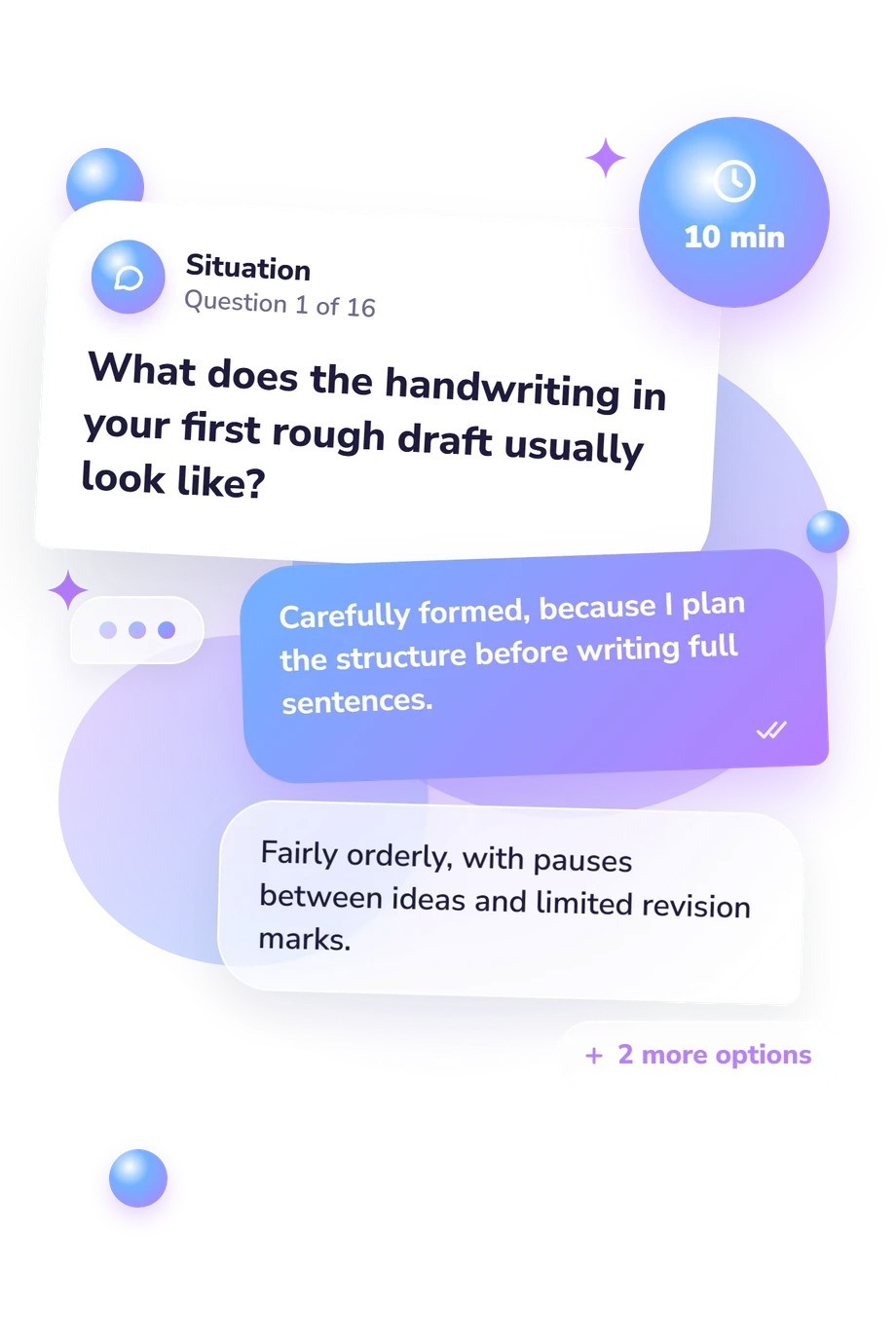
- Carefully formed, because I plan the structure before writing full sentences.
- Fairly orderly, with pauses between ideas and limited revision marks.
- Driven by momentum, with some crossings-out, arrows, or changing forms.
- Rapid and highly fluid, as though the pen is racing to keep up with the ideas.
- Letters are mostly separate and formed one at a time.
- Connections appear mainly in familiar words or phrases.
- I use a natural mix of joined and separate forms.
- Strokes connect readily, creating a continuous sense of movement.
- They are mostly medium-sized and stay within the available space.
- They are noticeably large and give the words a strong presence.
- They are compact, leaving plenty of unused space around them.
- They are moderate overall but become larger on important words.
What Does Your Handwriting Say About You Quiz - Description and methodology of the test
Readers deciding whether to explore their writing style can use the What Does Your Handwriting Say About You Quiz as a guided way to notice patterns in familiar writing situations. A handwriting quiz of this kind may help you compare how you approach a note, a draft, or a personal message and identify observations worth considering in daily communication. It suits anyone seeking a prompt for noticing changes across contexts.
What This Assessment Explores
This self-report questionnaire captures perceived writing habits rather than inspecting a handwriting sample. Readers can use the What Does My Handwriting Say About Me Quiz prompt to compare reported tendencies across situations. Its result remains tied to the style you report, not an observed fact.
The profile presents four dimensions:
- Expressive Impact (0-12) shows Subtle Presence (0-4), Selective Expression (5-8), or Strong Expressive Affinity (9-12) in visual emphasis, including size or weight.
- Minimal Economy (0-12) shows Decorative Openness (0-4), Balanced Simplicity (5-8), or Strong Minimal Affinity (9-12) in decorative detail, use of space, elaboration, or economy.
- Spontaneous Flow (0-12) shows Deliberate Pace (0-4), Adaptable Flow (5-8), or Strong Flow Affinity (9-12) in movement and pace.
- Structured Precision (0-12) shows Flexible Structure (0-4), Practical Order (5-8), or Strong Precision Affinity (9-12) in consistent form, spacing, and alignment.
Methodology and Scientific Basis
Each item offers four response descriptions covering different combinations of control, movement, emphasis, and economy. Rather than analysing a sample, this self-report handwriting analysis quiz asks you to choose the description closest to your usual behavior when writing quickly, arranging space, repeating letterforms, emphasizing words, or adapting to a new pen or surface.
Responses are organized into the displayed dimensions. The What Your Handwriting Says About You Quiz result identifies your strongest affinity; if another is within one point, the profile reads them as a blended result. This result describes reported writing-style tendencies rather than stable personality qualities.
Dazzi and Pedrabissi (2009) examined the validity of handwriting-based personality inferences, providing conceptual context. The questionnaire is conceptually consistent with Allport and Vernon’s expressive-movement framework, but it is not presented as an adaptation of that work. Klimoski and Rafaeli (1983) and Neter and Ben-Shakhar (1989) likewise offer context on inference and predictive validity. Those sources do not establish validity or norms for this online questionnaire. Its displayed bands are descriptive scoring categories, and results can vary with context, materials, purpose, and self-perception.
- Carla Dazzi and Luigi Pedrabissi. (2009). Graphology and personality: An empirical study on validity of handwriting analysis. Psychological Reports, 105(3, Part 2), 1255-1268. 10.2466/PR0.105.F.1255-1268
- Gordon W. Allport and Philip E. Vernon, with Edwin Powers. (1933). Studies in expressive movement. New York: Macmillan.
- Richard J. Klimoski and Anat Rafaeli. (1983). Inferring personal qualities through handwriting analysis. Journal of Occupational Psychology, 56(3), 191-202. 10.1111/j.2044-8325.1983.tb00127.x
- Efrat Neter and Gershon Ben-Shakhar. (1989). The predictive validity of graphological inferences: A meta-analytic approach. Personality and Individual Differences, 10(7), 737-745. 10.1016/0191-8869(89)90120-7
Updated: