
How Girly Am I Quiz
How the Scales are Structured
Who Usually Takes This Test?
See How You Compare
Below is a preview of how scores are typically distributed across each scale.
Example Questions From the Test
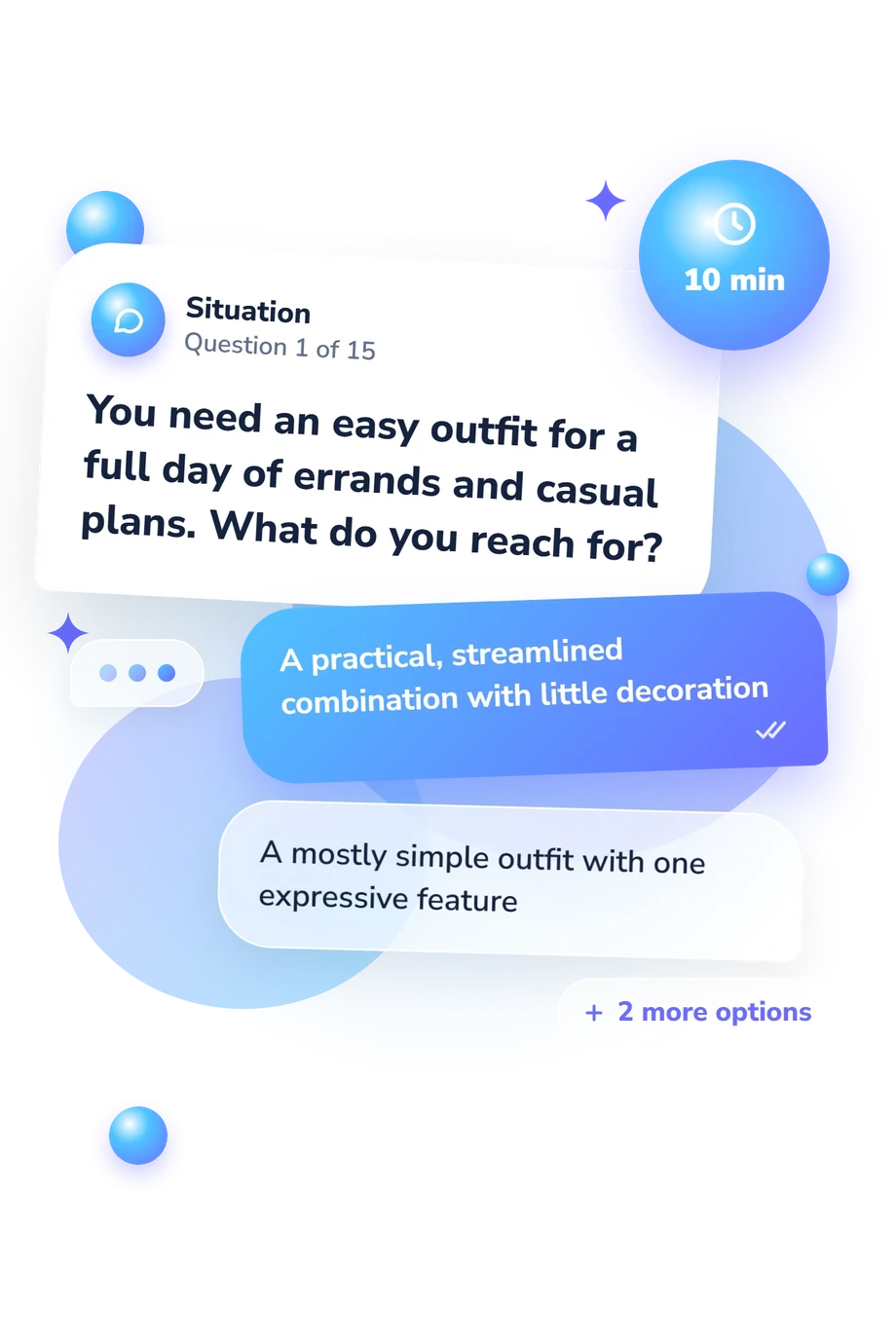
- A practical, streamlined combination with little decoration
- A mostly simple outfit with one expressive feature
- A decorative or distinctly feminine combination, even if it takes more planning
- A comfortable outfit with a few subtle style details
- They appear in a few carefully chosen places
- They shape much of the overall look
- They are present alongside several contrasting styles
- They are mostly absent because I favor a different aesthetic
- A detailed design that makes a strong feminine statement
- A classic design with a small decorative accent
- A versatile design that is mostly understated
- A clean, minimally gender-coded design that works almost anywhere
How Girly Am I Quiz - Description and methodology of the test
People curious about presentation can use the How Girly Am I Quiz to reflect on how feminine-coded details, understated choices, and shifts between them fit self-expression. This quiz lets readers explore the am i girly quiz question in context-whether their style feels girly-without turning an aesthetic pattern into a statement about gender or identity. The result is a multidimensional profile: aesthetic affinities can coexist, while presentation may remain steady or move between styles.
What This Assessment Explores
Questions cover clothing, accessories, beauty routines, rooms, personal items, and preparation for occasions. They also ask how mood, company, and context affect presentation, linking preferred style with flexibility. This makes the girly quiz useful for anyone exploring aesthetics, regardless of gender identity.
The result uses three descriptive dimensions, which indicate aesthetic tendencies rather than fixed categories:
- Girly (0-15) measures the prominence of feminine-coded colors, details, rituals, and decoration; bands are Light 0-5, Mixed 6-10, and Strong 11-15.
- Neutral (0-15) measures preference for understated, ungendered, clean, versatile choices; bands are Light Neutral 0-5, Balanced Neutral 6-10, and Strong Neutral 11-15.
- Switch (0-15) measures movement between girly and neutral modes across contexts; bands are Steady style 0-5, Situational switch 6-10, and Strong Switch affinity 11-15.
These dimensions form a multidimensional profile: decorative and understated affinities can coexist, while presentation may move between styles.
Methodology and Scientific Basis
Each item presents a familiar situation with four response options, ranging from understated or stable presentation to stronger feminine styling or noticeable variation. The self-report format records the respondent’s view of usual choices rather than an observer’s judgment.
The questionnaire reports separate results on the three displayed scales, and the accompanying bands describe levels within this profile rather than clinical cutoffs. When interpreting results from a quiz about how girly you are, read this profile alongside the situations behind the answers.
The Socially Assigned Gender Nonconformity measure described by Wylie et al. offers limited context about perceived gendered presentation; it does not supply this questionnaire's dimensions, scoring, or validation. Garbarski (2023) distinguishes gender expression from identity in survey measurement, while Stolovy (2021) links clothing practices with personality and body-image experiences. Together, these sources offer context about gender expression, clothing, and identity, not validation of this questionnaire.
Mood, setting, cultural expectations, and self-presentation goals can influence responses. Read the result as a current style profile. A quiz result about whether you are girly can prompt reflection, but it cannot establish a stable trait.
- Wylie, S. A., Corliss, H. L., Boulanger, V., Prokop, L. A., & Austin, S. B. (2010). Socially assigned gender nonconformity: A brief measure for use in surveillance and investigation of health disparities. Sex Roles, 63(3-4), 264-276. 10.1007/s11199-010-9798-y
- Garbarski, D. (2023). The measurement of gender expression in survey research. Social Science Research, 110, 102845. 10.1016/j.ssresearch.2022.102845
- Stolovy, T. (2021). Styling the Self: Clothing Practices, Personality Traits, and Body Image Among Israeli Women. Frontiers in Psychology, 12, 719318. 10.3389/fpsyg.2021.719318
Updated: