
Do I Have Parkinson's Disease Quiz
How the Scales are Structured
Who Usually Takes This Test?
See How You Compare
Below is a preview of how scores are typically distributed across each scale.
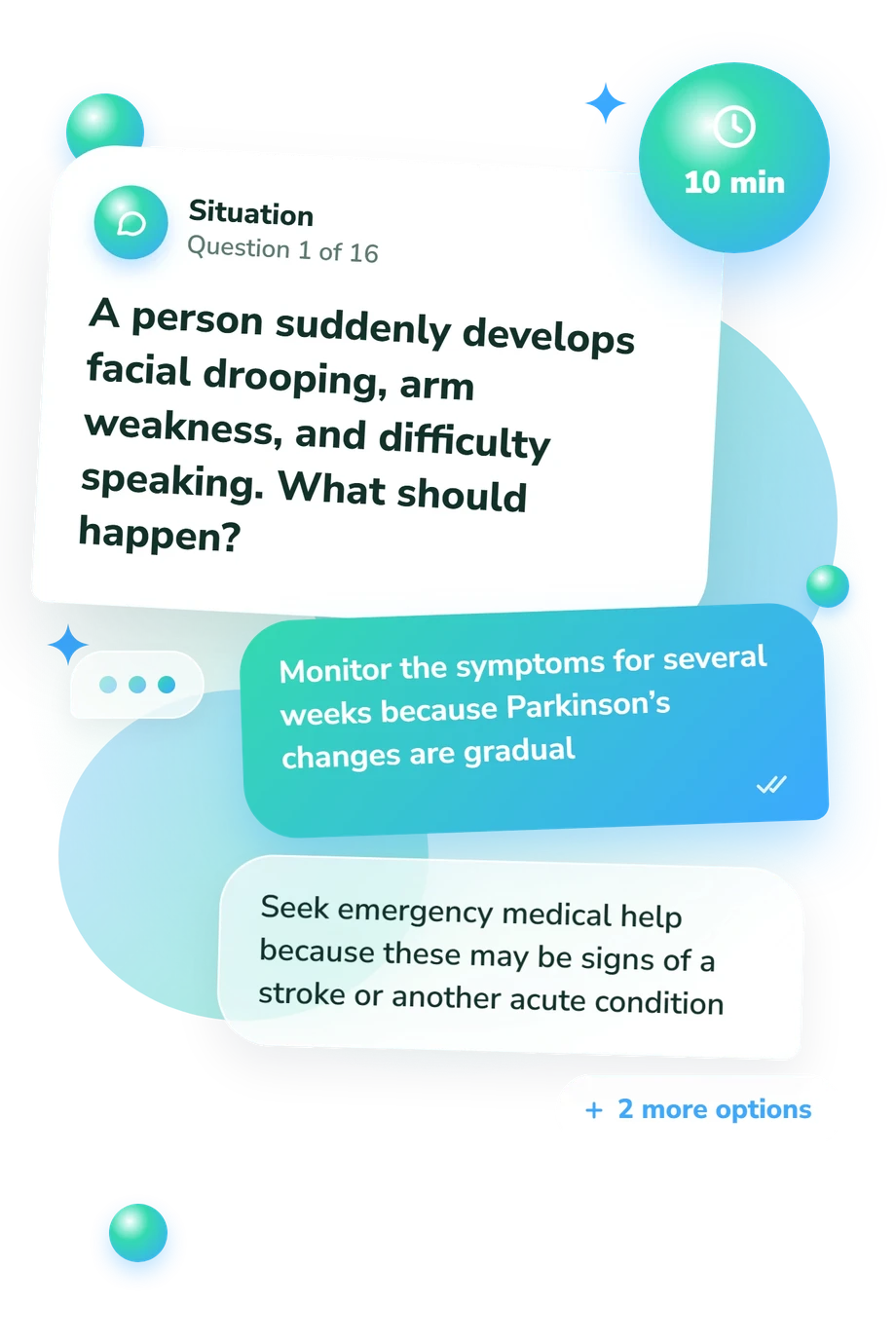
Example Questions From the Test
- Monitor the symptoms for several weeks because Parkinson’s changes are gradual
- Seek emergency medical help because these may be signs of a stroke or another acute condition
- Rest and see whether a Parkinson’s medicine would help
- Schedule a routine Parkinson’s screening at the next convenient time
- It can improve motor symptoms by helping replenish dopamine activity in the brain
- It permanently stops the underlying disease process
- It is used only to identify whether a tremor is psychological
- It prevents every person with Parkinson’s from developing balance problems
- Nonmotor features are always caused solely by reduced physical activity
- Nonmotor features occur only after severe movement disability develops
- A reduced sense of smell by itself confirms Parkinson’s disease
- Changes involving sleep, mood, constipation, or sense of smell can occur and may precede motor symptoms
Do I Have Parkinson's Disease Quiz - Description and methodology of the test
People who want to understand Parkinson’s disease, prepare for a medical conversation, or review health information can use this educational assessment. The Test De Parkinson helps readers identify knowledge strengths and learning priorities, then focus further study on areas where confidence is lower. Readers taking a Do I Have Parkinson's Disease Quiz can use its educational score as a learning profile, but it cannot establish Parkinson’s disease.
What This Assessment Explores
The questionnaire checks whether respondents recognize Parkinson’s concepts and appropriate next steps, building practical understanding.
As a Parkinson's disease quiz, it covers motor and nonmotor features, parkinsonism, evaluation, treatment, exercise, swallowing, falls, and neurological emergencies. The result shows practical knowledge and highlights topics for review.
The themes fall into three areas:
- Recognition and diagnosis show how symptoms, emergencies, and clinical assessment fit together.
- Treatment and management explain levodopa, wearing-off, exercise, procedures, and medication changes.
- Everyday safety reflects decisions about falls, swallowing, mobility support, and contacting the care team.
The Parkinson’s Disease Knowledge scale runs from 0-16. Foundations to build (0-6) marks basic topics to review; Developing knowledge (7-12) reflects understanding of central ideas; Strong knowledge (13-16) indicates broader command of the material. Together, these bands show where further learning may be most useful; they are unvalidated educational results.
Methodology and Evidence Base
Each item presents a knowledge question or, in some cases, a clinical or care scenario with several answer choices; the respondent selects the best-supported option. The displayed total is a knowledge score; because no weighting formula is stated, no point value should be inferred. The resulting score shows how well the respondent applies information to clinical and care decisions.
KnowPD is the closest conceptual reference because it examines patient knowledge about Parkinson’s disease and treatment. This questionnaire is conceptually consistent with that work, not an adaptation of that instrument. Diagnostic themes align with the MDS clinical diagnostic criteria, while treatment topics match Fox and colleagues’ framework. These sources support the subject matter but do not validate this online questionnaire.
Interpret the result as an educational profile. Prior reading, guessing, wording, context, and self-awareness can affect performance, and the score has no validated clinical cutoff. Use correct and missed answers to prioritize reading; a person using this parkinsons quiz can focus questions for a clinician. Persistent changes need clinical assessment; sudden facial weakness, arm weakness, or speech difficulty require emergency help.
- Salinas, Meagen R., Elizabeth J. Chambers, Tiffany Ho, Priyanka Khemani, David M. Olson, Sarah Stutzman, and Shilpa Chitnis. Patient perceptions and knowledge of Parkinson's disease and treatment (KnowPD). Clinical Parkinsonism & Related Disorders. 2020;3:100038. 10.1016/j.prdoa.2020.100038
- Postuma, Ronald B., Daniela Berg, Matthew Stern, Werner Poewe, C. Warren Olanow, Wolfgang Oertel, Jose Obeso, Kenneth Marek, Irene Litvan, Anthony E. Lang, Glenda Halliday, Christopher G. Goetz, Thomas Gasser, Bruno Dubois, Piu Chan, Bastiaan R. Bloem, Charles H. Adler, and Gunther Deuschl. MDS clinical diagnostic criteria for Parkinson's disease. Movement Disorders. 2015;30(12):1591-1601. 10.1002/mds.26424
- Fox, Susan H., Regina Katzenschlager, Shen-Yang Lim, Brandon Barton, Rob M. A. de Bie, Klaus Seppi, Miguel Coelho, and Cristina Sampaio. International Parkinson and movement disorder society evidence-based medicine review: Update on treatments for the motor symptoms of Parkinson's disease. Movement Disorders. 2018;33(8):1248-1266. 10.1002/mds.27372
Updated: