
Pokemon Trainer Quiz
How the Scales are Structured
Who Usually Takes This Test?
See How You Compare
Below is a preview of how scores are typically distributed across each scale.
Example Questions From the Test
- Very little; observable compatibility matters most to me.
- A little, once practical compatibility is established.
- Quite a bit, alongside what I can learn through interaction.
- A great deal; an unusual sense of connection can lead my choice.
- It would be one of my first choices for an extended stay.
- I would enjoy visiting, especially for the shifting atmosphere.
- I might stop briefly, though other landscapes attract me more.
- I would prefer a warmer or more energetic destination.
- Quietly checking supplies and preparing for the next morning.
- Helping wherever needed without setting the camp’s mood.
- Keeping the campfire lively and lifting everyone’s energy.
- Starting an upbeat activity once everyone has had time to rest.
Pokemon Trainer Quiz - Description and methodology of the test
Readers who enjoy Pokémon as a lens for self-reflection can use the Pokemon Trainer Quiz to explore how they approach challenge, uncertainty, teamwork, and discovery. It suits fans who want the quiz to answer what kind of Pokemon trainer you are, while keeping the result open to mixed styles. The profile highlights tendencies that may feel natural in battles, journeys, and team-building.
What This Assessment Explores
Fans use this Pokemon personality test to reflect on intuition, persistence, steadiness, and teamwork.
Close scores blend.
The dimensions follow:
- Blaze Trainer (0-12) measures passionate momentum, direct challenges, and turning conviction into action: Banked Ember (0-4), Steady Flame (5-8), Blazing Spirit (9-12).
- Grove Trainer (0-12) measures grounded endurance, patient growth, habitat awareness, and protective team-building: Wandering Seed (0-4), Rooting Path (5-8), Ancient Grove (9-12).
- Mystic Trainer (0-12) measures intuition, symbolism, hidden patterns, unusual experiences: Clear Horizon (0-4), Veiled Insight (5-8), Mystic Beacon (9-12).
- Storm Trainer (0-12) measures speed, invention, curiosity, sudden possibilities: Distant Rumble (0-4), Rising Charge (5-8), Full Storm (9-12).
- Tide Trainer (0-12) measures adaptability, patience, emotional steadiness, and comfort with changing conditions: Sheltered Pool (0-4), Turning Current (5-8), Open Tide (9-12).
Every score within one point of the highest score forms part of a blended elemental identity.
Methodology and Evidence Base
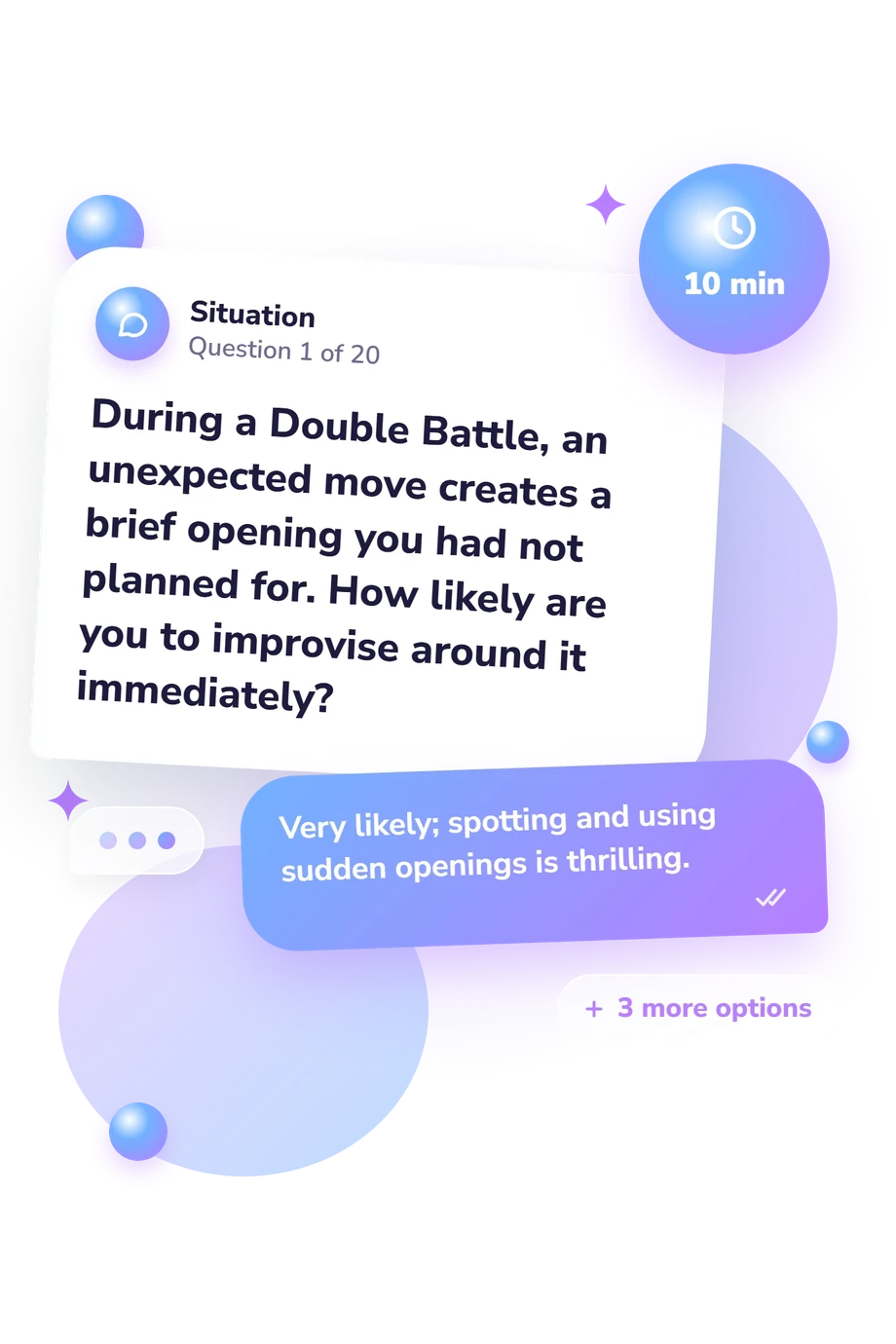
Each item presents a battle, journey, training, habitat, or team scenario with four response choices. The alternatives emphasize direct action, observation, persistence, experimentation, intuition, or adaptation, allowing respondents to choose a natural approach rather than rate a symptom.
Scoring compares dimensions rather than producing one total. The highest score marks the strongest affinity, and every score within one point of it forms part of the blended identity. Bands indicate relative strength, not norms or diagnostic thresholds.
The questionnaire is an original comparative self-reflection format; adjacent research supplies general context, not evidence for its five dimensions. Khalis and Mikami (2018) examine Pokémon Go behavior; Lalot, Zerhouni, and Pinelli (2017) address perseverance and sustained play. McCord, Harman, and Purl (2019) discuss game-like personality testing, while John, Naumann, and Soto (2008) provide trait-taxonomy context.
Current mood, self-awareness, and familiarity with imagined situations can influence online self-report answers. It uses comparative scoring without standardized norms or reported reliability estimates and has no diagnostic status, so the elemental trainer identity is best read as a structured reflection on preferences.
- Khalis, Adri, and Amori Yee Mikami. (2018). Who's Gotta Catch 'Em All?: Individual differences in Pokémon Go gameplay behaviors. Personality and Individual Differences, 124, 35-38. 10.1016/j.paid.2017.11.049
- Lalot, Fanny, Oulmann Zerhouni, and Mathieu Pinelli. (2017). "I Wanna Be the Very Best!" Agreeableness and Perseverance Predict Sustained Playing to Pokémon Go: A Longitudinal Study. Games for Health Journal, 6(5), 271-278. 10.1089/g4h.2017.0051
- McCord, John-Luke, Jason L. Harman, and Justin Purl. (2019). Game-like personality testing: An emerging mode of personality assessment. Personality and Individual Differences, 143, 95-102. 10.1016/j.paid.2019.02.017
- John, Oliver P., Laura P. Naumann, and Christopher J. Soto. (2008). Paradigm Shift to the Integrative Big Five Trait Taxonomy: History, Measurement, and Conceptual Issues. In Oliver P. John, Richard W. Robins, and Lawrence A. Pervin (Eds.), Handbook of Personality: Theory and Research (3rd ed., pp. 114-158). New York, NY: Guilford Press.
Updated: